The Poetics of Information
GRAY CHRISTIE
WRITTEN, PRINTED & BOUND
IN HOLLYWOOD, CALIFORNIA
Binder’s Note·See the Physical Edition
One proof copy, No. 0, followed by a hand-bound edition of fifty copies, Nos. 1–50.
This is the inaugural volume of The Poetics of Information, which, after this initial run of my sixteen essays, I plan to turn into a periodical, compiling submissions from interested artists. Let me know if you, or someone you know, would like to submit work. I will print work in any printable medium.
The volumes and editions of The Poetics of Information are the body of work and intellectual property of The Apple Press, an imprint comprising my DCP-L2640DW Laser Printer, my kitchen table, eleven bricks, two 3’x3’ sheets of plywood, and my Mac. Rights reserved, etc.
Preface
This book can be split into two more or less equal parts. The first eight essays I originally drafted in the Spring of 2024. They build from observations and experiences with (mostly musical) media to a characterization of industrial media culture. The last eight I wrote over the course of 2025. They deal directly with “Information,” described as such, and are influenced by my interaction with the mathematical theory. Reading Mr. Shannon’s theory for the first time, I was astounded and excited that someone had already gotten where I was going, at least from a conceptual standpoint. But the concept can only go so far. The feelings and frameworks I lay out in the last eight chapters, I believe, are the cultural contribution of this period of my life. They are what I have to offer. Enjoy.
You should feel free to jump around, even though the printed order is how I think the chapters are best read. If you do jump around, let “The Poetics of Information” not be the first chapter you read. You should preface it with, at the very least, “The Information Age,” and preferably the preceding two chapters, “Frankenstein” and “The Informational Being.”
And, it is probably best that you save “The White Album” and “Otis Blue” for when you’ve already gotten the gist of what I’m trying to do here. Although I’m sure they’re enjoyable without any context, one of the purposes of these final chapters is to bring my feelings and frameworks into thorough conversation with real pieces of art.
Putting this book out into the world is a particular kind of loss. It is not like losing a child or a loved one. Because this book, unlike a human being, has been completely under my control for the time that it has existed. Now that it is in your hands, part of it is lost to me. Now it is concrete, and now it is fifty copies. And so I no longer really know it. You, holding one of its copies, know it just as well as I do.
However, I am ready to move on to other things. I have had all this in my head for some years, and now it’s out. That has been a great relief.
So I say to my book, as Woody Guthrie once sang,
So long, it’s been good to know you.
This book is a wish. It has been my attempt to realize something on my own terms. At my tender age, I would like to give my own terms a try before submitting to someone else’s.
I should also say that everything in here is quite literally true, even the strange things. Perhaps especially the strange things. I have realized all of it. I don’t mince words in the pages of my own book.
With love, always,
20 Questions with Consultants
1
When you describe someone as “Who,” they are a person. Persons have families, limbs, and occupations. Persons relate to each other, and themselves, assuming things called personalities, emotions, beliefs, and values.
I like being a person. I love myself, as a person, and I love other people. I know where I come from. I know what I’ve done, and I mostly know why I’ve done it. And I know what I want to do.
If “Who?” is a valid question about us, and if we can answer that question in a way that makes sense, then we have a workable - although sometimes imperfect - framework to understand the things we do, the people we meet, the pursuits to which we apply our time, effort, and passion. We all share something called personhood, and persons do, think and say things that persons do, think, and say.
Of course I know who I am. In today’s world, I can be especially sure who I am. I have gigabytes of data to back up my theories. Images, notes, text messages, interaction patterns which are processed through content algorithms to feed my personality reading straight back to me. Categorical descriptions of my personhood abound.
But “Who?” is incomplete. Its answers are finite, just like any categorical description. And it is not enough for me.
It’s not enough, because simply, we are more than can be described by any contrivance, including the assertion of personhood. We can sense far more than we can ever describe. The fundamental mystery, the beauty and pain and uncertainty, of this magical experience we share, has nothing to do with “Who” - the narrow categories we cognizers occupy in each other’s mental frameworks. The endless articulation of someone’s social personhood - and many of us will articulate endlessly if given the opportunity - eventually gives way to a more basic kind of question:
“What?”
“What am I?”
“What is going on?”
Not “What kind of thing am I?”
Or “What kind of thing is going on?”
But, simply, “What am I?”
These questions elude precise answers. The basic realities they invoke elude precise description.
I may be a young man, a young professional, studious, inquisitive, loving. I may be a human, an ape, a primate, composed of tissues composed of cells. The molecules regulating my nervous system may be subject to quantification and some degree of discrete measurement. But what am I? What is a cell, what is a stomach, a brain? What is the edge on which I sit, transfigurating energy into experience? The actual nature of these things - of the sensation in a fingertip, of the plunge of heartbreak, of the glinting reflection of sunlight - is not categorical. Any categorization, any attempt to describe or to organize, reduces. I don’t know how many things there are in this wide world, and I certainly don’t know how to describe them.
And so I don’t know what I am.
The ineffability of What, for which we assume the referential “who,” “when,” “where,” and “what kind” to be adequate substitutes, is much more pervasive than many people would like to admit. It was made clear to me very early on in my adulthood - the month after I turned eighteen.
Looking back, I now consider the election of November 2016 to be a defining moment in my intellectual life.
I was two months into my Ivy League education. For the previous year and a half, every smart fucker I knew, in every sphere of my life, had told me the exact same thing: “He can’t win. And here’s why.” They would recall some demographic figure. They would do some quick electoral college math. They would introduce value judgements about our cherished institutions, how rigidly they must hold up to the rise of stupidity and abuse - that’s how we designed them, after all. And finally, definitively, they would conclude that he simply can’t win - not because of anything he does or thinks, but because of who he is. He’s a scoundrel, a reality star, a con-artist, a rapist.
I learned to make these contrived calculations. I began to talk along these lines. He can’t win, and here’s why.
Then he won. To the politically optimistic 18-year old me, and to the couple hundred bushy young “elite students” I sat with that night, there was simply no explaining it. Every trusted person in my life had failed in their calculations. High school teachers, news anchors, late-night hosts, now college professors and the distinguished lecturers and politicians whom I had heard speak that fall, parents, uncles, aunts, people on the train, people on the bus and in the airport, people at restaurants; every cognizing, well-intentioned personage in my life, including me, was fundamentally wrong about the nature of reality - what was really going on. Our pride and surety, our assertion that he “couldn’t,” that the reality of him was somehow “unacceptable,” incompatible with our world-image, was partly to blame for what happened. As we have seen, fascism rises through a world in which it “cannot happen.” We take conceptual understanding to be enough, when it isn’t. Every model, every concept, is limited. Life’s real nature is far too ambiguous, too unpredictable, too close to the heart, for any concept to fully grasp. And there are many true things which we refuse to accept.
I remember when Michigan and Wisconsin fell. There is no describing that feeling. What is going on?
You tell me what’s more characteristic of truth: the explanation, twisted, faltering, failing, subject to the hidden grip of fear and insecurity, or the mysterious, simple reality - what happened, what we all are, what we now must grapple with. Which of these really carries the torch of the human existence?
The attempt to explain is a lie. We tell most of our lies without even knowing it. And then we are caught in them, as life draws us down its intractable path.
* * *
Three months later I found myself in a particular kind of college course which they call the “weeder.” The intention here, plainly, was to “weed out” the future policy analysts and Capitol Hill assistants from the rest. Some people are Yeses, the rest are Nos. After watching the chirping and strained facial expressions of the front-row students for five weeks and achieving middling results on the first exam, I basically knew where I stood. Categorically, I was a “No.” This felt bad. And so I left town.
Leaving town is a nice feeling. In most towns it is easy; you just pick a road and start walking. On this day I left town to the East and I walked up a hill for half an hour. I found a meadow. It was February, and so the meadow was filled with snow. The sun’s reflection rendered it a field of pure white, white radiating back toward the sky. The top layer of snow had just begun to melt, rewarding my close inspection with a kaleidoscopic liquid sheen.
I sat cross-legged on a stump which peeked through the snow. And I waited. There was the snow, and there were the black branches, and there was the sun peering down on me. There was the black asphalt road with bright yellow paint.
After about an hour, a family of crows settled in my field of view. One announced itself with variegated clucks and calls. Two walked in zig-zags on the meadow floor. Another one jumped up and down on the electric line. Another two watched from the top of the pole.
When I returned to town, things were perceptually different. The sun had worked its subtle magic as I had only experienced it during long days on the California coast, days of eucalyptus trees and sandwiches and ocean wind. Here I was, across the country from my home, in a cloistered, confusing, intellectual place. But even here in the great north woods was that penetrating yellow-white sunlit still-image of life. My beating heart was a part of it, as always. Sunlight brings out the simple whiteness, the inner light, in every blade of grass, in every flower, in every particle of dust, in every strip of pavement and asphalt, in every concrete building, in every one of us and our cascading aims, fears, and loves. It brings about the penetrating mind-substance in every branch of this great tree.
When I returned to town, I had a stillness with regard to the grasping of others. I had a stillness with regard to myself too. I laughed at things I thought were funny. It didn’t matter who said them.
2
We’ve been climbing this mountain for some time. The end is out of view. Closer to the cliffs fog had obscured the ocean, but now we’re above the fog. The sky and sea form great blues and the sun beats down.
“You guys want to play 20 Questions?”
Now it’s the summer of 2023. I am with two of my college friends, both of whom have gone down a decidedly different path from mine since we graduated in 2020. Halfway through college, they began their preparations for careers in consulting. I didn’t. My refrain at the time was that I was too invested in enjoying my life at school to spend my precious attention on the future. This was true. But it was equally true that I simply wasn’t willing to do the work required to land a prestigious job at a large highly organized firm, right out of college. It seemed to be more effort than it was worth, and succeeding at it would not ease any of my life’s greater uncertainties. This was not the way for me. But for many people, consistently pursuing the most profitable outlet does seem like the way. For them it would be unthinkable not to take the next step towards success and security, broadly defined, the opportunity being right there. By the end of sophomore year my friends were already spending hours every week doing a particular kind of interview prep: “cases.” I would sit next to them and listen.
Cases interested me. A case interview presents a fictional business problem with intentionally vague parameters and many possible solutions. It is your job to make ostensibly accurate guesses about the quantities involved, and given these quantities, propose an effective solution to the problem.
Suppose the task is to outline a new strategy for marketing diapers. You, the 19-year old interviewee, might begin by guessing off the top of your head the total addressable market for your diapers - how many diapers are generally sold in the United States every year. Luckily you are prepared; among the hundreds of “general knowledge” figures you’ve memorized is the number of babies born every year. You also know how often a baby needs a diaper change. With some simple arithmetic you arrive at the number of diapers required to meet the yearly demand. Then you go on to solve the more complex and subjective pieces of the problem, recommending a budget reallocation here, a marketing campaign there, to increase your hypothetical firm’s diaper market-share.
Any case interviewee will tell you that the accuracy of your guesses does not matter. What matters is your ability to convince the interviewers that your line of thinking is legitimate. This requires that everyone in the room share certain generalizations. No one needs to know how many diapers are actually sold. No one needs to know what marketing schemes will resonate with which diaper-demographics. Instead you draw on the general ideas, the shared non-specific understandings, of these processes. Your numbers only need to sound right. Once the interviewers are supposing the same things you’re supposing, you’re making progress.
No direct knowledge is required to succeed in a case interview. A lack of experience does not hurt you. Interviewers seek not the greatest truth, but the greatest plausibility. Plausible generalization makes the machine run.
Today I’m the picker in our game of 20 Questions. By the third or fourth question we’re in a pleasant rhythm. We can feel the swaths of potential answers fall away, disqualified, as we narrow it down.
“Can it fit inside a house?”
“Yes.”
“Is it mass-produced?”
“Yes.”
“Is it a common household tool?”
“You are.” … “…No.”
“Is the thing edible?”
“Partially.”
They pause, confused.
My answer is the Double Double.
Here’s a categorical description: I’m a Californian. Here’s a likely (it turns out, accurate) implication of that description: the Double Double is precious to me. Maybe picking it is unfair, since my friends are from the east. But I took them to In-N-Out after they landed at LAX, so they had been exposed. I was trying to be playfully oblique, but I had unknowingly run us into a ditch.
The game of 20 Questions has a problem. The problem doesn’t have to do with the object being discussed, or with the method of finding it. 20 well-asked questions seems to be enough for a guesser to arrive at almost any single object or concept. Sometimes it is enough questions, and sometimes it isn’t - this indeterminacy is part of the fun, giving the game its suspense. No - the problem shows itself when you turn inward, towards each player’s mental background. How does the player categorize the things around them? What things, in the vast universe of things, fit into what categories?
Players progress through the game by defining a group of possible answers. Introducing a new category with each question (a category might be “things that fit inside a house”, or “edible things”), they slowly narrow the group of possible answers until it can contain only a few things. For this to work, everyone in the game must be in unspoken agreement, both on the meaning of each category introduced, and on every item that falls into every category. With respect to each category at play, every item carries a yes-or-no designation. It either is, or isn’t.
There is slippage here. If my word is “hot dog,” and we disagree about whether a hot dog is a sandwich, the game can probably only progress so far. If the guesser asks whether my word is a sandwich, and I answer “Yes, it is a sandwich,” but they don’t think a hot dog is a sandwich, the game breaks. We’re lost in an ambiguous state in which the hot dog both is and isn’t a sandwich. This is why 20 Questions can be a scary game. Unspoken disagreements over categories, like this one, cut startlingly deep. We hold our concepts of what “is” and what “isn’t” quite close to our cores.
“Is the thing edible?” forces such a juncture. Some part of me knows that to keep the game on track, the right answer was “yes.” But I didn’t say “yes,” I said “partially.” For a moment, another part of me had stepped in, one that feels strongly that there is more to the Double Double than just the sandwich.
To be specific, there’s no Double Double without the brown paper and red wrapper. The wrapper is integral to the experience of the sandwich. It always has been. Bite by bite, you pry away the layers of damp paper, which take bits of cheese and onion along with them. Eventually you make your leap of faith, tearing the wrapper away and trusting your fast hands to avoid drips. Every Double Double, no matter where in California you get it, is served in exactly the same way, in the same wrapper, on the same tray, in a restaurant laid out exactly the same as all the other In-N-Outs in the state. On each of these stages you do the same little dance of paper and cheese. The wonder of the sandwich isn’t just in its edibility and resolute sandwichness. It’s in the technological and cultural marvel of its manufacture and distribution - the wrapper. It’s in the particularities of its consumption experience - the wrapper.
My friends are understandably thrown off the trail. Their group of possible answers had settled squarely in the “food” category, but most foods aren’t partially edible. We go off another way.
I’ve been fascinated with the brush plants of Southern California since I moved here. During a lull in the question-asking I see a particularly nice one, and I drift away to photograph it. This one is a great mound of spikes, with a trunk that shoots up and bursts into white and yellow blossoms. Later I would learn the name of this excellent species. Our Lord’s Candle Yucca. The shutter clicks.
“Does it have an industrial application?” asks my friend.
The question lands softly. I turn around to face its asker and I take a moment to think. This question would resonate within me for months. Inside it begins to knock on my windows and undo my screws.
In the moment I realize the following: my friends are treating this game of 20 Questions exactly like they would treat a case interview. The same categories, rules of thumb, and general knowledge they learned to land their jobs are still operating in their heads today. They apply these mental complexes to the same kinds of problems. Doubtless they deal with the distinction between industrial goods and consumer goods all the time in their consulting jobs.
What I witnessed in college was not just preparation for a series of job interviews. It was the installation of a complete framework of rules and methods to understand and operate in the world. The world, which is full of so many things that no one can truly comprehend them all. Our inability makes us anxious, so we erect structures to ease our anxiety. What are the categories? What things fall into what categories? To answer these questions is somehow to secure ourselves in the storm. Critically, our answers to these questions need only be plausible enough, acceptable enough, to ease our momentary waves of anxiety. All you need is a plausible generalization, an acceptable utterance, an answer that does not disturb you or the people around you.
In the social life of the elite institution, one seeks not just any acceptable utterance, but the most-acceptable, the most convincing, the most skillfully researched and artfully articulated. Knowledge of the world is constructed within highly complex reference systems. For social-science types and business majors, it’s the right kind of predictive model, the model that can most convincingly mirror reality, of course without explaining it. And for the high-intellectuals, there are the mighty pillars of theory, critical theory, post-theoretical critique, theory of practice, impractical critique, post-theoretical practical theoritism. They read philosophers who you truly don’t need to read in an attempt to triangulate which way the wind blows. They carry around obscure, dignified, in-group understandings, modes of analysis constructed and deconstructed at will, subject more to emotional and subconscious forces than any grounding in “truth.” There is frighteningly little truth underlying any of it. These understandings rest instead on generalization. This is the nature of prestige in the Information Age - this is the “value of an elite education” - access to, and the chance to internalize, the most sought-after, informationally-advanced, and socially-current set of concepts and utterances.
In a high-level consulting interview, or in a tight-knit competitive academic social circle, success is defined by which utterances are most acceptable, not necessarily by which are most true. The most successful persons, i.e. the utterers of highest acceptability, glide smoothly upwards from high-achieving youth to promising young professionals to impactful contributors. Out of this socialization process emerges a particular kind of human image. This is not a human being, for no human can be reduced to a categorical description. It is a human image: a human-shaped thing that we aspire to enact. I have a name for this thing: Homo corporatus.
Homo corporatus is the embodied urge to generalize. It makes us generalize, and accept generalization, about the facts, choosing to apply conceptual models instead of simply sensing reality. For Homo corporatus, everything is a model of something else. The finer, more elegant, and more precise the model, the better.
Homo corporatus urges us to generalize about ourselves, too. At my college we were told that repeatedly it’s a perfectly good choice to become a consultant, that there is nothing theoretically wrong with his decision. This may be true for Homo corporatus, the theoretical person whose interest is to gain something called business acumen and a rough familiarity with different sectors. For this theoretical person, it is even a logical and likely decision to become a consultant, and continue to feed their urge to generalize for as long as they live and work. But we, in reality, are not theoretical people. We are each ourselves. Just because in general it is a decent decision, does not mean that it is your path.
I have met people swayed by the generalizing pull of Homo corporatus many times in my life. I met them rushing through musical instrument auditions when I was 9. I met them in speech contests when I was 12. I met them frantically gathering resume items when I was 16. Elite college is a hive of these busy bees. They are, by-and-large, very lovely people. But they are guarded. They might stop talking to you if you fall outside the range of acceptable utterances. They might even drop you like a stone. Because the utterance, the image, the performance of value, truly matters to them. Upsetting it brings them physical, biological pain. To Homo corporatus, image is reality. They must seek to benefit from the precious image.
The inner life, on the other hand, seems to matter less to these types. To make a child study hard enough to get into an Ivy League school, you must convince them, on quite a deep level, that many of their thoughts and feelings simply don’t matter, that fundamental realities of their experience of the world are unacceptable and unproductive. There is a higher purpose, a potential, to which they ought to strive. They shan’t get caught up in feeling and cry over nonsense. Ignorance to your particulars - that’s what keeps you uttering acceptably for long enough that you land the offer. Thus there is no “Song of Myself” in the consultant’s heart.
Homo corporatus accepts generalization as truth. It wants you to treat yourself as an image, as a concept. It wants you to reject your body’s particulars.
But what do you find when you stop ignoring your particulars? What of these unproductive, unacceptable, even nonsensical utterances? I promise that they are still in you. They are just as true as the “productive,” or “acceptable” ways of being. They must be true, because they exist. You don’t need to close yourself off from them. In fact, you do your heart a disservice by adhering to the concept of anything over its reality - even the cheeseburger. The point of the Double Double’s partial edibility is that it’s true. You can feel it. It is far more true than the assertion that the Double Double is merely food, merely a product, merely a cheeseburger.
There are things in me, things like the cheeseburger and the dancing crows, which I refuse to ignore. There are also basic realities in the world, realities like the rise of fascism, which elude conceptual description. These are what kept me from sliding down the smooth direct channel to “success” from my lofty position as an elite teenager. I have seen things, and felt things, that rendered my concepts useless - things which no academic or professional code, no system of analysis, could resolve or encompass. Why would I let myself slip into generalization?
What about reality?
Even years after these events, there is still a debt to pay in my life. I feel it every time I sit down to meditate. I owe it to myself - quite frankly, I owe it to nature - to feel. For too much of my life, my feeling has been subject to bizarre constructions and machinations, resolved away from simple being. But truly, it need not be resolved - only felt. Now the instant of feeling makes my heart shake. Every day is filled with discrete and continuous wonders.
No concept.
- Ginsberg1
Does the cheeseburger have an industrial application? Many would say that it does not. I think it’s more complicated. People have to eat to do their jobs, and burgers are cheap. The Double Double also stimulates the economy by being a sort of nostalgically delicious touchstone, a strong reason for people to stop on the interstate. That should be enough to establish that it’s at least a little bit industrial. Mostly edible, a little bit industrial, and who knows what else.
I grant what I assume to be my friends’ definition: items with industrial applications are items sold to factories or industrial farms to produce other goods. I answer “No.” I can do it too.
By the time we hit question 20, we know some confusion has thrown the game off. It’s all in good fun. In the post-game triage, I lay out my misgivings about the Double Double. It’s obvious that I am overthinking it. But I sense they also recognize that the categories we implicitly agree on aren’t always so clear cut and effective. These categories are powerful analytical tools, but each can only describe an incomplete part of the object being discussed - its edibility, its sandwichness, its industrial character. A category, or list of categories, can never grasp the whole nature of anything.
But the question from that day stayed with me, jammed deep into my head. “Does it have an industrial application?” For a while I would just think back to the moment my friend asked it. Then I started applying this category to things I saw. These bolts have an industrial application… this table could have an industrial application… this corn would have an industrial application if it wasn’t already picked, kerneled, cooked, flash-frozen and bagged for me - you could turn it into plastic, or animal feed….
Do I have an industrial application?
3
It’s dinner time in the late summer. Bo Diddley plays on the hi-fi. I am making pasta - not a recipe, but a technique I vaguely remember from watching my mom. You sauté the corn in browned butter. Then you add the cooked pasta and you toss it all together. As I return the packet of Trader Joe’s kernels to its slot among the other frozen goods, snapping the rubber band around the cinched end of my human feed bag, it hits me. By God:
The Les Paul Has An Industrial Application.
I request that you suspend any confusion about that statement for a couple of minutes while we take a step back.
Since publishing my 12-copy, 11-song CD project entitled Folk Songs earlier that year (2023), I had been talking to people close to me about the music, and about the liner notes I wrote. In those liner notes I made a single delineation that I felt cut to the heart of music-making in our culture. There is the impulse to play music for art, and there is the impulse to sell music as a product. For me at the time, these were definitely separate, distinct motivations, each affecting the artistic process. Ultimately what you hear on a record reflects both. Pretty good, right?
I wanted to drive this concept of mine deeper, to explore its roots and implications. But even a month later, by the time of the hike with my east coast friends, I knew it needed work.
That summer I became obsessed with a particular album called Otis Blue, which I played constantly on my car stereo. As I listened to it, again and again, dozens of times in a given week, my delineation began to unravel. Now, the two impulses didn’t seem so separate. The musical product (in this case, the CD in my car stereo), the music, the musicians, the producers, the audience, all seemed to share in a kind of dual-understanding. Not a conflict between two natures, but a dual nature. What’s on offer here is both art, and a piece of commercial entertainment. What’s on offer here is durable, but imitates the fleeting. A single person can do both, create both, and understand both, at the same time. A single act of creation can encompass both. Maybe in our culture it always encompasses both. Our music has a dual-nature.
Music is beautiful. It’s fleeting. It holds unspoken insight into the human experience. This is music’s first nature. At some point in the last two hundred years, another nature of music came along. Eventually it eclipsed the first nature. Now, most of your interactions with music are with a mass-produced object. Manufacturing music, marketing it, selling it, and distributing it, breaks the traditional connection between the artist, their work, and the audience. This began with the advent of recording and playback technology - Edison’s devices. And as soon as music could be made physical, the effects of music’s second nature leeched into its first nature. As soon as music could be sold as a product, we started creating music specifically to be sold. This changed the art of music.
In the modern music machine, artists have to buy into, and benefit from, structural arrangements that leech their integrity. The industry that produces the music we listen to every day cares about the music only to a limited extent. It cares most about the image, that which generates attention. It operates, simply, on money. This is troubling. It’s vaguely sickening. And it’s the kind of problem that’s so large that getting at the whole thing seems beyond any single person, any single line of thought. It’s what might be called a “Wicked Problem.” 2
In this flash in my kitchen with my flash-frozen corn, one of the problem’s many aspects slammed into view. The question from our game threw a spotlight directly on it. Some things have industrial applications. The Les Paul, to a great extent, is one of them.
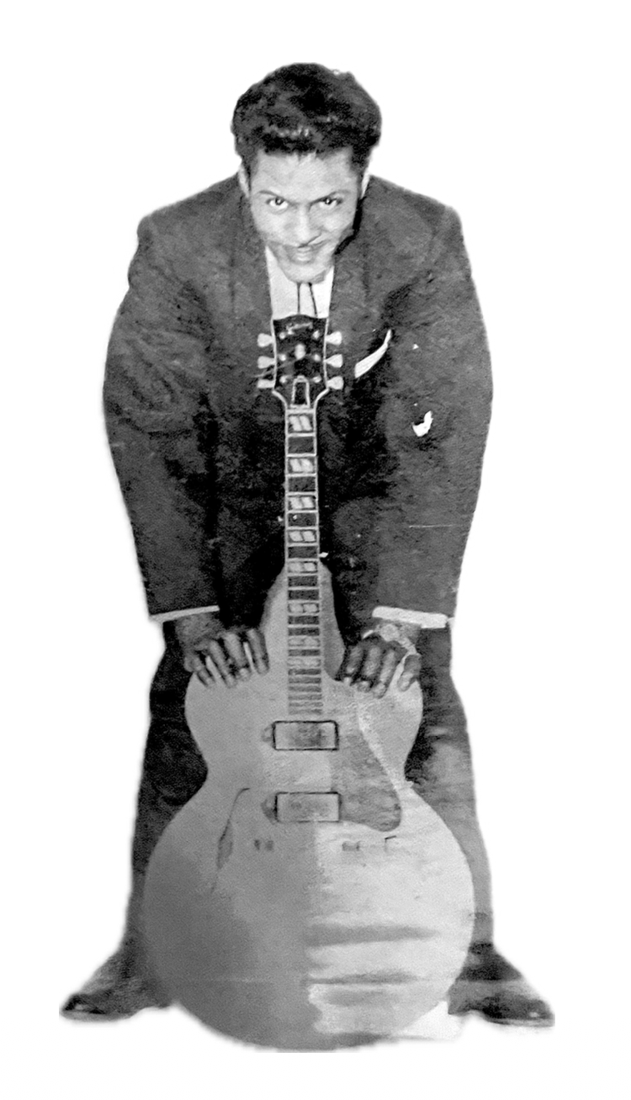
The Les Paul is an electric guitar. It’s a frighteningly powerful tool for making musical art. I’ve seen one played with such mind-bending precision, such force of personality, that it drew the primal scream out of me, right there in the pit, surrounded by sweaty dudes. The Les Paul, a complex of circuitry, can produce deeply-felt human catharsis.
This instrument’s forceful potential is well-known. Since its introduction it’s been one of the guitars of choice for players at the highest level. It helped make Rock and Roll possible, and participated in some of Rock’s greatest achievements. It’s the guitar that made “Ramble On.” It’s the guitar that made “Blue Suede Shoes.” So, in the wide world of things, many would say that the Les Paul is an artistic thing, a thing whose character and applications are artistic, and artistic only. In my friends’ parlance, something like an “artistic good.” But like the Double Double, the Les Paul has a dual nature, or more accurately, a mixed nature, which subtly throws off our attempts to categorize it. It may have artistic applications, but it is also a piece of mass-produced technology. It could not be created or adopted until the components required for its creation were readily available - until it could be built and marketed and sold profitably. Even its invention reflects a duality. It was conceived by a highly skilled guitarist (Les Paul, the man), in order to expand his creative and artistic range. But it could not be adopted until it was mass-produced by a subsidiary of Chicago Musical Instruments Co. called the Gibson Guitar Corporation. With electric technology in the hands of popular musicians, performing on the radio and television, demand not only for the guitar, but for records featuring electrified sounds, boomed. Guitar music’s potential - both artistic, and commercial - underwent an exponential expansion. This potential was immediately harnessed not just to perform music, but to make and sell records. The artistic and the industrial were simultaneous parts of the same processes. They involved the same people.
What’s so great about Rock and Roll? It’s not just the reelin’ and rockin’ till the break of dawn. It’s that the music was a cultural and industrial behemoth. The power of the electric guitar (in the right hands, with the right face, and along with some other key technologies) was enough to move millions and millions of people, mostly young people, out of their cloistered suburban homes, to record stores, to spend money on music. A machine rose to meet the kids’ demand for culture with ever-more-attractive faces, and ever-more-powerful music production technologies. Rock and Roll, along with the automobile, television, makeup, movies, cigarettes, became constituent of America’s industrialized youth culture - a culture that since its crystallization has dominated the world through the power of the image.
The dual-nature of the Les Paul - as both an artistic and a commercial device - is emblematic of our entire musical culture. Sure, music is music, but music is also product. Music production is technology. The more you pull on strings of the tangled web of modern art and media, the more you see that each string is threaded with two colors.
That’s what this book is about: pulling strings. The strings I am after are woven through music, through mass media, and finally, through “information” itself. We will find behind these concepts far deeper, richer, and more ambiguous - sensory - natures.
I feel strongly that many of my personal ills, misconceptions, and maladjustments are caught in the web of media’s mixed nature. I feel the same about our culture and our institutions. As more and more of our knowledge, tools, and social arrangements are translated to media and presented to us on screens, our lives become a series of interactions with a series of mechanized images. Each of these images contains a contrived piece of human logic. Each attempts to impose a concept. Some images are put in front of you for your benefit. Some are meant to harm you. Untangling the nature and true intentions of each one is beyond us; there are just too many. And the dubious intention behind a piece of media isn’t all that causes trouble. Media splits and ambiguates human experience in many sinister ways.
After spending a while untangling the Les Paul and Rock and Roll, I began to sniff out something else hiding in the background. Really it was hiding in plain sight. The properties of media, and of the media-inflected culture, seem to emanate from something else - something more basic. The true wizard behind the curtain, casting us into our wicked predicaments, seems to be the thing we call “Information.”
Informationalization - the encoding in a medium of a piece of human experience, i.e. “The Message,” the transmission of that message, its receipt, its decoding, and finally the message’s tenuous passage through the many layers of human sense and cognition - this is the fundamental process at work in modern music, in broadcast, in our artwork, in our language, in our content algorithms, our advertising, banking, election campaigning, and international relations. It threatens our hearts, too.
* * **
Now it’s 2025. In 2025, the distortions introduced by recorded music seem to be properties of information. The unspoken regulations of social media conduct seem to be properties of information. The current political farce seems to be a property of information. The Wizard of Oz’s many-faceted spectacles seem to be properties of information. Form and content seem to be properties of information. And my friends’ interview tactics - their methods of categorization and reasoning, and their internalization of the acceptable utterance - seem to be properties of information. Informational constructs supply us with our generalizations. They feed the inner urge of Homo corporatus. When we accept them, reality is obscured, and sometimes, lost altogether.
Information buzzes in the background. It is uncertain. It carries our knowledge, yet it has no inherent knowledge of its own. It is forced to generalize. Accepting it, we are forced to generalize.
But what, in our beautiful world, is not truly specific?
- ** _— *
Back in the Fall of 2024, after spending a few unsuccessful months drafting and assembling material for this book, I watched a video recording of a man demonstrating the world’s first graphical computer interface. There was a computer mouse in 1968, the year of The White Album. There were clickable visual fields on a display. There was text entry, copy, and paste.
Said the man as he typed:
I’m putting in an entity called a statement. And that is full of other entities called words.3
Entities called words. Watching this uncanny demonstration I knew that there was no alternative but for me to continue my work. Because in this moment, and in the uncountably many human moments that accompany it in the Information Age, there is a poetics at work. A way of describing even the conceptual communication of our information systems not by its contrived meaning, but directly, through our hearts, and through our senses.
There is a Poetics of Information.
4
At this point I would like to put forward some goals.
My first goal is to examine the concept. The concept needs to be put its proper place alongside our other ways of understanding. The concept, the rational understanding, the mental image, these phenomena are always present as we learn, and as we live our lives. But they are phenomena. They arise, they do their work, they fall away. They change over time. As I talk about about Rock and Roll, about encoding and decoding, about the user interface, my goal is not just to discuss what’s happening, but to identify how we conceptualize these things, and to distinguish those concepts from deeper kinds of feeling. How we feel, and why, is fundamental to the nature of these things - as fundamental, or more fundamental, than any concept we have of them. How we feel, and why, can’t be explained away by rational conceptual language. If you feel your banking app is stupid, that’s because it is.
My second goal is to de-mystify the communication technology that brings forth our unending stream of images. Today most of us know as little about the content algorithm as a medieval peasant knew about the text of the Bible. But you can understand these things. They’re sophisticated, but not that sophisticated. The minds involved in their design were human minds, following the same drives and impulses you follow. You deserve to know how the images in your life were created, and why.
My third goal has to do with expectation. In a certain way, I expect all of this to fail. It is my goal to feel that failure, and to survive it.
Finally, a note about writing, my medium of choice for this effort.
In my first work I compared the mechanization of folk music to the damming of a lake and the installation of an artificial beach. About a year after my realization that The Les Paul Has An Industrial Application, I began this project - attempting to write my way to the many-faceted nature of modern music, and possibly, artistic media in general. I wrote ten essays, seven of which were keepers, including the first draft of this one. I wrote hard. I mustered an entire month of sustained effort. And then I fell off the track, where I remained for another year.
The first thing that pushed me off the track was the idea of finality. Printed words are permanently themselves. If I was to share my work with other people, send it to my friends and family, it would have to be good. Every paragraph of it would have to be good. And not just good. It would have to be up to my standards, the standards at which the fire abates. This was too much pressure for me. I stopped writing, and it took me a long time to get going again. I now feel that the stress of finality is a widespread issue in my generation. I believe that this is an effect of our media infrastructure. Certainly it involves the “acceptable utterance,” what we feel it’s “okay” to say, and to do. We are afraid to practice. To do anything without sharing it is unthinkable. Equally unthinkable would be to share something we’ve done that we’re not satisfied with. In effect, we can’t do anything we’re not already good at.
There’s another way in which practice terrifies us. To truly practice is to let go of the certainty of long-term success. You need to be uncertain in order to learn. You need to abandon the expectation that you’ll be successful any time soon. Yet, practice is the only way that you will ever be successful. Evaluating what you’re doing today by terms you’ve set for your future success nips your practice in the bud. So you need to let go. And somehow, by letting go of your desired future, you progress toward it. This mystery often gives me pause. I don’t have its tidy resolution here.
I also became distracted by my word count. I sunk into the habit of copying my work from TextEdit into Pages to count the words at least every hour. Am I finished for the day yet? How much have I gotten done tonight? How much do I need to get done tonight to feel satisfied? These questions do not stem from the love of writing.
The obstacles I’ve faced in this project could be described as unconscious processes. They are products of my conditioning, my habitual ways of living my life. The fears of practice, and of finality, my reflexive urge to evaluate my work negatively, have all been built up over a lifetime of living and working. But it’s not just my hindrances that are driven by unconscious habit. I have lately realized that even my motivations and goals for this project are driven almost completely unconsciously. I do not know why these complexes and concepts - folk songs, information, the Wicked Witch, the Double Double - have made themselves important in my life. I don’t exactly know what it is I’m trying to get out. There are fundamental urges that form all of the ideas on offer here and drive me to describe and execute them. I just have to channel those urges. The first seven essays of this project (what are now the first-through-sixth, and eighth, chapters) basically flowed straight out of me last year - all I had to do was maintain the right conditions. The parts of me that felt these things, and ruminated about them, and were empowered by getting them in writing, were in control. The rest of me was basically subject to those parts. But after a few weeks, other parts took over and kept me from writing for a long time. None of this was truly intentional - I was just riding the waves of my personality.
The real obstacle to getting this thing done was that, at the outset, both my hindrances and my motivations were largely unconscious. Here it seems is the real point of practice. Practice builds the conscious ability to choose. I can choose how I spend my time. I can choose how I think about things. I can choose how I think about the Double Double. And I can choose to write, again and again, until my task is complete.
Two journal entries.
February 2025.
On Writing.
There is no writer’s block, they say. Then what am I feeling right now?
The computer digs in to my full stomach. My mind is moving, slowly. My heart is somewhat open. I spent 20 minutes playing songs on guitar to open myself up and now I’m feeling tender. The channels are cracked. But there’s not much coming through. I am now going to move to the kitchen table.
This is a working position I am in my underwear and a button down shirt and it’s 76 degrees in my apartment in February. Write write write that’s the challenge I’ve lain myself.
For me to write is to find a thread, and pull it. The lack of thread is a terrible feeling. It is sickening.
Writing is not an easy thing to do.
We struggle to do it artfully. We struggle to do it even in our mundane communications. Efficiency, style, patience, finesse - these qualities are lost as hands spew thoughts into a digital document, Gmail, a Slack channel. Just get the message sent. Just get this book written. Even authors and academics don’t necessarily write well. They succumb to the medium.
One word must follow another. This is writing’s great challenge, its liberation from many-dimensional experience. This is the wall we must get over when, as people, we teach ourselves to write. For most writers, including myself, this limitation is crushing. It makes us contrive stilted transitions like “And you know what? That’s a good thing. And that is because…” It makes us rely on knowledge we think you have, ways of thinking we think you probably share in, and especially, values that we think you hold, or ought to hold.
There’s no fresh air in this. There’s no trust, there’s no discipline. The writer has none, and they think you have none. So they shepherd you, step by step, down the path they’ve laid out for you. They craft the channel to optimize your transmission through it. In the ideal state there are no tripping points - there is no noise. But on the other end, what has really happened to you?
Stiltedness is a human response to the limitations of the written word. It’s a human response to uncertainty, and our need to validate the quality of our work. But it is not artful. Just because words have to be in sequence doesn’t mean they have to be in order. It doesn’t mean that you have to be in order. Words should throw you out of order. I don’t want my book to read me.
Writing is not an easy thing to do because the human experience cannot be linearized. The spirit cannot be linearized. The heart cannot be linearized. There is no line. A line is an abstraction. Things happen simultaneously in unknowably many configurations; spacetime is curved along unknowably many dimensions.
The art of writing seems to be to find the right word at the right time. This is what brings me joy as I attempt a long practice of writing. It’s not the resulting body of work - the Body of Work which would determine each individual word that makes it up. It’s the right word at the right time, respecting nothing but the moment.
The right word at the right time is fresh air. It’s the chance for you to think and feel. Space to breathe; space to breathe for long enough that words fade into the background. You have to be the one to think and feel and breathe. Living is not a passive exercise.
We need the right word at the right time. Our souls deserve the clear water, no less than those who have written before us, made our literature, our film and our television and our
Instagram Reels.
Words should create space for the reader. Words should relish in the unexpected and in the nuance. They should brandish contradiction. They should show us that those things are okay.
Then, I can be the unexpected; I can be the nuance. I can be the monkey; I can have something to hide. Words shall not drag us into their shallow water. They shall reflect us and the sky above.
May 2025.
Writing my book has become living.
I must take it one paragraph at a time.
Paper Tabs
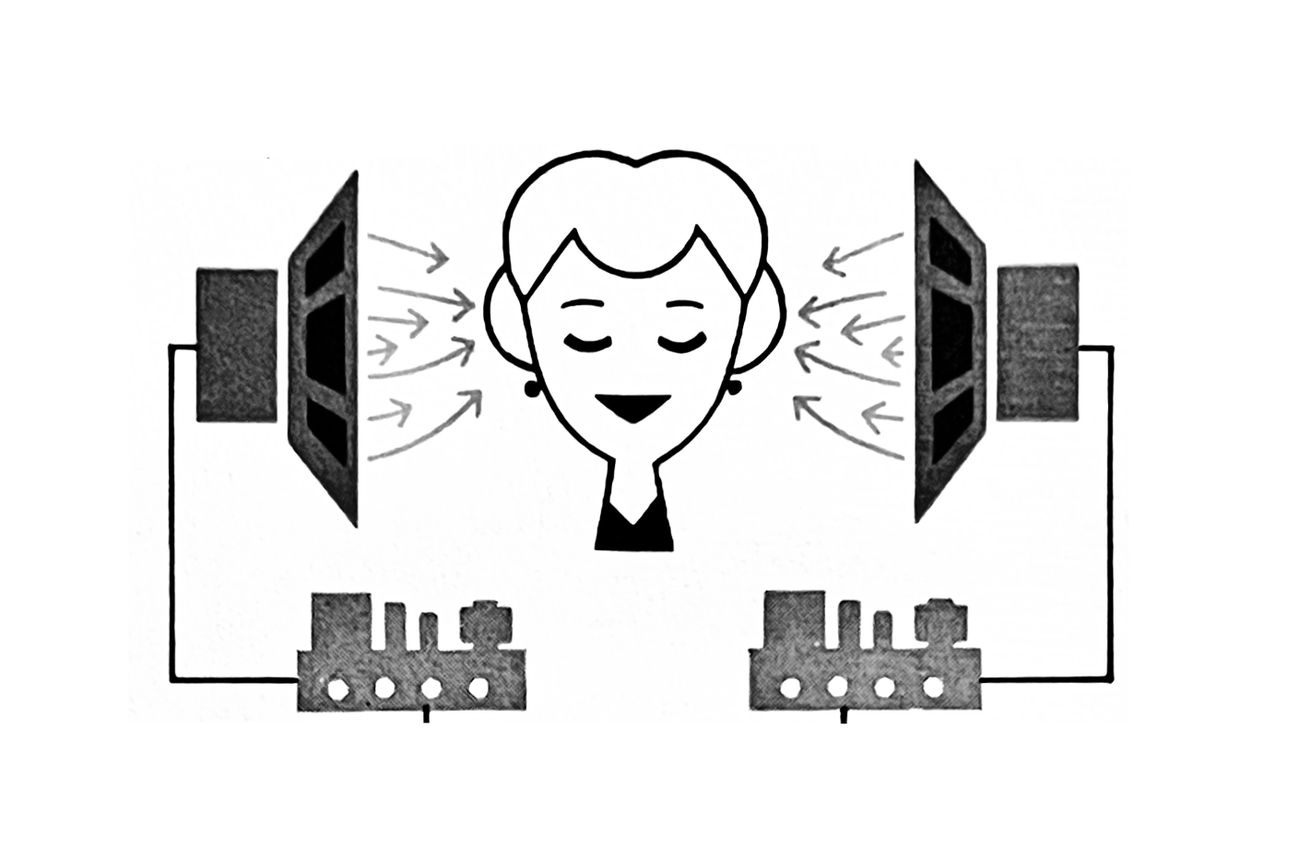
The needle drops, and so do you, into the sensation of an open channel. This is not silence. Outside the walls of the channel there was silence. Inside there is a low, dark, enveloping hum. Even passage through smooth material creates a sensation - a swooshing, like standing in the wind with your eyes closed. There are crackles - sudden tremors as obstructions in the channel move through you. You feel time passing.
Then, you hear a human sound. The walls of the channel resonate with the sonic image of a voice, and you are immersed in it. The voice is vibrant and clear as day. You hear both the voice and its echo - creating a perfect illusion of the hall where the singer performs. The low swoosh of friction, the crackles of imperfection, are audible, but they are the background, brush-strokes. Miraculously the channel walls begin to project the sounds of a guitar and drums. These are just as lifelike as the voice. How the same vibrating walls could imitate such a range of sounds is beyond you. But the closer you tune in to the vibrating channel walls, the realer it all sounds. The more overtones you hear in the voice, overtones placed there by the vibrations of vocal cords - the more richness you uncover in the tone of the electric guitar and the rhythm of its players hands - the more physicality you feel in the thumping bass drum, and the more the shining cymbals scratch the upper ceiling of your skull. These sounds are beautiful. They are an illusion.
In our culture you can attain a shockingly direct experience of recorded music. Getting sounds into those grooves was an electromagnetic miracle. It has created the conditions for some truly awesome works of art.
I’m a record collector. This means that I spend very much of my time and spare money in record stores, hunting down particular copies of my favorite albums. I don’t do this just because I “prefer the physical object” - which incidentally I do. I do it because the music I’m looking for was created specifically to be pressed to vinyl. This bears some explanation. Music’s format - the material that transfers a sound to a listener - affects both its production techniques and the listener’s ultimate experience of it. For the decades in which our technological pop culture emerged and blossomed, music’s format was vinyl. When digital technology rendered vinyl unnecessarily expensive, labor intensive, and risky, vinyl and its accompanying analog production methods were phased out. But you can still find the records - the artifacts of this era - in record stores, at street markets, and online.
The vinyl market has had a resurgence. Today it’s one of a handful of roughly equivalent-sounding release formats for new music: Streaming, CD, vinyl, sometimes cassette. These are all cut from the same digital source, so they end up sounding very similar to each other. Today, the digital source file is king - infinitely reproducible, and high-definition enough to please most listeners. Clearly the stream and the download are the easiest, lowest-cost ways for consumers to access these files. And yet, for some reason, we keep the physical media around. Part of this is physical media’s novelty value - the record is an alluring object to be collected. We like vinyl. It appeals to our visual and material tastes, not necessarily our sonic taste. Even if the music sounds worse through a crappy record player in a dorm room than it would through a decent bluetooth speaker, we still consider it a valuable experience. And even if played on a state-of-the-art system, the sound on a new vinyl record comes from the same digital source material that a CD or streamed file does. Thus the unique quality of the sound is not the reason people buy new vinyl. People buy new vinyl for sentimental reasons, and because of their drive to collect. These are fine reasons, but they’re not why I collect records.
In the modern vinyl resurgence, I worry that the record has been reduced. Now it seems to be just another way to sell the image. Each copy is simply a cardboard and plastic re-incarnation of the digitized marketing entities we know as Drake and Sabrina Carpenter. Vinyl’s vinyl-ness, and the sounds particular to vinyl and analog production, play almost no part in the experience. Today’s vinyl generates nostalgia, and a certain mental image of the purchased object. It does not generate a distinctly beautiful sonic experience of the music you’re purchasing. Any large square of cardboard with liner notes and a picture on it, and something inside that plays the digital source file, would do exactly the same thing.
The music industry was once a vinyl industry: the physical properties of vinyl were the limiting factor for its product, so music and production became highly optimized for vinyl. The characteristics of musical media were the specific characteristics of vinyl. Now the music industry is a data industry. Vinyl is just one of many formats into which the data is unceremoniously squashed.
My record-collecting does not proceed from an interest in building a stockpile of cardboard sleeves depicting the cultural attitudes into which various algorithms have pulled me. While I take some satisfaction in my records as a collection of visual art, weighty sensations and musty smells, for me it is almost completely about the sound. During the decades in which music was vinyl, the sound - dare I say “the substance” - held a more sacred position in this arrangement than it does now. There is something beautifully non-informational in a vinyl record. In a record lies a direct physical linkage to the musical performance. You can hear this thing if you listen for it.
Here is what happens when a record is produced. A performance, through the magic of the electromagnet, the vacuum tube, the transistor, and various other technology, is transmuted to a physical imprint on magnetic tape. The tape is played back; the vibrations carve grooves into “lacquers” in the circular shape of a record. Those lacquers stamp the physical imprint of the music’s vibrations into metal plates. The metal plates in turn stamp the imprint into thousands of hunks of soft vinyl, which harden as they cool into finished discs. These copies are packaged, marketed, sold, and finally played back on individual machines all over the world - machines that read and electromagnetically amplify the microscopic vibrations to reproduce the recorded sound. In this process, the tape onto which the performance was recorded is the recording of the music - uniquely itself. Each of the thousands of vinyl records is also uniquely itself - produced at and bearing the subtleties of a specific physical process at a specific point in time.
Today music is recorded straight to a digital format that can be copied exactly, an unlimited number of times. For this to occur, a sound must be “quantized” - translated into a finite set of symbols that are not sonic in themselves; at the most basic level, the 1’s and 0’s of stored data. But sound resists quantization in a way that some other media do not. Sound is not like written language.
Take another example of quantized media - the book. All of English can be represented as varying sets of the same 26 characters, plus the punctuation marks. This allows us to mechanize the reproduction of English works with relatively simple machinery: the press plus a small set of letter blocks. Already, this arrangement enables the endless perfect copy. In print, no “H” has any more inherent “H”ness than any other “H.” The same word is always the same word, bearing the same qualities. So, while you may value the first printing of a book for its artwork, or its distinguished mustiness, the old book does not offer you any more literary meaning than the new book. Sound is different. Because sound is not read and cognized like the letter “H,” but sensed, like a guttural scream or a wine glass breaking, its quality is essential our experience of it. You hear the sound before you categorize it. In sound, like touch, like vision, inherent quality is everything. The technology to quantize sound at high fidelity did not exist until relatively recently, so until then, we had to rely on analog reproduction - a physical, not a digital process. In analog media, the direct physical imprint retains much of sound’s inherent quality. Vibration stays vibration - it is not translated to an alien format.
A quantized sound does not sound like an analog sound. Just as you start to see the red, blue, and green pixels when you get close to a digital image, as you pay finer attention to a quantized sound, you begin to sense something non-sonic beneath the surface. It may sound accurate, and vibrant, but it lacks life.
An analog recording is not quantized. It is literally a real-time imprint of sound, carrying all the sound that the recording medium - usually tape - will accept. There is only one (or a small handful) of these direct imprints for a given piece of music, and these cannot be exactly copied. They can only be copied at very high fidelity to other pieces of physical material. And they can only be mass-produced using a mechanized physical process, where the tapes and metal parts wear down through repeated use. So, every copy of an analog record sounds slightly different. Every “remaster” and “reissue” sounds different from the first mastering and the first issue. And because machine parts deteriorate over time, the very first copies of a record - the original pressings - generally sound best. Dynamics and subtlety are lost over time, smoothed out with repeated use of the same machinery. This smoothing, what might be desirable in the manufacture of something like a ball-bearing, wears away the distinct character of a sound - gummifies it, generalizes it.
Underlying my record-collecting is the following belief: an original pressing of an analog recording is as clear a picture of a whole record that you can possibly get.
This is true for any recorded music from the 1940’s (adoption of vinyl material in records) through the early 1990’s (adoption of digital production). It’s also true for any modern recording created with a completely analog assembly line - which occasionally still happens. The only way to get closer to the performance would be to break in to the label offices and listen to the master tapes.
_- \ - —
It was the Spring of 2021. I was just embarking on a fraught and perilous record-collecting journey - to track down the “best” pressings of the Led Zeppelin records. I had been content for almost a decade with my 2014 remasters of their first six albums - the only ones I really care about - Led Zeppelin I through Physical Graffiti. Jimmy Page had competently conducted these remasters himself, creating forceful and dynamic renderings. Comparing these 2014 reissues to a couple 70’s and 80’s pressings we had picked up over the years, my dad and I agreed that they were pretty great. They felt reliable - no unpleasant surprises. We felt zero apprehension in the entire listening process. They sounded exactly how we thought the music was supposed to sound - in-your-face, bright, and exciting at all times.
I care about this music. I think it’s important. Counting all playback formats I have listened to each of the six albums hundreds of times. In my pursuit of electric-folk wisdom I am devoted to them like a monk is devoted to scripture. Favorites come and go, but the first one - now referred to as Led Zeppelin I - holds particular sway over me. In my heart this album makes the sound that planets make when they crash into each other. It makes the sound of nuclear fission. The cover art is apt. Oh the humanity. Every time I listen to the album, I hope it evokes this feeling.
But ultimately the feeling I’m describing is mine. It lives inside my body. Whether and how the record holds the source of this feeling is subject to discussion. Certainly I can’t reproduce the feeling with 100% reliability, no matter “how many more times” I play the record, ha ha. Firstly, as a listener, my surroundings matter. Am I on the highway pushing 90? Are roommates or neighbors around? Led Zeppelin I demands my full attention, an open heart, and the license to unapologetically blast the volume. The material format of the music matters too. Unlike the Double Double, it’s not just “same burger, different city.” All copies of the same music are not created equal. They were created very unequally, at different times, by different people, and for different purposes. Some copies sound better than others. When you listen to certain “pressings”, or particular runs of an album completed around the same time with the same machinery, the instruments and vocals sound more more “moving,” more “dynamic” - more like a real human voice and real instruments - than they do when you listen to other pressings. These qualities in a record result from skill, attention to detail, and technological sophistication. Record collectors know that fine, and in many cases gross, variations in production procedures happen all the time, producing widely varying sonic results. We are collectively interested in finding the best results - the results that give us a view into the beautiful art that hides within the paper and plastic and the endless reproduction. Somewhere in this mess, the music really exists.
My Led Zeppelin search began as a pandemic-era curiosity. This was early 2021. To say the least, it was an uneasy time for self and society. Apparently my malaise bled all the way down to my Led Zeppelin collection. Suddenly my set of 2014 remasters wasn’t cutting it. I remember wondering: “Is this really it? Are the Jimmy Page reissues really the best I’m going to get out of the Led Zeppelin records? Surely there’s more in this music that I haven’t experienced.” I wanted to break through to something new. And for 22 year old me - in the height of the pre-vaccine pandemic, without a job and living at my parents’ house, this was a wall through which I could actually break.
My inquiry led me to the online jungle known as the Steve Hoffman Music Forums. It turned out that there were other, “better” pressings of the six albums out there, lots of them. The trouble with these forums is that every collector brings their own set of opinions, based entirely on subjective experience, yet written to be passed off as the gospel of Led Zeppelin. As a reader, you have to know what to look for. The posters did all agree on one thing - the 2014 Page remasters were not great.
I slowly pieced a mental picture together. Each of the six albums had its sequence of original pressings and their early reissues and remasters. While most of the notable pressings were done in the UK and the US, some collectors are partial to West German, or even Canadian, copies. Then there was the issue of ’90’s and 2000’s “audiophile” re-pressings - sure to draw collector’s money, but the musical value of which was unclear, unless you were willing to shell out to try one out yourself.
To my satisfaction, it turned out that for each of the six albums, there were a handful of early pressings both generally lauded by the forum dweebs, and cheap and common enough to find “in the wild” if you gave it a few months. So I started looking.
Record collecting is complex, beautiful, and not without its dangers. The store, populated with tens of thousands of records, is daunting to the uninitiated. There are simply too many records for anyone to go through themselves. There are probably too many records in a given record store for anyone to listen to in a lifetime. My way through all this, developed over the eleven years I’ve been doing it, and with significant influence from my dad, with whom I’ve shopped for records hundreds of times, is to proceed using methodically-developed rules of thumb. Rules tell me which records are worth looking at, and which are worth buying. There are greater rules and there are lesser rules. No rule tells the whole truth; often the rules combine and contradict. But together they form a strong framework.
My three cardinal rules are as follows.
Rule #1: The Originals Always Sound Better.
Or, find pressings that were made as early as possible.
Rule #2: Go for the country of origin.
Or, find pressings that were made in the country where the music was recorded.
Rule #3: Don’t trust Mobile Fidelity.
This is more of a broad mental note to avoid flashy, scientific-seeming reissues when in all likelihood, the original is much cheaper and better sounding (see Rule #1). Mobile Fidelity helped create the “audiophile” vinyl culture, which relies on fancy and obscure mastering techniques and expensive materials. With very few exceptions (to be discussed later), even the fanciest audiophile remaster sounds worse than a beat-up first pressing.
You would be surprised how far you get by internalizing these rules and holding to them. Often the rules require that I let a record go when I really don’t want to. But that’s the game. It’s a matter of discipline.
Why do the originals always sound better? Good question.
There is a physical explanation which I’ve already outlined. Records are physical copies descended from a single source. The source material deteriorates, and so does the reproduction equipment, making later pressings sound “lifeless,” or “dull,” compared to early pressings. But very high-fidelity mass reproduction lessens this dynamic. By the 80’s, and on into the early 90’s, the 112,000th copy of a record sounded almost indistinguishable from the first copy. By this time, tapes no longer deteriorated. So theoretically, we could go back to a Nirvana or Alice in Chains tape today to cut a pressing that sounds just as brilliant as the originals.
But there’s another factor at play here, a more intuitive explanation by which the originals almost always end up sounding better. This lies within the art of “mastering” - forging a Master Tape from the individual tape reels, and cutting physical parts to press vinyl from that tape. The first vinyl mastering is often done by a skilled artist in the heat of that music’s creative process. Think of Nirvana’s Nevermind. This record was pressed to vinyl in the height of the first wave of digital music. Vinyl was no longer a money-maker, so vinyl production was no longer a focus. But against all odds, those who have heard one of the rare vinyl originals of Nevermind universally report that it blows away any other copy of the record ever produced - analog or digital. There have been many re-pressings and remasters of this album throughout the 90’s, 00’s and 10’s, and ’20’s, conducted by the greatest vinyl production talent available. Why does even an album with such public devotion, such attention paid to its vinyl remasters, originally pressed at a time when vinyl was going down the drain, still sound best on its very first vinyl mastering?
I am lucky to have confirmed the forum-legend of the Nevermind First Pressing with my own ears and vibrating ribcage. Here’s my take. Despite the shift towards digital, Geffen still had the technical capacity to produce glorious-sounding vinyl. They still had the machinery, they still had the mastering talent. And let’s speculate a little bit. Put yourself in the shoes of the Geffen Records mastering engineer assigned to make the metal parts for a new rock record. You’ve been mastering glam metal records for six years with no breaks. You have never heard Nevermind before. No one has. You give the tape a first listen. Oh the Humanity.
Freshness, spontaneity, inspiration - these all bear on the quality of an album’s mastering - a real-time process of creating a master tape and cutting physical parts from it. Production and mastering are part of the artistic flow of creating a record. It makes sense to me that when these technical processes have close proximity to the music’s creative processes, the results are better. 30 years later, we think we know how Nevermind sounds, just like we think we know how Led Zeppelin sounds. But for some reason, we just can’t make pressings of these albums that sound the better than the originals. The heat of the creative process has cooled; the spark is never coming back.
When vinyl was recorded music’s dominant medium, vinyl producers brought their highest technological standards to producing records. Mass-produced behemoths like Nevermind and Thriller were pressed on highly sophisticated, powerful machines in the prime of their usefulness.
I recently advised a friend regarding Thriller: “You can shell out for all the half-seed mastered, one step, virgin vinyl, box set bullshit you want, but none of that is going to hold a candle to the beat up, 1982 Epic Records original. Early 80’s mass market vinyl has that secret sauce.”
I was telling the truth. At first glance, this all seems to follow from Rule #3 (Don’t trust Mobile Fidelity). But it also brings into view a lesser rule: Early 80’s mass market vinyl does have that secret sauce. It has the sauce to such a degree that some ’80’s American pressings of English bands actually sound better than the UK pressings. You’ll notice this is in direct conflict with Rule #2 (Go for the country of origin). And so we find a greater rule and a lesser rule in direct conflict.
You can only really make your way through these conflicts by play-testing various copies of the records involved. I have. This is how it all plays out. Generally, for a UK artist, even a huge US seller like Bowie, the UK vinyl is king. The brits just paid stricter attention to detail and material quality. And, overseas pressings were often made with second-or-third-generation copies of the master tape, instead of the master tape itself. So, for a UK-based artist, the US would press its copies not with the original master tape, but with a copy. This resulted in lower-fidelity pressings on the US side. But there are exceptions to this dynamic. Some records, like Bowie’s Let’s Dance, surprisingly do sound better on American vinyl. Dire Straits and the English Beat also tend to sound better on US vinyl. Hence the formulation of a lesser rule (Early 80’s US vinyl has that secret sauce) which occasionally trumps Rule #2. While the rules offer us functional guidelines, based on general understandings of production techniques, they can only go so far. Maybe, in actual fact, the album was recorded in the US, and so our labels received the first-generation tape. Maybe the UK-recorded reels were flown across the pond for the first generation of lacquer-cutting. There is no real way of knowing. The only way to really find the best sound is to test the options.
We use rules of thumb because they are almost always effective. Mass media forces us to generalize, to construct rules that apply to many specific scenarios. Generally, when consuming musical media, you’re not dealing with properties of a specific object, but with the properties of a generalized “album,” a “song,” a “pop star” which exists across thousands and thousands of mass-produced objects. The statement “You have no idea how huge Thriller was” does not refer to the huge size of any one material object. You’ve heard a song a dozen times on the radio, you’ve heard it on TV, you’ve heard it on the copy of the album they’re playing in the record store. Now you’re hearing it on your copy. In mass media, the artist and their performance are not discrete things - they are reproducible entities spread across an ocean of copies. The record collector makes their way through this ocean by thinking with categories. Records pressed in these years, by these people, sound best. The rest sound worse.
But our well-informed guessing games can only go so far. Analog production could not truly meet the goal of the endless perfect copy. In recorded music, every aspect of the production affects the actual sound you hear, and thus the meaning you derive from the record. Each record bears subtle variations. It wasn’t until the advent of digital that copies were truly the same. So, when your copy of a record makes its way into your hands, onto your turntable, all you’re truly dealing with is a single copy - a unique object among millions. Mass media wants you to generalize, but the analog record is still truly specific. This object has characteristics - its liveliness, its punchiness, its sonic beauty, that you can’t understand just by guessing about them. You must experience them yourself.
Here is the major caveat to both Rule #1 (The originals always sound better) and Rule #3 (Don’t trust Mobile Fidelity). There are many records where the originals were so cheaply and unceremoniously produced that revisiting and recutting, even decades later, is well worth it. For example, Capitol Records published some of the most important pop music of the 60’s (Beatles, Beach Boys, etc.) but those originals just don’t sound great. For the Beatles it’s unfortunately necessary to hunt down UK pressings - a difficult, expensive, and years-long task. Thankfully the Beatles and The Beach Boys received a fantastic mono remastering in the 2010’s. That’s the best that most collectors can do.
Two more cases. For records where the original recording was made during a more primitive era of recording technology (such as folk recordings straight to wax, metal, or lacquer), there is basically no “great” sounding version of this music. It’s best to just go with the most accessible format. Finally, for music that was recorded and/or processed digitally, a CD gives you just as “great” a sound as the vinyl. The music has been quantized, and will forever remain quantized; it can only sound so real.
Rules of thumb in hand, record collectors develop a wide set of analytical tools to cunningly pursue our sacred first pressings.
We learn the record labels and their variations over time. Record companies changed the design of their labels every few years - either completely redesigning them or adjusting their labelling conventions. Knowing when these switches occurred, you can determine within a couple years when the record in your hand was pressed. Some label variants, like the Columbia Records “6-eye” (indicating a pressing from 1956 through 1961) and “2-eye” (indicating a pressing from 1962 through 1969) are well-known enough to be common collector parlance. But every label has its variants. Knowing them and applying this knowledge with fine accuracy is the collector’s most useful strategy.
It’s a dramatic moment to pull a record from a dusty bin to inspect its label. To find what, based on the texture of the cardboard, might be a 6-eye Columbia, to coax the brittle paper sleeve (or even more exciting - the round plastic baggie used from the mid-fifties to the mid-sixties by select pressing plants) from the jacket. You exalt to find that your guess was correct - this is a 6-eye. Or you despair that it’s a 2-eye, and you need to keep searching for a true original. Oh the humanity.
The next step into the depths of variation-analysis is to learn the major labels’ pressing-plant identifier codes. By the late-sixties, the major labels and imprints shared a small number of pressing plants. These manufacturing centers printed the records that would be distributed and sold by a variety of corporate entities. We collectors know which record plants held to the highest manufacturing standards. We know the unique identifiers these plants imprinted on their material (such as the “MR” stamped into the deadwax, indicating a record made at the Monarch pressing plant). When comparing two otherwise very similar-seeming copies of the same record, determining where the copies were pressed often makes the difference.
Next we learn to read the matrix numbers - those barely-perceptible scratches and stamps in the “deadwax” - the space between the grooves and the level. These markings carry vital information. Which generation did this record’s metal parts come from? How “close” is this record to the master tape? The matrix numbers are often the best way to find out. Every record company has different protocols and language for matrix numbers. This is a lot to keep track of. The internet helps.
Here’s one of my favorite tricks: You can very accurately judge when a record was pressed just by looking at its paper inner-sleeve. What other albums does the sleeve advertise? For example, if the most recent album advertised on the sleeve is Aretha Franklin’s Lady Soul, you know that the record in your hands was distributed in 1968. If it were any later, the sleeve would advertise records that came out after 1968.
Next, there’s what I would like to call “the tremendous weight of experience and sense memory.” This is a conglomerate of all the tough-to-quantify sensory elements at play in record collecting. Nowadays when I’m flipping through a stack of records, I can tell almost exactly what year each record was pressed just by the texture of the cover, the weight of the record when picked up, the thickness of the cardboard, and how easily and in what ways the record bends when shaken or lightly flexed. Even the smell of the cardboard registers with me before I pull the vinyl out of the sleeve. Cardboard of different ages, produced in different countries, smells different. All of this is as much an efficiency mechanism as anything - an advanced form of generalization. When you’re flipping through thousands of records in a store, you try to screen for interesting ones with as little mental effort as possible. The more you know about records, the more safely you can generalize about them without actually hearing what’s in the grooves.
Finally, there’s the real hail-mary voodoo nonsense. This refers to highly specific knowledge picked up under unclear circumstances, usually with unclear benefits. The following is a true story:
One day it occurred to me that some time in the history of record production, manufacturers switched from packaging records in the thick brown cardboard I had become so familiar with by collecting jazz and 60’s ad 70’s Rock and Roll, to a thinner, more pliable, whiter card stock. Eager to investigate, I pulled some records off my shelf from what I guessed would be the transitional periods - a few to represent the late ’70’s, the mid-’80’s, the late ’80’s. Eventually I isolated the change to white paper stock to some time in the early ’80’s, courtesy of a US 1983 pressing of David Bowie’s Let’s Dance (which I have in my collection over the UK pressing, because, as you now know, early ’80’s US vinyl has that secret sauce). Assuming that not every record label would make the paper stock switch at the same time, I postulated a 2-3 year window around 1983, depending on the label. A subject for further investigation.
I began the routine motion of putting each record back into its jacket.
Okay… record in the right hand, thumb here, fingers here on the label, alright, inner sleeve on the left, and slide it in… there.
“Put on your red shoes and … dance the blues,” I sang.
Now, mouth facing away from me… and I grab the jacket and place it on top like… that… and now gently pull the cardboard into my body, and look at that, it opens right up…
“The moonlight, the serious moonlight…”
And now I just …slide the inner sleeve into the jacket, and oh, the corners are caught, let’s try that again…
“Because my love for you, will breaeeeaek my…”
In we go, and oh. Caught again. What’s going on here?
I looked inside the jacket and I see what’s going on. A seemingly insignificant detail of jacket construction had thrown off my unconscious routine. I was re-sleeving Fugees - The Score. In this record jacket, the paper tabs that are folded over and glued to the other side, holding everything together, are cut diagonally. Usually they are cut flush with the edge of the jacket, so that the inner sleeve slides in easily once it enters the jacket. I had no conscious memory of the paper tabs being cut this way for any other record. But on this 1996 first pressing, the tabs were cut diagonally, closer to a 75-degree angle. Once more I pulled down a bunch of records to investigate.
Here’s what I eventually found: a few years after the change to white card stock, we’re talking late ’80’s, the paper tabs on the inside of record sleeves changed shape. Through the end of the 80’s, these paper tabs had had straight sides and 90-degree corners. But starting in the ’90’s, the tabs became diagonal.
I can only assume that this was an early digital-era attempt to cut every last corner, ha ha ha, in vinyl production. But then, around the year 2000, the diagonal tabs vanish. Straight tabs again. Maybe the labels changed paper suppliers as the old guard finally disappeared, maybe some executive decided that saving those little corners of paper was no longer worth the hassle.
I told my roommates about my fantastical journey of knowledge. The point of all this was not immediately clear to them. It wasn’t exactly clear to me either, but I was still satisfied - a discovery is a discovery.
Two days later I drove my roommate Adam to LAX. He got out of the car at the terminal and I drove off. Before I could leave the oval, he called me. Flight cancelled. I swung back around. We had some time to kill while he figured out his game plan. I decided it was time to check out that weird little record store next to the airport.
I inspected the bins while he alternated phone calls with his parents and American Airlines. I glanced up at the wall behind the register. And there it was - Automatic for the People. I never expected to find the first pressing of this one. It’s from 1992. Vinyl reissues of it abound, but the firsts are very hard to come by. This copy had the white card stock appropriate for its time period. The tough thing - as always with ’90’s records - was to discriminate between true ’90’s original, early 2000’s limited-run reissue, cheaply produced 2010’s digital rip from a shady European bootlegger, and 2020’s faux-deluxe cash-grab. This delineation was not immediately clear from the weight of the vinyl or the markings in the dead wax. The inner sleeve provided no clues - plain white paper, rounded corners, with the center cut out - standard for almost any record pressed in the last 35 years. Then, I remembered my study from earlier that week. I checked inside the jacket. Boom. Diagonal tabs.
Diagonal tabs! Oh my sweet Jesus and Michael Stipe, diagonal tabs. My heart thumped. Having identified this marker of 90’s production I now knew that I was holding a first vinyl pressing of Automatic for the People - likely among the best-sounding versions of this album available. That’s pretty great for $25.
I haven’t done any further research to validate my diagonal tabs theory. Can I really expect my findings from 15 records on my shelf to predict the paper tab variations in every record produced for a whole decade? Probably not. I know I can only generalize so far with so small a sample. It worked once with some amazing serendipity. I am not confident it will ever work again. That’s why I refer to this section as “hail-mary voodoo nonsense”. Record collecting fortune is for gods and spirits to bestow.
All of this said, for me, there is one ultimate rule in record collecting. It easily trumps all the other rules I’ve discussed, which are concerned merely with identifying the “what” and “how” of a record in order to guess at its sonic quality. For this ultimate rule I will break any other rule in a heartbeat: Music, music, music.
The music is the true goal. For it I will sacrifice any formal aspect of a record - stampers, vintage, label variant, paper thickness - anything. All these can do is inform my pre-conceived notion of the music. And they are limited, because I don’t know how something sounds until I hear it. If during testing I find that the reissue sounds better than the original, fine - reissue it is. If I find that the Mexican picture-disc of Scary Monsters beats the UK original, then bienvenidos, monstruos. If the jacket of a prized first pressing is ripped, dog-bitten, burnt, molded out, scrawled-on, covered in dead spiders, but the vinyl is still intact enough that the music shines forth in all its glory, that’s a score. All other rules are just sorting mechanisms - methods of increasing my chance of success. Paper tabs, while a useful indicator, are not the goal of the exercise. The music is. The sound is.
“Music, music, music” was operating when I paid ten quid on the streets of London for two tattered, blank-jacketed pressings from the late-sixties Track records “Backtrack” compilation series. I knew that inside the plain green and brown jackets were copies of Are You Experienced and Axis: Bold as Love - pressed with the very same parts that pressed the first UK pressings - just no cover art. These were first pressings of two of the greatest Rock and Roll records ever, offered to me for mere shillings on the street. Collectors care a lot about the condition of cover art, the intactness of the shrink-wrap, and other such non-musical details. But the copies I found for a few pounds each sound identical to the copies a collector would shell out hundreds for. The music wins. I win.
Of course, there is a dark side to this passion for inimitably musty cardboard. The search for analog perfection can corrupt even the most innocent.
Record store men (the ones I’m talking about are always men) are the Gollums of this world, lurking in caves, eating raw animals, moaning and wallowing in their agony. My dad describes doing business with these guys as “buying heroin from addicts.” You can’t trust them. They can’t even trust themselves. They are record fiends. They are often know-it-alls. They will spare no opportunity to assure you of the depth and breadth of their trivial knowledge.
I can’t help but sympathize with these guys, for in many respects I share their curse. They spend their lives surrounded by thousands and thousands of records - sorting them, selling them, talking about them, comparing them to each other. They probably have many times more “tremendous weight of experience and sense memory” at their fingertips than I ever will. And of course there are great old record store men, and to them I send my tender love and appreciation. But by and large we’re dealing with bastards here. One more warning before we move on. No matter how much you may want to, no matter how passionate about this subject you may be yourself, do not get a record store man started on the UK Beatles pressings. Say goodbye to your afternoon.
I have to say I really enjoy laying this all out for you. These are intricate matters, full of wonder and dramatic tension. But it may strike you that almost none of this has anything to do with music. Herein lies one of record-collecting’s key ambiguities. To find the “best-sounding” versions of the music that you care about, you must channel your discipline, effort, and meticulous attention to the non-musical details. These are the “form” elements of the media, which at first are not musical in character (paper tabs, pressing material), but ultimately foreshadow and co-determine our experience of the sounds on the record - the “content.” The form has to be a part of our experience of the content. It might seem counterintuitive, but it’s true.
In record collecting, you obsess over form so that the content can flow freely. If the form isn’t right, the content probably won’t be right. Finally listening to a record whose physical details you’ve obsessed over is to experience the form and content simultaneously - to experience the “whole” record - both music and material. Not jacket and marketing and radio spots and vinyl and turntable and speaker and sound, all competing for favor in your intellectual understanding of what the music is and represents and means, but a single Nevermind - a single Thriller - one Physical Graffiti - one White Album.
* - ~ _- .
Okay, let’s bring our focus back to Led Zeppelin.
Material qualification done, the only way to determine which copy of a record sounds best is by carefully play-testing it in comparison with other copies of the same record. This is an acquired skill. I shopped around for the six Led Zeppelin records I was interested in, Led Zeppelin I through Physical Graffiti, for a few months. Slowly, as I learned the intricacies of my chosen test tracks, I could tell pressings apart. Favorites emerged.
For Led Zeppelin I my clear favorite was an early U.S. remaster from 1972. Forum legend had it, and a couple of tests confirmed, that the first batches of US pressings sounded strange and unreliable. Revisiting the tapes in 1972, mastering engineer George Piros created a real workhorse pressing - clear, dynamic, awesome. I followed well-known pressing plant guidelines to select one from Los Angeles-based Monarch Record Co. An expansive “Your Time is Gonna Come” sealed the deal - this would be my play-copy. Remember the 1972 Monarch Led Zeppelin I.
Led Zeppelin II was a unique challenge. The very first U.S. pressings, conducted by the legendary Robert Ludwig, were apparently cut so “hot” - meaning vibrant and loud - that copies of the record would literally throw the needles of cheaper turntables out of the grooves. They quickly gave the album a dampened re-master, and it wasn’t until 1978 that another great U.S. pressing emerged. I found a 1978 copy, and loved it instantly. Later I received one of the original Robert Ludwig’s as a gift. I treasure this gift very highly. The music sounds truly stupendous.
Led Zeppelin III defies true explanation. If Led Zeppelin I is the Analects of my invented discipline of Electric Folk, then Led Zeppelin III is the Tao te Ching. It points the way to something words can’t grasp. Play-testing this one involved intensive repeated listenings of “Since I’ve Been Loving You.” I tested copies until the bass drum sounded just - so. Until the guitar solo totally gripped me, just like it does in my heart’s memory. I tested copies until I knew every note - right down to Plant’s “Oh!” on the and-of-two on the fourth bar of the first turnaround; right down to Bonham’s last drum fill. In addition to following my rules of thumb to a great-sounding U.S. first pressing (also pressed at Monarch), I took a chance on the Canadian first-pressing based on a forum recommendation. This one features a sick all-red label, and it rocks. To this day, I play both copies often.
The search for Led Zeppelin’s fourth album, officially untitled but now known as Led Zeppelin IV, brought me after some futile and confusing months to one of the Bay Area’s most distinctive shops (more well known for its smells than its sights), Redwood City’s “Record Man.” The carpets are covered in dog pee and the old man is a classic. Primarily to save himself the work, he hasn’t priced anything in his catacombs. You bring him your stack, he looks up collector prices, and then he charges you as much as he thinks you’ll pay. On this visit I had come up empty in my Zep search. About to leave through the dog gate installed in the front door, I noticed IV’s distinctive grey corners sticking out from a stack of records on a stool. I pulled it, checked its stampers and label variant. U.S. original, mastered by George Piros, Monarch pressing. This was the one the forums had told me about. I brought it home and fired up the hi-fi. Previously I had tried a handful of mid- and late-seventies pressings; the results had been underwhelming. Immediately it was clear that the first pressing beat them all. This record has a Tolkien-like mystique. I commented to my dad that the later pressings just didn’t have that “Misty-Mountain Funk” like the first pressing. He immediately understood.
Here it gets a little boring, largely because at this point in the history of American record production, there were pretty high quality standards across the board, especially for major-label acts like Led Zeppelin. Pretty much any first pressing of Houses of the Holy will do you fine. I found Robert Ludwig’s mastering (indicated by “RL” in the deadwax) to be only marginally better than other early copies.
Physical Graffiti just sounds great. Find a U.S. original, and you’re set for life. I actually already had one before starting this journey, having revered the physicality of the original sleeve from a young age. My brother found a UK pressing on our trip to London, which edges out the U.S. very slightly, but honestly, not enough for it to matter to me. For this record, like Houses, pretty much any clean original is going to sound just about as good as it is possible for these recordings to sound.
So after a few months, I had solid play copies of all six records that, to my ears, beat out the 2014 Page remasters by a long shot. My initial mission was accomplished, I learned a lot, and I had a lot of fun along the way. But in my travels I had unknowingly awakened a monster.
Lurking in the depths beneath every record-collector-forum post is a hidden lust. A lust for power - a lust for perfection - for a claim to ownership of supreme beauty. The lust emanates from covetous knowledge - our shared knowledge of the “grail copies” of the records being discussed. An album’s “Grail Copy” is its widely accepted best-sounding pressing. It is generally one of the rarest pressings available. And in the world of Led Zeppelin, there is one grail of grails. The original UK pressing of Led Zeppelin I.
This pressing is identified, apart from finer gradations in the details of the credits on the label, by the striking turquoise-blue LED ZEPPELIN on its cover. In all future pressings and reproductions of this album, physical, digital or otherwise, those letters would be red, orange, or yellow. This very first batch was the only vinyl run with the turquoise blue lettering. The few forum collectors who have heard one universally claim it to be the kind of Led Zeppelin I pressings, followed closely in quality by the immediate UK re-presses from 1969 and 1970, which share the original’s purple and red label, but not the turquoise cover lettering. You never really know when to trust the forum dweebs with this kind of judgement, but since this all fits within my three cardinal rules, I have no problem believing it.
This is a rare record. I expect to never find one in the wild. Instead, after earning my first million, I’ll make advance arrangements to see one in a hole-in-the-wall London shop, fly across the Atlantic to make the acquisition, and slip the record back through customs tucked away in a bag of Wham! records.
But one day in 2023, two years after I concluded my Led Zeppelin search, my dad and I went to one of our favorite record stores (and in my pretty well-informed opinion, one of the best in the country) - San Jose’s Needle to the Groove. We know these guys, and they know us. They’re part of what I consider the new guard of record store men. They’re younger, they care about the community, they’re DJ’s. Unlike the old guard, they maintain basic cleanliness in their stores and respect the intelligence of their clientele. The industry is looking up.
The Hindenburg called out to me from the shelf behind the counter. This wasn’t the turquoise-lettered original, but even from six feet away I could distinguish the cover sheen and distinctive corner wear of a late-sixties, maybe early-seventies UK pressing. I asked to take a look. I pulled it out and found the “Plum” label - purple and red - used by Atlantic Records in the UK until 1971. This meant the record in front of us was an early UK re-pressing of Led Zeppelin I, pressed within two years of the original release. Not a turquoise copy, but close.
I had been living clean for almost two years, satisfied with the pressings I was able to track down. But this pulled me right back in, no questions asked. My heart and stomach flooded with a feeling I can only describe as “jonesing.” I am not immune from the lust for the grail copy.
Trading in a good portion of the stack we had come to sell, we were able to bring it home. As a joke I replaced its price tag with a $5 tag from another record. That’s better.
The payoff of finding a rare coveted item, while strong, is not the most important reason I do all of this. I’ll say it again - Music, music, music. It’s my love for music, my love for records, and my desire for ever-more vivid experiences of music and records. A high-quality rendering of recorded music is magical. At first it creates the illusion of a musical performance. Then the production begins to offer aesthetic joys - the mixing, the reverberation, the dynamic and frequency ranges. The sounds sound how they sound for a reason. They are crafted to move me. There is art and love and humanity wrapped up in every detail of this strange thing, this shelf-stable thing that imitates the fleeting, this unfeeling thing that evokes the most vibrant human sensations.
We drop the needle on the early UK pressing of Led Zeppelin I. The channel opens. We wait in the low hum for the two quarter notes.
As for the details of the entire listening experience, well, it’s a bit of a secret. I don’t want to spoil the mystery. I also don’t want to spend undue energy trying to describe something that words can only point towards. Suffice it to say that this was a very “good”-sounding record - by far the “best” version of Led Zeppelin I my dad or I had ever heard. It was super clean, super lively, super warm, super heavy. It was explosive. But it was not explosive in the way I thought it would be. It was not explosive in the planets-colliding, 95MPH on the industrial orange-county highway, oh the humanity, devil-exorcising-and-flaying-and-quartering way that the music sounds in my memory. Instead the sounds were simple. They were direct. The warmth we experienced was the warmth of sitting in a room with electric instruments plugged in. The liveliness was from the air coming in and out of the band’s mouths and reverberating inside the drums. The heaviness was in the band’s rhythmic interaction. Dad remarked that “Communication Breakdown,” one of the most over-the-top heavy songs either of us could think of, sounded almost “punk” in this early rendition. It was almost punk. It was stripped down - all raw energy.
We were in awe, but vaguely baffled. We searched for the words.
I gave it a shot:
“It’s almost like… they didn’t know what this was at the time, what it was going to eventually become. So they mixed it like they would mix any other blues band. They weren’t Led Zeppelin yet, they weren’t touring, no one had this larger-than-life image of them, so how was an engineer supposed to make a Led Zeppelin record?”
“You know - I was thinking the exact same thing.”
“This is probably just what the band really sounded like, in a room.”
“It’s interesting that we both thought that.”
This way of listening to Led Zeppelin was totally new to me.
In the direct experience of recorded media, many layers, material and immaterial, come into view. You hear the pops and clicks of a vinyl record. You hear a beautifully rendered vocal. You also hear a person. You hear the words and notes just like you remember them. You hear a strikingly clear and vibrant rendering of those words and notes, perhaps so vibrant that it introduces you to aspects of the sound you didn’t know were there - the singer takes an extra breath as he hesitates a split second - the lightest ghosted note on the snare drum. On a record you also hear a particular and intentional balance of sounds. The guitar is loud here, soft there. It blends in here, and cuts through there. This balance is a product of the physical process of turning performance into disc.
You can hear all of these layers. You can feel them in harmony and conflict. In and between these layers lies the path to the nature of mass media. I believe that there are two ways to follow this path.
The first is to bring as many of these layers and their tensions into discussion as possible. The music, the lyrics, the mixing, the qualities of sound, the band’s fabulous aura and its influence on history, its politics as a white blues band, can all be discovered and understood by talking, writing, reading, and thinking about them. I must warn you however of one of the audiophile hobby’s classic pitfalls: the more layers of the music you bring into your conscious awareness, the more potential there is for small imperfections to break your enjoyment.
The second is to shut the fuck up and listen. What you’re really after, what your heart is after, is not an illuminating discussion of Led Zeppelin. It’s what lays outside the discussion. It is the pure sensation. Music moves you, changes you, despite your intellect’s best efforts, not because of them. Over time, this experience of music wears away at your discursive qualms until they are nonsense.
Listening to the early pressing of Led Zeppelin I was just such a moment. Now we had heard the band, just in a room. The more this sat with me, the more it unraveled contradictions I had long held about Led Zeppelin, and broadly about Rock and Roll and British Blues. These contradictions had been implanted in me by conceptual discussion, not through direct experience of the music.
I have always loved this music, but to me, a young concerned listener sixty years after the British Invasion, the identity politics of the whole affair raises some thorny problems. Isn’t it odd and yucky that suburban whites could go down in history, and make countless fortunes, by appropriating and selling the cultural experiences of Black America? What do we make of the fact that this dynamic drove the genesis of our entire popular youth culture? How do we grapple with its continuing force today? In the sixties it was Led Zeppelin and the Stones going on TV and singing like Robert Johnson and Howlin’ Wolf - today it’s an Instagram influencer gesturing and appropriating slang from POC subcultures to draw attention and brand money. Appropriation is a reflex in our culture. This appropriation generally flows up the ladder of privilege, and the money, as it tends to do, stays at the top. Rock and Roll was one of the first times this appropriation became a global media force. It proved beyond a doubt the profitability of this model, and around it the pop-culture institutions formed.
There is however a sympathetic reading of the boyish souls of Clapton, Jagger and Page:
Life was rough during England’s post-war recovery. Parents were strict, having lived so long under bombardment - conserving resources, rationing. The suburbs had risen with the automobile, and they were boring. Television could now take the edge off, beginning to work its sedentary powers. But other large technological forces were at work, sweeping profitable cultural commodities around the world. There was radio, and there was the 45 RPM record - music cheap enough for a kid to buy. And by some miracle, the records of Chicago, Memphis, the Mississippi Delta, found their way Britain’s ports, and into the hands of its culture-starved youth. The parents may have been traumatized into suburban stasis, but the kids were still kids - i.e. they were wild - and they found in American blues records something that lived up to their lust for life. A new cultural institution formed and quickly became a pillar of the sixties’ mechanized youth culture: The child leaves the suburbs for the city to pursue vibrance and artistry. They join a band.
It was artistry that Clapton and Page and Plant and Jagger and Richards were after - it was the sensation of freedom. It was not necessarily the money or the fame, although I’m sure most of them didn’t mind that part. They were just doing what they loved. And they loved Chuck Berry and Jimmy Reed and Muddy Waters. They did the best they could to emulate these masters, their style and grace, their hard and soft edges. Most of the time, they did a good job. And eventually, as the counterculture they helped inspire came into its own momentum, they found their own way. Their performance became the basis of a new set of cultural institutions. They formed new emotional channels through which the rest of us could feel, and live, and love.
This is the power of mass artistry, that interesting practice which consumes our culture. It could be within the power of a child’s drawing, a sculpture shining in a chapel, a fiery set at a jazz bar, to inspire, to strike a heart, even to change the course of a life or two. But the effects of the single work or performance are limited to its direct audience. To conjure a simultaneous experience in a mass audience, to shape the public emotional life with a common template - this is a potency unique to mass media. This potency is beautiful - it allows us to relate to each other in new ways, it brings us joy and catharsis, it can even change hearts and spirits on a massive scale. Mick Jagger channels the collective lust and anger; John Lennon channels the collective snark and yearning for peace.
But the following should be noted. No audience member of mass media has as direct an experience of the art as the front-row attendee of a jazz set. Instead we all share a kind of diluted experience. We have a common language of material and meaning in our culture - movies, music, memes. There is no live performance or single object in this shared language - there is only the reproduced object. Thus our language is non-specific - it is impersonal - it operates like the machines which produce it. It does not enter our lives biologically, or through direct experience, but through a series of billboards, projections, and flashing lights. Its scale and variety overwhelms us. Sorting and classifying the entire unending stream is enough work to fill thousands of lifetimes. I declare that this effort is futile, and I implore you now to click your heels.
It’s easy to dismiss British Blues as “problematic,” and move on to the next topic in your great mental good-and-bad sorting machine. But I’ve found that doing so just creates internal dissonance. Instead of engaging with what makes me so uncomfortable about all this, and developing my ability to identify those same dynamics in our culture today, and eventually to actually do something about it when the opportunity arises, to blanket label elements of our culture as problematic would basically be to say “Not my problem.” “I declare these things a problem, but you won’t catch me within a hundred miles of a good faith solution.” We have to search for the oneness in our culture. We have to find a way to love each other, bitch. Led Zeppelin’s “problematic”ness, as a single piece in the larger puzzle of exploitative media, does not undo its emotional beauty.
The discussion of problematic-ness, the application of a judgmental contemporary framework to a mechanized and distributed public performance, is just the kind of mental bubble that can be popped by a good listening session. When you hear Led Zeppelin, just in a room, you remember what it was all about for them - the art. And magically, your cultural anxieties and self-protecting rationalizations melt away. You find that you can let something be awesome.
My greatest revelation that day had to do with marketing.
Let me talk about another puzzle. The emergence of AC/DC, hair metal, Harleys - the “Rock” subculture that deals not in Chuck Berry but in Van Halen and gristle, had always puzzled me. People cite the British Invasion as its genesis - the whitening, straightening, and leadening of Black American music. But how did we get from twangy Jimmy Reed covers to Black Sabbath? Led Zeppelin always seemed to be a key player. Part of their artistic contribution was to make Rock and Roll heavier, more bombastic, more flagrant. The distortion and volume were turned way up. And while they still stuck largely to folk-forms, 12- or 16-bar blues, folkways-inspired jaunts, English ballads and mysticism, their approach to sound and production eventually paved the way for “Hot for Teacher.”
My mind was subtly changed that day. In our Led Zeppelin I listening session I was struck by the realization that, in the beginning, the “Rock God” sound was not a constituent part of Led Zeppelin. To be honest, the band sounded like Howlin’ Wolf’s band or Muddy Waters’s band - heavy at times, light at times, heroic at times, subdued at times. They were using similar instruments and microphones, recording to similar tape. Really they were just an incredibly virtuosic, and unusually loud, blues band. This is why they received the standard blues band production treatment on the first run of their album. Page was certainly a boundary-pusher, but he didn’t quite know what was possible yet.
Within a couple years, another element came along that would co-determine the world’s experience of Led Zeppelin, and affect all subsequent re-masterings and re-pressings of their early work. My 1972 vinyl pressing, my favorite for years and still my go-to version of this music, already bears this element. This is the marketing complex of the Rock God.
Marketing, in musical media, includes the design of the label, the inner sleeve, the jacket, the cover art, the liner notes, the plastic packaging, the album’s radio and television promotion, its window displays - all physical aspects of the record, intentionally manipulated to spark the exchange of money. Over time, both by listening to the music itself and by exposure to the music’s marketing, the listener develops notions of what the music sounds like, how it makes them feel, even, and perhaps most nefariously, how the music is supposed to sound. Eventually even the band’s idea of how it’s supposed to sound is partially informed by marketing. At this point the line between artistic and commercial intention is irrevocably blurred. The band begins to adopt a persona and style informed by their own public image.
As Led Zeppelin gained a commercial following, the industry mythologized them. Not just a band, they were among the earliest and finest examples of the “Rock God” archetype - at its core a commercial phenomenon, a marketing concept engineered to increase record and ticket sales. This archetype didn’t suddenly burst onto the scene - it had prototypes in Little Richard, Elvis, developing as Rock’s market expanded, until the late sixties when a new Rock God could be minted every month. My copies of Led Zeppelin I had all been created well after Led Zeppelin’s Rock God mythology took hold, until we found the early pressing at Needle to the Groove. The mythology colored not only how fans experienced the band, but how the band saw themselves, and undoubtedly how record executives and mastering engineers saw them. The band’s developing media image, consciously or subconsciously, colored all future Led Zeppelin products. When it was time to master a new Led Zeppelin record, or to remaster an old one, the engineers made sure it was extra dynamic, extra in-your-face, extra mythological. The Misty Mountain Funk, the sound of planets colliding and bombs bursting, were all placed there intentionally.
What did Led Zeppelin contribute to the culture? First, they were a particularly skilled and virtuosic blues band. They pushed music’s artistic boundaries for almost a decade. But Led Zeppelin were also an example of the industry’s “magic combination” - white faces we could exalt and throw money at for their interpretations of black music. The Rock God mythology and its cultural effects were an outgrowth of the commercial viability of a very specific cultural interaction - the British reinterpretation of American Blues. This mythology was not just an artistic phenomenon - it was also a marketing phenomenon. Now we must understand the music as influenced by the artistic, and by the commercial, and by the strange brew that results from combining the two. Once artistry and commerciality were blurred, the music changed forever.
Hearing Led Zeppelin without its heavy layer of commercial mystique did not diminish my experience of it. If anything, I’ve had my eyes opened, with unexpected layers newly in-focus. It showed me the line between music and marketing, unraveling contradictions I had long held about the band and their music. As the music was mass-copied, distributed, and sold, thousands and thousands of times, a generalized sense of Led Zeppelin emerged. They were now larger than life, something endlessly reproduced. As this general sense sunk into the collective consciousness, we lost the intuitive sense of who the band was, just in a room. The music was no longer specific. The band’s faces were no longer specific to the four humans who carried them around. Instead they shared their faces with millions of pieces of material. Now the only way to experience the band and their music was by generalizing - by discussing a rough impression that only exists across a sea of copies. The only way to discuss the band - to call them problematic, to exalt them, to say they changed your life, was by generalizing.
These discussions, thoughts, and machinations do not deal with the specificity of a single performance, or a single piece of art. They do not really deal with the human. They happen only through the mechanized transfer of information. They can only use what they have to work with - the reproduced piece of media and its physical attributes. The single record among millions, its packaging, and the vibrations encoded into it. All we have to go on is the paper tabs.
-_—-\
I still go to record stores almost every week. Really I’m looking for just one record, the first pressing that has eluded me for years: Otis Blue. Volt Records. Volt was a sub-label of Memphis-based Stax, founded to get around the radio stations’ restriction on playing too many records from the same label. It wasn’t Stax’s fault they had so much of the best music in Memphis. Now it’s all Warner Music Group, ha ha ha. I’ve searched for Otis Blue for years and haven’t found it. But I keep looking.
I live in Hollywood now, and here I have found my second-favorite record store in America: The Record Parlour. The handful of blocks of Selma from Vine to Wilcox were labelled at some point the “Vinyl District.” The Record Parlour sits right here - Selma and Cahuenga. To my knowledge it’s the only vinyl establishment in the Vinyl District. Still a cool name.
This was one Sunday in the Spring of ’24. I was bored. I walked around town, I went to the farmers market. I dropped in to the Record Parlour. The guys I know were working. One was on the ladder hanging up that week’s rarities. The other was arranging a grid of 16 records on the floor to photograph and post to Instagram. Later I would like the photograph when it came up in my feed. I dug through the new-arrival bins - always amply and freshly stocked. They had recently bought a jazz collection from an old widow - common story - and knowing my interests, ladder guy was telling me about what they had. N.Y. label Blue Notes. Awesome. United Artists, you know this Mingus record? Yeah I know it, that’s sweet. Bethlehem originals. Woah! Yeah and those Pablos that you never see. Yeah I don’t really go for those, that’s awesome though. Aw really?
I looked up at the wall and felt a rush. Beatles for Sale. UK original. I maintain that I only go out hunting for Otis Blue, but if a UK Beatles record finds its way into my path, I can’t say no. The guy was still on the ladder.
“Hey could you pull down that Beatles for Sale for me?”
“What this? Oh yeahhhh, man we listened to this one earlier, and don’t even get me started, you can’t get this from the US originals, no way. Capitol just messed it all up. It’s so warm, so live, I can’t even describe… there were those 2014 Beatles in Mono things but even those are so hard to find now that it’s just tough. I mean I haven’t heard the music sound like this before-“
I cut him off. “Yeah I know, there’s something about the UK’s right? They sound real.”
I walked back up the hill past the Capitol Records building with my brown paper bag. Past the Hollywood Stars of John, Paul, George, Ringo, and Buddy Holly.
I entered my apartment. Through the ceiling I could hear my upstairs neighbor shifting around. He’d have to deal with it for about 34 minutes while I blasted this thing.
What a great Rock and Roll record! On the digital remasters, the Beatles’ Chuck Berry and Little Richard covers can come across corny and thin - not appealing to contemporary ears. Whole different situation when the drums and guitars are resonating in your room. Whole different situation when you hear the analog warmth, the heavy hum, the resonance of the Beatles’ voices. It turns out Rock was already heavy in 1964. The sound is magnetic. And just like the original Led Zeppelin I - what comes through on Beatles for Sale is startlingly simple - just the sensation of four talented guys in a room, playing their instruments.
Okay, side 1, done. Now for an all-time banger, “Eight Days a Week.” I’m amped, ha ha. The needle drops, the channel opens. The triplet rhythm starts, and there’s the guitar, the crescendo, the famous lick, “Oooh I need y-“
“…babe, yes I-“
“..it’s tr-“
FUCK.
The record skips.

The Sense of Sound
Most sounds you hear today are human sounds. They largely come from our machines. We have made very many loud machines, so many that in most places, they eclipse nature’s sonic image. These days I almost never hear silence, because I live in the city. When I leave the city, the silence is shocking.
But there are many places, and many times in our memory, in which the human sound is rare. In such a place and time you can distinguish the sounds of water falling and trickling, of a tree swaying, its branches adorned with textured leaves. You can hear when you’re not alone. You can hear when something walks. You can even identify it by the characteristics of its rustling. You can learn to read its vibration, to discern unseen qualities. How large is this creature; how gentle? Does it breathe heavily, or softly? By listening, you can begin to know this world and its creatures.
You can hear the bird song. Bird song is beautiful to you. It is spontaneous. It seems that there is no reason for the bird to sing.
Then, you hear something like yourself. Footsteps that mirror yours. A voice in your audible range, speaking words you understand. Perhaps it sings these words, articulating a feeling you have felt. Perhaps it sings a feeling you have not felt, and your heart opens to its teaching.
A circle of soft souls chants and dances. We recognize ourselves in each of us.
*
Through deep time, every human culture has discovered that the stable pure tones have relationships. Every culture has uncovered harmony and overtone, and used them to invoke the resonating higher spheres. There is a hidden order, harmony teaches us, beyond the frail surface of single-minded perception. Every culture in its time has crafted material channels - Drum, Rattle, Flute, Lyre - to extract this order out of the world’s vibratory chaos. With these instruments we invoke the qualities and interrelationships of existence, that their harmony and resonance might enter our lives.
Of coexistence.
The Myth of the Fall
It’s Christmas Eve, 1906, and you are anchored for the night a few miles outside Boston Harbor. The weather has been problematic all day. Tonight you huddle indoors, sipping your celebratory brandy and eating stale bread.
There’s a new crew member on board. He’s not a professional sailor. Instead he operates the radio, the ship’s newest mechanical addition. His job is to listen to the strange machine’s nebulous chatter, and then to translate what he hears into English.
In the radio room you are bombarded with whirs and beeps. The apparatus was installed primarily for emergency communications. So now, every time you hear its alien ringing, you fear a distress signal. The distress hits your gut first. Then, as the operator scrawls out his reading, your head finds out whether your gut was right.
The radio operator having wrested his message from the air, you can now assume knowledge of off-ship matters. This makes the operator’s job quite important. It is skilled labor to extract meaning, and to attempt to infer truth, from the primitive data stream.
You’re tired. You sip your brandy and nibble at your bread. The door of the radio room hangs open.
Beep beeeeeep beep beep beep beep beeeeeep
Beep beeeeeep beep beep beep Beeeeeeeeeeeeeeeeeee
Eeeeeeeeeeeeeeeeeeee
Eeeeeeeeeeeeeeee
This note carries, and now the signal itself starts to waver. You realize that this is not the usual stable tone. It’s no longer just a sound. Now it sounds like something. It sounds like a violin. You pile into the radio room to hear the familiar stringy tone conjured from thin air. In the little cabin, miles from land, swaying in the winter storm, you can practically hear the fibers of the bowstring.
After a while the violin stops and a human voice starts. The voice from the sky reads Luke 2:14 and the words resonate in the radio room.
…Glory to God in the highest, and on earth peace, goodwill toward men.
Silence except for the hissing equipment.
Ashore in the transmitter room, Reginald Fessenden and his helpers are experiencing a new kind of stage fright. They scramble for their next bit.
Now a crack, some pops, and the swell of an orchestra. You recognize that the man on the other end has dropped the needle on an Edison phonograph record. Now the music you hear is neither happening in the radio room where you sit, nor in the transmitter room on shore where they’ve been putting on this show for you. This music, the record transmitted over the air, is happening nowhere. Yet you can hear it.
. . _ . . _ .
What was music to the people of the Bronze Age? What was it to Americans before the phonograph, and before electromagnetic communication could carry complex sound signals?
Clearly it was something. It was a cultural practice, an art and a skill. An individual and a collective practice. A channel to the body, to the heart, the gut, the brain, the spirit. It is one of our fundamental art forms, the artful use of sound.
The real nature of music lies somewhere close to the real nature of beauty. To a listener anything can be music. Music can even be accidental. Music can be made, but it need not be made; to a great degree the listener decides what’s music and what’s not. The birds and the wind and shifting sands can be music too. The pounding of your inner ears and the bursting of your heart are music. The soft touch of a lover’s fingertips is music, music which arises and falls away. It’s not just human sound, but the human interaction with sound, that makes up what we know as melody, harmony, and rhythm.
It is taught that these three: melody, harmony, and rhythm, are the basic elements of music. I’m going to abstract a level further and tell you that they all boil down to one thing: time. Time is music’s basic medium. Time is the medium of rhythm. Time also determines the audible quality of vibration. To our ears, things vibrate at frequencies. So, not just rhythm, but also harmony and melody, are formed in the movement of sonic material over time. The quality, the feeling, the lyrics and the artists’ intended meaning, are all found in the interplay between our running sense of the present moment and the timed movement of the artist and their materials. To the extent that we can hear or otherwise perceive these movements, and we recognize in them intention, humanity, beauty, they are music to us.
But music does not live solely in the perception of an individual listener. There is more to it than audible beauty - that is only part of its nature. To treat it solely in terms of the listener experience would be to dismiss music’s other fundamental aspects: it is practiced, and it is performed. And its beauty emerges when performer and listener come together in a synchronous emotional experience. Music is real-time communication.
I have never doubted that music goes back as far into human history as any of our arts and skills. It seems even more fundamental than drawing, painting and pottery. We all have voices built in to our bodies, and we use them. As soon as we can say that there was a human mind, adapted with our particular capabilities of attention, awareness, self-ness, we can consider our sounds to be music. I’d put that in the several hundred thousands of years ago. Maybe millions, if you allow the chance that the other human species communicated with each other along the same lines that we do. So far as there is human sound, and so far as there is “intention” to go along with it, there is music.
This makes music very, very old. Likely older than cooking, likely not as old as bipedalism. And for hundreds of thousands, again maybe even millions, of years, stretching back and back, through what Joseph Campbell terms “deep time,”4 into the origins of our species, one thing about music did not change: The instant that music was there, it was gone, like “the present” itself. It was bound to time, its basic medium. So, traditionally and for the great majority of human history, the only way to experience music was to perform it, or for it to be performed within earshot of you. And as soon a sound was made, it rang out and then disappeared. It could never be reheard.
It is exactly this limitation - that it comes and goes - that gives music its power. The full expression of its beauty requires real-time participation. Music brings a performer and an audience together into a shared web of sensations, a vibrant moment which only happens right now. In a musical performance we receive and participate in communication which goes beyond words. We enter a zone of vibratory sympathy, where certain unspoken things can be released. This all comes, goes, and brings about its changes in real time. And once it is over, it is over. We go on and do other things.
In this essay we follow music through a series of fundamental transformations, from basic human utterance to today’s complex of sonic activities. I draw on history, and I draw on science, but I do not have a PhD in either of these subjects, and neither should you. My goals instead are mythic: this essay is about rendering understandable the present state of the art of music, through a story of transformation. Things were once one way; now they are another way. You deserve to know what changed.
The Instrument
Most musical performances involve things called “instruments.” “Instrument” and “tool” are synonyms. As soon as we used tools, our music used instruments. You can imagine that we made our first tool-enhanced music by simply banging sticks and bones and rocks together - drumming. Whacking something with a stick is present in our music-making to this day. We have always beat the drum and enjoyed its vibratory effects. Over the long millennia we have created many more acoustic devices to augment this situation. Each one has allowed its artist a new range of sonic expressions.
One of the fundamental qualities of an instrument is that it creates a tone - usually a stable or predictable tone. Instruments do this by constraining motion into something called vibration. When you pluck a string in one direction, the string’s tension pulls it back the other way. We designed it this way, introducing the tension so that the string swings back and forth, predictably, over time. Its stable vibration creates a sound far more stable and far easier to train than the human voice. The walls of a drum amplify a strike by constraining its shock waves. A clarinet’s rigid geometry amplifies the vibration of the reed. Each of these material arrangements produces a unique and beautiful tone.
The artist, then as now, could choose their instrument. They could also choose not to use an instrument at all - we can make music with just our voices, if we want to. Our voices are vulnerable, difficult to train, and constantly changing, but they are also powerful, and they become more powerful in harmony and in unison. Furthermore, they are completely ours, unaltered by material or machine. Picking up an instrument alters your relationship to your own sounds in two ways.
First, the instrument augments and limits your sonic powers. The piano can make a wide variety of sounds that a human cannot make. This is its obvious appeal. But, you can’t use a piano to make the sound of a flute. And only when you get really good can you make the piano approximate human vocal sounds. Choosing an instrument, you accept a limited range. The artistic challenge is to inflect this limited range with your infinite humanity. The music that comes out bears both human qualities - your discipline, your soulfulness, your intellect, and material qualities - its woodiness, its resonance. Your instrument’s material comes from the earth. Its qualities are as subtle as your own. You might spend years mastering your instrument, bringing its qualities into harmony with yours. So, the quality of instrumental music is fundamentally mixed.
Second is a subtle but potent psychological effect, particular to musical tools because of their prominent emotionality. When you play an instrument, you are putting on a mask. You are now expressing yourself not purely through your voice, but through a device which obscures and magnifies your voice. This mask is seldom limiting. Often it’s the opposite. Putting on a mask, elements of “you” are free to express themselves which remain hidden under your everyday operating personality, the person with a name and a job. This is why I loved playing the saxophone when I was a teenager. I often felt that I could communicate better through it than I could through my spoken English. The horn was a resonating metal hookup to parts of me that “Gray” did not have the nerve to express. Making music with other people is not like talking to them. You are communicating with a wide universe of other things, vibratory things in the infinite spectrum of feeling, which your everyday countenance tends to hide. The mask frees us to take part in this process.
There is a fundamental choice here - to use a tool, or to go it alone. The world where no one uses tools to make music is the world of the crows and the apes. Our communication would be complex but impermanent. Our calls would only reach so far. They would be undoubtedly, perfectly human. But they certainly could not last.
To play an instrument is to take the very human first step toward externalizing our communication. Once, we used only our bodies. Then, we chose to use the earth’s materials to augment and limit ourselves, finding not only new ways to express ourselves, but new things to express.
We ventured very far down the path of tool use. But as long as music was a fleeting, performance-based art form, its styles and methods could only “develop” so far. Music spread through social activity, through the teacher-student relationship, through individual tinkering and practice. It spread at the speed of human connection - tempered by weather, geographical barriers, death, and disease. The Information Age not having flowered into the widespread practice of record-keeping, knowledge could only be shared so far, and it could be wiped out very easily. And of course you could not sell and distribute your art in a “mass-market.” Most people had music, but all they had was their town’s music, their country’s music. And even between the lone singer on the porch and the most highly coordinated orchestral performance, one thing about instrumental music remained constant: its relationship to time. Music was fleeting, and its fleetingness was part of its magic.
The Bible
Now is not the time to fully explore the implications of the written word, the conventions which render our vocal language into discrete symbols. Other authors have done this with far more depth than I ever could; they have been doing it for thousands of years. I touch on it in other places throughout this work. What’s slightly more relevant to our current exploration is the transformation of writing from an individual craft to a product of mass-production: the advent of moveable type and the printing press.
Now, our handwritten characters were set durably in metal and wood, and the same blocks pressed the same letters onto thousands and thousands of “copies” of a document. This changed the nature of written media. It allowed for publication on massive scale. It allowed for mass-literacy on a level previously unimaginable. Print was a wholly new modality of communication, changing our relationship to the written word. The range of possible written materials, and the associated meanings and intentions they carried, changed forever.
I think that many things were misunderstood in this process. Texts whose nature fundamentally contradicts printing and mass production were printed and mass-produced. Their meanings were dispersed and fractured and fought over. I am speaking of course of the Bible, Gutenberg’s most impactful publication. The foremost effect of translating and mass-producing the Bible was that people could finally read it. But in its mass-production, the Bible’s literal words gained a primacy which perhaps they never should have gained. In printing, the word is all. In poetry and scripture, the word is merely a pointer to something larger. This “Something Larger” is studied, taught, and practiced in the close-knit communities of clergy. It is practiced orally, socially, and it takes many years to master. Under the protections of the cloister, the Bible’s historical verity, the empirical impossibility of its stories, is hardly an issue - the language is symbolic. It points towards a system of beliefs and values, and an orientation toward the basic forces of nature. This was all distorted when the Bible became a piece of mass media. The believer was thrust into contact with the word - not faith, or truth, but the printed word - and the resulting uncertainty caused a storm of conflicting interpretation, as permanent as the printed word itself. So it is with all scripture, and to some extent, all published material.
Music’s mediafication would echo the augmentations and distortions introduced by printing a Bible. The infinite would be rendered shelf-stable, and music’s very nature would bear repeated fractures. Music would begin to be made not for the performance, but for a new kind of thing: the record. The record would mirror the word-is-all orientation of the printed document. Its quality resides completely in its representation within a storage medium, not in its synchronous humanity.
At first, the printed word did not impact music very much. Maybe you could print and distribute sheet music, but you couldn’t hear sheet music. Sheet music still had to be read and performed. And you couldn’t encode a sound into moveable type. However, the printing press laid an informational foundation in our culture that would first result in music’s mediafication as the record, then a little later, its reduction to a character-based data stream.
For now, even as the modern age dawned and we laid the foundations of industrialization, music was still music, developing at the rate of human connection. By the 19th century, industrialization had begun its hockey-stick-shaped upswing. Marx was writing and we emerged into the self-conscious struggle between “labor” and “capital." Colonial empires were peaking. Yet musical instruments were still made of the same wood, metal, and fiber. They played as loudly as they played. People played music in their homes, at public venues and on the street, sometimes in large-scale gatherings like symphonies, festivals, and rituals. To hear it you still had to play it yourself, or find it being played. Music’s inextricable relationship to time was still intact.
The Phonograph
Here was music’s greatest leap since the advent of the instrument.
Here was a device which could transform sound into an etching in a wax cylinder, and then by tracing the etching, play the sound back as recorded. The quality was distorted. Teplayed sounds came out faint and ghostly. But they were an unmistakeable impression of real life. After a few decades of development, very high-fidelity reproductions of musical performances could be pressed to record and replayed in your home.
Now, there were two things called music. One was performed music, bound to time, involving a synchronous experience between performer and audience. The second was recorded music, stored in a physical medium and recalled at will.
A listener might consider both of these to be equally “music.” They both sound like music. But how can they both be music, when one distorts and obscures the very basis of the other? Recorded music is not time-bound. You can replay the same sound - not just the same song, but the same sound - again and again, at whatever speed you want to. Thus the recorded sound is completely disengaged from the fleetingness of time. Recorded music does not involve a synchronous emotional experience between performer and audience. Miles Davis feels nothing when you listen to one of his records. He’s dead now. What’s left over on a record is merely the convincing impression that his music has happened.
Performed music and recorded music are fundamentally at odds, yet we call them the same thing. This is a distortion. I call it a distortion because it introduces ambiguity, both into our mental concept of music, and into our sensory experience of it. Strange phenomena have slid into the empty space between music’s two natures. It is dangerously easy to confuse one of music’s natures for the other, to be fooled either into thinking or feeling that you’re listening to the real thing, when in fact, you’re not. We all run into this ambiguity. Most of our interactions with music, unless we are performing musicians, or hang out with a lot of performing musicians, are not with “music” in its traditional sense, but with recorded music. Eventually we expect music to always behave like it does on record. We lose our taste for improvisation and spontaneity, because they no longer mean what they’re supposed to mean.
It also introduces ambiguity into our music-making. The line between making music for the love of performance, and making music to be sold, is quite fuzzy. The record’s durability makes it sellable. Making a record, while ostensibly an artistic act, is tinged with the intention to package, to market, and to sell.
The phonograph’s distortions are completely forecasted by the nature of its mechanics.
It’s a simple enough machine for you to make one yourself. Today you might use a couple of plastic cups, a needle, and a crank (and probably some tape). One cup absorbs vibrations, sending them through the needle, which scratches them into the second cup (the cylinder, which can also be wax, like in Edison’s original). The second cup is mounted on a crank.
The phonograph cannot work without one central element. Without this element, you are not recording, you are just shouting at an inert hunk of garbage. As you make your sounds, you must turn the crank, so that the needle drags across the cylinder as it scratches out its message.
This is the (groovy) material record of a (perhaps groovier) sound. It can only be created by moving - ideally at a consistent speed, so that the record can be played back reliably. Passing back through the groove, the needle picks up its carved vibrations, and the phonograph’s horn (cup #1), amplifies them back into your audible range. So in playback, you must turn the crank again.
Here is the mechanical explanation of recorded music’s distorted, ambiguous nature: When you turn the crank, you are creating a contrived system of time. This “Little Time” is expressed physically by the speed of the rotating cylinder. The music recorded on the cylinder, and its sonic quality, no longer bear a direct relationship to time in nature. Their quality relies instead on Little Time, the illusion of time that we construct by turning the crank. Adjusting the speed of the cylinder changes the speed of Little Time, so that the audible quality of the recorded music changes.
You need to establish Little Time in order to record a sound. This is still true with today’s digital recording, whose key parameter is the “sample rate” - how many impressions per second the receiver takes. The sample rate is, essentially, the speed of the spinning wax cylinder. Both are Little Time.
Nature’s time wasn’t good enough for us, so we invented our own. Recorded music exists only in our contrived system of time. Records give an illusory musical impression entirely based on a manipulation of one of nature’s basic forces. There is no time in a wax cylinder, at least not time as we conceive of it. There’s just an inert impression over a concrete length.
It’s not just that we can sense something vaguely different when we hear recorded music - something eerie. It’s also that, when we are producing a sonic product, rather than performing in real time, the music changes. With music separated from the fleetingness of the human sense of time, the qualities required of a performance wear away. In Little Time, which can be stopped, started, and bent at will, real-time communication is no longer required.
The phonograph achieved the musical corollary to moveable type, granting us the ability to encode a physical imprint that recalls a sound, just as the printed sentence durably encodes a spoken sentence. While you can hear a recorded sound, it’s not the same as a performed sound. Just like in print, the emotion of synchronous communication is lost. Records often carry emotional qualities - we love records and we find them extremely moving. But these qualities are different from the qualities of a performance. The communication is fractured; the participants are distanced.
The phonograph, and its suspicious arrangement with nature’s time, were not enough to crystallize our industrial musical culture. That would require a second deal with the devil: harnessing electromagnetism.
The Audion
Two years ago my dad and I constructed an analog tube amplifier from a circuit diagram which he had been sitting on for years and was finally ready to build. His schematic was based on a very early amp design - straightforward circuitry, no audiophile frills.
My dad has worked with electronics and analog audio equipment for his whole life - building it, taking it apart, building it again. The youngest of five, as a boy he would cut his parents’ power cables and vacuum cables to build radios in his attic room. I, on the other hand, find electronics difficult to wrap my head around. Despite finding the math and the language of schematic diagrams to be pretty straightforward, something has always subtly irked me about electronics - when my dad first introduced them to me as a boy, in the electronics unit in high school physics, all the way up to today. My trouble is this: I don’t really get how the stuff works.
Of course I had mental models which partially explained what goes on inside a circuit. I’m familiar with voltage and current, and how those quantities are altered by basic circuit components. Current seems to be related to the amount of flowing electrons, and voltage to the amount of energy transferred in the flow. My mental image of electricity was basically an image of water flowing through a pipe. More or less water can flow through a pipe (current), and if you tilt the pipe, increasing the potential energy of the water at the top, the water flows with more energy (voltage). You can install devices along the pipe which modify the water’s flow, or convert the water’s movement into mechanical outcomes (the high school example would be a water wheel powering a textile mill).
I knew, however, that my mental models were limited. Electricity is not water. I have seen lightning strike. Electricity is frightening. It’s wily. It belongs to Zeus for a reason.
As we assembled the Direct Current components of our circuit, my mental image was functioning just fine. I understood how the current would flow through the circuit, as water would flow downwards through a branching pipe. I understood the reasoning behind the arrangement of components. Then we began to discuss the circuit’s Alternating Current components. Here is where my mental image lost its power to explain what was going on. Sure the math still worked, but what exactly was “alternating?” How can a current alternate? I knew that AC has a waveform, a frequency, which in our amplifier would actually correspond to the frequencies of the reproduced sound signal. But what vibrates? What has a frequency? I had no idea what the waveform actually “is” - how it looks, how it functions, how it relates to the flow of electrons.
At a certain point an idea struck, and I checked it with my dad: “Does AC flow in both directions at once?” This mental image was of a suspended rope. A hand reaches down and plucks the rope, and the shockwave flows and reverberates in both directions simultaneously.
Tenuous as that idea might be, it was the only way I could think of that a signal could vibrate. He smiled and took the question into the flow of the discussion:
“That’s a good thought, but what’s actually happening here is that the current is switching directions - very fast. It rushes from one end of the circuit to the other, then it rushes back. That’s what these frequencies refer to.”
Alternating Current switches directions. Definitely not like water. As the current rushes back and forth, the voltage swings from a negative to a positive value - now tilting one way, now tilting the other way. The waveform is simply how we conceptualize these predictable swings, the shape that emerges when we measure them, the shape upon which we base our mathematics. The waveform is an abstraction. This was big news to me; I was excited.
This also meant that something has to power the rapid-fire switching. I pictured a little man cranking a wheel inside the machine to switch the current’s flow back and forth. I realized that the energy that generates this switching is part of the “power” that the power companies supply through our AC wall sockets. Some subtle relationship between the directional energy of motion and the oscillating energy of vibration started to gnaw at me, but remained well out of view.
We moved on to discuss the Transformer. A Transformer is an electrical component that “transforms” a high-voltage, low-current signal to the low-voltage, high-current signal that powers the speakers. It does this with a wire coil and a trick of electromagnetism. Running electricity through a coil generates a magnetic field perpendicular to the coil. As the input signal varies, it generates variation in output signal. Neat!
My natural question was this: “Why does the coil generate a magnetic field?”
He answered: “As far as anyone’s concerned, that stuff is black magic.”
He was serious.
There is a difference between understanding how something works and merely understanding that it works. Electromagnetism is one of those things that we know works, but we are, truly, not sure how. We have found it to be one of nature’s fundamental forces, and seeking an explanation for it we have driven deep into the subatomic and quantum world. But still, we don’t know why it behaves how it behaves, just as we don’t know why time passes. The true nature of forces and electric charge is just one of those big mysteries. No one can tell you what magnetism is, or explain its relationship with electricity. No one can tell you “why” the transformer transforms. Engineers just tinkered until they found an arrangement of wires that did something interesting, then they slapped a patent on it. Now I knew that it wasn’t just me who didn’t get this stuff. No one gets this stuff. Working with electronics, you must accept a lack of direct understanding.
We arrived at the amplifier’s ornate centerpiece, the vacuum tube, originally named the “Audion” on its accidental invention in 1906. Here’s how a tube works. The tube passes an electrical voltage, from cathode to anode, through a “grid” in a vacuum-sealed environment. The grid’s charge is controlled by a much weaker electrical voltage which varies according to an input signal - in our case, the un-amplified sound signal. Minute variations in the weak voltage effect massive changes in the strong voltage flowing through the tube. Now you have an amplified signal.
The tube was essential to advanced radio transmission. Later it became essential to all electronics, including analog sound technology, the amplifiers involved in musical recording and playback. With the power of amplification and electromagnetism, the phonograph could be greatly enhanced. Modern record needles use an electromagnet, which translates the physical vibrations in a record into the weak input voltage. The weak voltage is amplified, sometimes through tubes, or else through their modern replacement, a series of transistors, into the strong signal that powers the speakers, another electromagnetic device, which translates the signal back into physical vibration - vibrating the air in the room. This all relies on harnessing the strange electromagnetic dance between vibration and electric signal - a dance which, once again, we do not fully understand.
Recording and storage equipment received electromagnetic upgrades. Microphones now operated by electromagnet. After the war, magnetic tape, a strip of plastic bearing a metallic imprint, encoded and read by electromagnet, became recorded music’s dominant production storage format. These technologies increased our power greatly, allowing us to create ever more high-fidelity recordings.
Little Time has a part to play in all this. Clearly we generate Little Time by the movement of tape through a recorder, and the movement of the needle through the grooves. But our contrived system of time is also present in the electrical components which bind this whole complex together. Broadcasting music over the radio and manipulating it through the audion tube both rely on the fact that Alternating Current has a frequency. In an AC circuit, voltage oscillates, vibrating the electrical current over time. The success of an AC circuit relies on its ability to create, support, and harness these vibrations. In this sense the AC circuit shares its purpose with the guitar and the drum. AC Circuitry is a piece of moving material, just like the vibrating guitar string.
But there is a problem here, a distortion. AC is not just an instrument; it also a storage medium. It stores the sound it transmits, as it transmits it. And just like the vibrations in a wax cylinder, the electromagnetic “sound” bears a relationship only to the physical qualities of its medium - in this case, the electric current - not to nature’s time. The physical qualities of the electric current are wavelike qualities. In AC, voltage, the carrier of sonic quality, moves wave-like, predictably, over time. But music and life do not necessarily move wave-like and predictably over time. The wave is just a model of real motion. Thus the machine’s accuracy is always limited. There is always a gap between a real life occurrence and its wavelike record. Circuitry replaces unquantifiable life with a quantifiable signal. Thus the music on an electric record has always been distorted.
Sing a note out loud. Really listen to your own voice. Every instant contains infinitely subtle variations. Every instant is subject to infinitely many possibilities. Now picture yourself as a vibrating guitar string. In each moment there is no guarantee that you will continue to “vibrate.” The only reason your sound is stable is that the mechanics of the guitar constrain you into vibrating predictably. The machine has been programmed with physical tension to constrain your vibrations predictably. But you, the guitar string, know none of this. To you, you are not moving wave-like. At the tiniest level of detail, in the purest essence of the moment, you are simply moving, and each moment is subject to infinite possibility.
Humans can sense the microscopic variation and the endless possibility of a real-time performance. This is the sensorial quality of life and of real-time communication. On a record, translated into a machine-readable imprint using Little Time, this quality is gone.
Our continued use and manipulation of Little Time, plus our series of handshakes with nebulous electromagnetism, gives the practice of recorded music a Frankensteinian quality which I find it tough to shake. These tradeoffs are the difference between recorded music and music as it was traditionally understood. The tradeoffs are perceptible. You can hear electric buzz. You can hear the material of the tape. There is a peculiar feeling that you know what sound you’re going to hear next. Often, you know exactly how the whole song is going to play out. You can change the playback speed of a record and hear the effects. If your turntable is old or broken, it might not always keep to the same speed. Listen to what that sounds like.
And imagine yourself the sailor on Christmas Eve 1906, during Thessenden’s first musical radio broadcast. Imagine the amazement, imagine the uncanny shock. This was the human, struck for the first time with a kind of music that was not performed, but recorded, transmitted, and reconstructed, using technology whose fundamental workings live completely beyond our intuitive sensibility. I tell you now that that amazement and that shock is still there, in every piece of recorded media that you come into contact with. Imagine yourself struck by it.
Our various deals with the devil having been made, we were now in a position to make very many records, to play very much music over the radio, to sell a lot of music to a lot of people, and to do it all very profitably. Music was no longer just performed, it was recorded, and soon it would be industrially produced. Now musical culture would proliferate just as print culture had proliferated at the dawn of the modern age.
The Country Star
The first records, by necessity, were documentary. Many were of professional performers - orchestras, opera singers, broadway stars - the real-life entertainers who could draw a real-life an audience. It stood to reason that their records would sell. This was the record’s entrance into “popular”culture - an attempt to use records to capture the already-existent audience for live performers. But clearly, professional theaters and high-class nightclubs weren’t the only places where music was happening. There was also something which we now call “folk music.” Before records came around, it was just music. Church music, drinking music, family music, children’s music, harvest music, ritual music. Songs you sing and songs you learn to play, songs that you play for each other. In every community, musicians and ordinary people performed music. The professionalized “entertainment” of the big city nightclubs and traveling circuses was the freakish art form; what we now call “folk art” was the norm. And early in the history of the record, people with an anthropological interest in music’s various traditions and functions outside of pure “entertainment” began to travel the country with recording equipment. They found singers and bands, and they recorded them.
The records they made are now referred to as the field recordings. Today you can find them online, or pressed to vinyl or CD, and I recommend that you do. I am tear-wellingly fond of them - they document an art form that, after millennia of equilibrium, would soon change forever. The field recordings document music untouched by electricity. Untouched because it made use only of acoustic instruments and the voice - the blues singer on the porch, the church choir, the jug band. Untouched because even if radio had transmitted music to these folks, I am sure they paid it little mind. They knew music as something different from the electromagnetic impression appearing in the radio room. Untouched because up to this point, the music had never been “produced.” It had never been sold. It was just practiced and played. For most musicians on these early recordings, there was no profit motive in the way that there soon would be. Of course some were professionals who needed to get paid to survive. But the quality of their performance was still measured by its in-the-moment effect on an audience, not its value as a reproducible record, not the audience-oriented sheen of the pop star.
Now there was a record market. Records were made, marketed, and sold. Recording and broadcast equipment popped up in every city and town. In more and more communities, music was becoming two things - not just performed, but also recorded or broadcasted. Along with the record market came the establishment of “genre” as a marketing method and a way of categorization. Some records were fashioned in the mold of professional entertainment - pop music. Others sought to document music’s as a widespread community practice - folk music. Genre is a marketing ploy, to ease the cognition of a record buyer. The more specifically a record could be labelled, the better. Today the content algorithm works in much the same way. Later producers introduced explicitly racially segregated genres. Black folk artists made “Race Records,” no matter the musical content. White folk artists made “Country Records.” These concepts held, and to this day they characterize the popular conception of recorded music.
But in the world outside of the durable record, musicians still interacted with each other. Black people were always present in “Country Music.” The music that would enter the public record market as “Jazz,” “Rhythm and Blues,” “Country,” and our other now-familiar genres was the product of centuries of intercultural communication. New Orleans music, reflecting the city’s stew of African, Caribbean, European and Native American ancestry, would be vital to the development of Jazz and R&B. The music of Appalachia with its British, European, Native and Black ancestry, particularly inflected by the region’s centrality to the Civil War, would be vital to Country Music. So would the various traditions (Mexican, Spanish, Native, German, Central European, etc.) that shaped the culture of the western frontier. I am not the author to fully document the relationship between America’s cultural tapestry and the rise of the genrefied record. Other people have. But you should know that music in America, in its primary, non-recorded state, was the continual product of cultural conversation, dispersed over quite a large country. Conversation is natural to music, nonverbal transcendental language as it is. You can hear these conversations, still playing out in the old field recordings.
Out of the newly-genrefied, newly-industrialized cultural ferment arose a strange creature called the Country Star.
*^—.__-
Now, you’re sitting in a thick-aired barroom in Arkansas.
You’ve come here because you’re a music lover. You love the classic string-band tunes. It’s the end of a hard day. Your elbows peak through the holes in your shirtsleeves. You exhale roughly from your nose, releasing the day’s tension as the bartender slides you a glass. The beer has already been industrialized - Budweiser. You can get the same one wherever you go. But you love it. It is crystalline cold. You zone out.
There is a harsh ringing in the corner of the room. You look over. A spangled cowboy in way-too-large a hat plugs something into the wall. A hunk of metal on the stage hisses and cracks. The room fills with a kind of expanding screech, a monstrous buzz. The screech continues and the cowboy turns his face towards you, revealing a Mona Lisa smirk. Who is this mannish boy in the cleanest work clothes you’ve ever seen, setting himself up like that and smirking at you, smirking like he knows you?
He’s not from around here. He doesn’t know what street he’s on, or your wife’s name. He seems to have the inside scoop on something different.
The shriek of the unwieldy equipment continues and the cowboy’s voice slowly cuts through. He and his compatriots jostle around, positioning themselves just so as to abide by the invisible shriek’s desired arrangement of things. They find their places, and finally the feedback dies down.
“I’m Hank Williams, and these are the Drifting Cowboys,” he smirks.
Then he gets up real close to the microphone. He counts off measuredly. And then the band comes in. The instruments cry, and buzz, and shriek, and he cries and croons and yodels. Out of the tangle he weaves the most fantastic, visionary dreams. Each song is an electrified sonnet of love and loss. Line and verse and chorus hang together perfectly in an instant, and then they let you go. These songs are something like the songs you know. The sounds are familiar - the thumping bass, jangly guitar, the crying violin. There is a lap-steel guitar in the band, an electrified contraption that wavers evocatively. But the cowboy is strange. His songs have an unfamiliar power. They seem to come from something outside your lived experience, your ancestral tradition. Through the microphone, the guitar and the violin have an unusual grasp on you. Their tone is sharp, brazen. They vibrate your stool and they vibrate your beer.
Then, it’s all over. You don’t know what to do about what you’ve just witnessed.
What is it about the country star that moves us so?
Only one performer has earned the Hollywood Walk of Fame Star for all five commercial media - stage, radio, television, film, and recording. That person is Gene Autry, another yodeling cowboy. Undoubtedly we find the big-hat-small-ego archetype extremely moving.
The country star is humble. They can even be even crass and unseemly. They dress like us, they think and act like us. They live and love in our imagined West.
In the newly genrefied landscape of the 30’s and 40’s, in the tension between the polished professional performer and the folk artist, the country star seems to be like a folk artist. But truly, they are a performer on the caliber of a broadway or orchestral star. They are polished to the point of unrelatability. It’s not until you look really closely at their eyes, delving below the everyman facade, that you see what’s really going on. They’ve made a deal with a mysterious force to become part of the media machine.
This is the pursuit of the songwriter in the mechanized recorded landscape. You need to be a skilled, talented professional. The performance must be highly convincing, even off the stage. But you also need to “relate” to a “record-buying-audience.” It is no longer enough to put on a moving performance in a room. Now your performance must hold up in the national market, pressed into thousands of hunks of vinyl and transmitted endlessly. This is a tough ask. The Country Star was our first good answer: an all-in-one combination of “traditional” music and music as “entertainment.” The Country Star straddles music’s first and second natures, translating their conflict into some seriously interesting art.
This potent combination - the folksy pop star, the relatable prodigy - would provide the commercial basis for Chuck Berry, for Elvis, for Dylan, and for the Beatles and the slew of white Rock and Roll bands that followed. Each is positioned somewhere in the matrix between entertainment and relatability, between tradition and mechanization. This commercial formula worked wonders. With it, we began what now seems to be an endless churn of freakish-yet-familiar musical celebrity faces, bringing new sounds and recycling old sounds. These media personalities, and the firms that sponsor them, are not just engaged in musical excellence, they are also faces which sell material.
The technology that produced this material continued to develop. Every year it got cheaper and more advanced. The distinction began to blur between “instrument” and “production technology.” The Les Paul and the microphone, developed to electrify and record music, joined the acoustic guitar and the piano as artistic devices.
Music’s sonic range was expanding with a new wave of electrical tools. But many people noticed the distortions. They noticed that the nature of music, and the ultimate experience of the listener, was changing. The record was gaining primacy over the real-time performance. These folks were increasingly categorized as out-of-touch “folk purists.” Slowly, the last people carrying sense memories of the untouched, pre-electrified, American music, died. Today we can get a sense of what their music felt like, but all we have to go on is the record.
The Country Star scaled and evolved. Television, film, and radio were all enmeshed in the project of selling music. Country Stars weren’t the only ones weaving radical electric dreams in song-form. This played out everywhere the technology existed. In the South and in the Industrial cities of Detroit, Chicago, St. Louis, New Orleans, artists were expounding the electromagnetic gospel. Little Richard, Chuck Berry, Rufus Thomas, Jimmy Reed, Carl Perkins and Jerry Lee Lewis, Bo Diddley, Elvis, Buddy Holly, all formed a new incarnation of the Country Star. Each was virtuosic yet relatable, blending tradition with the emerging technological reality of the 50’s. Their exalted creation was Rock and Roll - a predominantly urban reshuffling of Blues, Country, Gospel, and more. Essential to the cultural conversation that produced Rock and Roll was not only performance, but broadcast and record distribution. The artists were synthesizing what they heard - on the radio, and on the records they purchased - with the increasingly technological youth culture, into a new, vital art form, a direct outgrowth of an increasingly media-informed life. Half the Chuck Berry songs are either about cars, or about Rock and Roll itself.
We shipped our records abroad, where they caught on with disaffected British youth. A television broadcast broke the Beatles in America. And we got the Rock Band. We got Led Zeppelin and Creedence. The predominantly white Rock and Roll of the 60’s would be a touchstone for American youth movements that would soon dominate all of culture. By the end of the sixties, even as the first computers were adopted and transistors replaced most of the vacuum tubes in our communication infrastructure, musical culture remained basically analog. Hank Williams is an analog phenomenon, so is The Beatles. Later we will deal with the effects of the computer - of quantization and digitization - on music’s fractured nature.
Something else had remained unchanged. Even as the Rock and Roll band became commercially viable, much popular music was recorded in a single take, of a whole band playing together, at the same time. This music necessarily consisted of “real” sounds, sounds which you could hear a band perform if you were in the studio with them. This last remnant of traditional music’s synchronous human character could not stand for long.
The Synthesized Sound
Multitrack was the first step from the synchronous recording session towards our modern practice of kaleidoscopic sonic synthesis.
Multiple-track tape manipulation had been around since the post-war adoption of tape. It had been useful for film scoring, but its value to the popular music machine still had to be proven. Eventually it would be proven twice over.
First, it simplified what would otherwise be a complex studio recording session by separating the recording of the “lead” parts, such as the vocals, from the “background” parts, the orchestra or band. It can be difficult for lead and background, performing all at once, to arrive at “the take” in the allotted recording time. They may get a couple strong performances out, but choosing a performance to stand forever in the material record adds some pressure to the situation. With multitrack, the orchestra could do takes until they got a good one, and only then would the lead be called in to record vocals. Sinatra or Ella Fitzgerald would listen to the recorded orchestra track, now a stable and reliable signal instead of a live performance, and they would do takes until they nailed their part. Later the two tracks would be mixed together, then mastered and pressed into records. In addition to being a more economical use of everyone’s time (you only have to show up to record your individual part), this process increased the likelihood of achieving a sellable rendition of the whole performance.
Second, separate tracks help achieve “higher-fidelity” recordings. A drum sounds purer on its own than it does with guitars and vocals making noise in the same room. Recording each instrument to a separate track, and bringing it all back together in mixing, seems like a win-win scenario. Certainly this was more efficient, more scalable, and resulted in a uniformly “cleaner” sounding product than the previous process of recording a whole band at once.
You can probably guess what I have to say about this. Multitrack might give you a high level of sonic detail, and an increased likelihood of getting your job done, but the music sounds different when the band isn’t playing together. Sitting isolated in a white room with headphones on, the emotional experience of the performer is completely different from that of a synchronous performer. Ringo hated asynchronous production;5 he much preferred doing whole-band takes. But more and more through the sixties, and certainly in the seventies, this practice became standard. And so less and less, the music you heard on record was actually recorded as you heard it. Almost every piece of music in pop culture became essentially a collage - sounds recorded at different times, juxtaposed together. Each carries the individual emotional quality of its isolated performance. In juxtaposition, all of these emotional qualities are muddled and confused. It is a technical and artistic challenge to blend them through skillful mixing and mastering.
I ask you, Mr. Record Man, what’s so wrong with hearing a drum sound that has a little bit of guitar in it? When you see a band live, you’re not hearing a collage of individual instruments. You’re hearing the whole band, playing live. And it’s better! All the instruments resonate together in real time. That is true harmony. In a multi-track record there is only a stilted, invented harmony, a harmony that never actually took place.
I consider this development to be the advent of The Synthesized Sound. Recorded music was no longer strictly performed. It was put-together.
Music had come a long way from its traditional synchronous nature. First its playback had been spliced from the fleetingness of time. We invented electromagnetic technologies to amplify and broadcast it. The musical culture became more and more mechanized and electrified. And finally, even the real-time emotional exchange between performers was lost. Little Time, the illusion of time constructed by the passage of tape through a machine, fully eclipsed nature’s time. Real-time participation, real-time harmony, real-time unity, were no longer required to make something passable as “music.” This enabled a new art of recording. Any tape could be juxtaposed with any other tape, at any speed, forwards or backwards or sideways. The Beatles (see “Tomorrow Never Knows,” Sgt. Pepper, “Revolution 9”), Hendrix (Axis Bold as Love), and Zappa (all 60’s work) were among the first to use this property of media to popular effect. Once these industry leaders proved the possibility of artful tape manipulation in pop music, it became standard practice, and all of a sudden, the whole-band recording session was rare. This introduced the mindset to pop music that you don’t need to get it all right, all at once. So of course the music changed. The parts you hear on a pop song are not played as components of a larger performance. They are played, literally, in isolation, by musicians carrying mental images of what they want the final product to sound like.
Later we see that this shift in methodology was one of Punk’s key gripes with seventies Rock. In Punk, it doesn’t matter how “good” the record sounds; what matters is the energy of the performance. Of course, the most successful punk bands eventually resort to multitrack, making room for new punk bands to rebel against them. This is one of Rock and Roll’s more charming self-perpetuations.
Multitrack was the basis not just of a new attitude towards recording, but a new sonic range. The world of media, i.e. the range of sounds you could hear in media, for decades, had roughly mirrored ours. But with tape manipulation, and later with synthesis, media could contain sounds which do not occur in nature. These sounds are completely our invention, characterized by our contrived relationship with time, and our harnessing of electromagnetism. Now sound media could delve into itself. New worlds opened up in the juxtaposition and manipulation of tape, and ultimately in the manipulation of AC voltages and frequencies. Finally we achieved in music what had been possible with language from the advent of the word: with language, you can conjure concepts that have no basis in reality (pink elephant). The synthesized sound is the pink elephant of music.
There’s another distortion to point out here. While this all happened, as asynchronous recording and tape manipulation took hold, the media of presentation remained largely unchanged. You still listened to the radio. You still bought a record, you still plopped it onto the turntable and dropped the needle. But now, a record could contain a universe of possibility that it once couldn’t. The plain truth of a musical performance was increasingly hidden, and you could no longer be sure what had gone into the production of the music you heard. The various parts of a song could have been recorded in different states or even different countries. The singers could have never met each other. Along with multitrack’s illusion of a synchronous performance came genuine uncertainty about whether and how that performance took place.
Effectively, we moved from realist recording to a kind of fantastical, imaginative recording, all without changing the basic user experience of broadcast and record. I find this incredible. There’s a strong argument to be made that it was dangerous. It begs some questions: What else do we not notice? What else is hidden in the cracks when music, and art, and life, are fractured by their recording and manipulation, and fed back to us as reality?
Around this time, weirdos and freaks east and west were generalizing the concept of recording and amplification into machines which manipulated pure electricity, modulating AC waveforms to produce electronic sounds. These machines were called analog synthesizers. Like the tape, or any other musical device, as soon as the synth was proven effective (thanks to Herbie Hancock, Stevie Wonder, and Kraftwerk, among others), it was adopted on a massive scale. Now, background orchestras, horns, even drummers, could be automated away. Now the instrument kept time for you. With the synthesizer, we began to follow the machine’s time. Again, this brought in a wave of creative possibility, but obscured aspects of the music’s nature.
It was not just tape and AC current that we turned into musical instruments. Beginning with Dub, and escalating with the rise of Hip Hop, increasingly our musical instruments, the material we manipulate over time, were the records themselves. The rhythmic, melodic, and harmonic manipulation of the record became its own art form, opening up infinite vistas for culture to develop. This is the great difference between Hip Hop and Rock and Roll, and what has allowed hip hop to stay great for fifty years: Rock and Roll is bound to its guitar-based format, but to hip hop, media itself is the instrument. And since there is always new media to incorporate into the great dance, there are always new boundaries to push.
At this point we have a view of another of Rock and Roll’s great self-perpetuations. New technology comes along, bringing new modes of expression. Artists use it to create new emotional experiences and reformat old ones. The boundaries are pushed and pushed, until the technology itself becomes the instrument of manipulation. And then more new technology comes along, and we start over again. While I have some serious qualms about the distortions introduced by media technology, I can still recognize the great art that has come from this continual churn.
There was one more limitation to overcome for recorded sound to become the fully manipulatable thing it now is, for it to complete its divorce from music’s traditional quality. It is quite difficult to make disparate analog signals “talk” to each other. You have to cut and splice tapes with your hands. You have to set up complex chains of synthesizers, effects units, and amplifiers to fully manipulate analog sounds. Part of the difficulty here is that, an analog recording still being a physical impression of a sound, it takes a physical process to manipulate that recording. Even an electronic device is subject to physical conditions, such as the grade and precision of its parts. And it’s ultimately limited by the qualities of its medium - electrical current and voltage. But a new savior waits in the wings to liberate us from this terribly uncertain, limited state: quantization.
The Quantized Sound
A quantized signal is essentially a code - not the physical or even the electrical imprint of a sound, but a string of characters corresponding to the sound’s frequencies over time. A machine reads the code and reconstructs the sound. Computers, the machines we invented to manipulate our symbolic languages, are our instrument of choice for this task. Computers encode vibrations into discrete codes. Computers transform and manipulate these codes, more or less skillfully depending on the programs and programmers involved. And computers re-translate all of this, through digital amplification and digital speakers, back into the air.
The immediate benefit of quantization is that it is far more information-efficient than magnetic tape. It takes less space and energy to work with a readable code than it does to work with a physical electrical imprint. So, as with all economizing advancements, music producers implemented quantization as soon as they possibly could. Digital recording replaced analog recording. Records, now strings of bits, could be manipulated with software and reproduced endlessly. Millions of CD’s could be manufactured of identical sonic quality, because instead of a flighty physical imprint, producers could now work with a concrete string of quantized data.
A quantized signal bears no relationship to the natural experience of music that has existed for most of human history. It is not even a true imprint of sound. It is a string of characters with no sonic quality. The sonic quality is only imposed when we run it back through an algorithm.
No quantized signal can capture an entire sound. Digital recorders pick up only limited frequencies, and they sample only at a certain rate. These frequencies and rates might be well outside human perceptibility, but you can still tell in listening to a digital recording that something is not there. Comparing a Led Zeppelin CD to an original analog pressing is no contest. While the analog pressing still carries a perceptible linkage to the real, physical performance, the sound of a CD is a simply a machine’s interpretation of a chain of characters. You can hear the lost liveliness.
However, we gain a lot by quantization, which is why we do it. Now you can make music with a range of computer programs, all of which can talk to each other. You can record and produce a song for free on any common laptop or mobile device. Quantization allows us to fully manipulate sounds, as if they are sentences and words and characters in a word processor. This is because, deep down in the database, they are strings of characters. We can copy and paste them. We can substitute some frequencies for other frequencies. We can bend Little Time at our will. Understood one way, this presents us with a fantastic range of new musical instruments - even a super-instrument which can produce any conceivable sound. But there are distortions here, too. Just like the transition to multitrack, the shift to software-based music production required no change in presentation media. It allowed for the CD and the stream, but the CD and the stream present the same gimmick that the vinyl record does: “Music contained within.” There is no way for us to know what went into our music’s production. The vocal track could be a composite of dozens or hundreds of individual takes, yet we hear it as a continuous performance. This is a trick, a sham, first enabled by Little Time and our deal with electromagnetism, and finally perfected by quantization. In modern music, almost everything is obscured.
Computers are now so advanced that we cannot hope to fully utilize them, as Hendrix fully utilized the Stratocaster and the amp. Where it might take a couple of decades to master an analog instrument and begin to push its boundaries, there is no mastering the Digital Audio Workstation. You find your slice of functionality and you work with it, improving to the best of your ability. But the full capability of this universal instrument - minute control over every frequency, every bit, every moment of the sonic experience - can probably never be mastered in a single human lifespan.
Now most popular music cannot be performed as it was recorded. That concept hardly even exists anymore. Pop stars press play and sing along to their digital Frankenstein’s Monster. The performance now follows the record.
Herein lies another shift emerging from the advancement of media technology. Early records featured whole bands, performing all at once, just like bands do in real life. At first, musical media simply recorded life. Like documentary photography, the early record’s magical value was its ability to capture and recall an image of life, on demand. But slowly, we began to smile for the camera. After a few decades, the camera began always to watch us, and always to inflect our music-making. Now there is no music, at least in America, that doesn’t bear the influence of recorded culture. Where once media reflected an image of humanity, now humanity reflects the contrived image of media. We walk down the street in our Bob Dylan sunglasses and we hit the treadmill for Brat Summer.
When the perverse ingenuity of man has outed some part of his being in material technology, his entire sense ratio is altered. He is then compelled to behold this fragment of himself ‘closing itself as in steel.’ In beholding this new thing, man is compelled to become it. Such was the origin of lineal, fragmented analysis with its remorseless power of homogenization: ‘The reasoning specter stands between the vegetative man & his immortal imagination.6
McLuhan writes (and prints) of the effect of mass print culture on the human mind. I think that the mediafication of music cuts much deeper. A recorded sound is far more complex - emotionally and sensorially - than a printed word. Music is a direct link to the immortal imagination. Compared to viewing a printed word, replaying a sound creates a far more vibrant illusion of quality - far more potent, and in our current situation, equally subject to manipulation and un-truth.
Pusha T and Max Planck
Now, you’re me. It’s the fall of 2022. You’re at a Pusha T concert with your friends. It’s the tour for the album co-produced by Pharrell and Kanye. The album is 36 minutes long, and most of the songs are around the 2-minute mark. Short and sweet, just like a Chuck Berry LP. It’s dark and stuffy as the crowd waits for the show to start. Then someone presses play, and Pusha T comes out to perform his first track, one you know well.
You know these songs. But somehow, their live performance still feels fresh. Pusha T is a great rapper. He plays with your expectations. He approaches every moment of performance with subtlety. His rhythm, his word choice, bring layers of meaning to the experience which arise and fade before your eyes.You know that at any instant something unexpected could happen. He’s putting on a show.
You look around at the pointillist light show of thousands of iPhones. They are moving in unison, wavelike. You are singing along to songs you know - the next word is always predictable. The bass is cranked so that the floor, the ceiling, and every bone in your body, feel the rhythm. The rhythm is in everyone’s body, whether they pay attention to it or not. You slip further into vibratory sympathy.
Now, we are particles in a continuous ripple which rushes, back and forth, from the stage outward in all directions and back to the stage. The ripple holds us in continuous tension, and we are in a kind of stasis as the energy pulses in both directions at once, catching us all. The water molecule, alone on its path, carries the vibration of the entire crashing wave. From the outside we can predict its motion, model it to a punishingly low level of uncertainty. We can attempt to constrain it. But from within, it simply moves, with a freedom only God can explain.
Into the ripple we effuse our concepts, our emotional and bodily stresses. Our shared understanding of what is really going down in this room. What the sounds mean, what the lyrics mean, what the clothes mean. Our shared histories, our different histories. To be fully in tune with a performance is to fully and appropriately welcome each instant. In every moment we expect what will happen next, we await it eagerly, and yet we are fully refreshed when it comes. We look to each other as the beat drops, as he raps our best friend’s favorite lyric.
This is the ritual way, a way of experiencing the largely scripted performance, not as an inert record, but as a route to something larger. It throws you away from the record and back into your humanity. Knowing that now is the moment for release, one is prepared to release fully.
Performances like this are the great contemporary articulation of our culture of recorded music - the instrument, the phonograph, the country star, and now the digital audio workstation. There is still synchronous emotional release in modern music. We still have traditions, we still have culture, we certainly still have art and skill. And great art is being made, with a dramatically widened variety of tools. Pusha T is a country star, pushing the technical envelope while connecting with an audience through shared reference systems. You can find great music today, suspended in the space between its two conflicting natures. It’s just more complex than it once was. And it carries far more distortion.
The Bible Again
This section is called “The Bible Again.” This is because the story I have told you is a myth. You could call it a myth of the fall.
Over the course of this essay I have asked you to imagine yourself from various perspectives: a sailor, a guitar string, a bar patron, a modern concert-goer. From the outside, looking back, reading a wikipedia page or a history, we can explain, analyze, and generalize. But it’s from within, from the human perspective which simultaneously lives and observes (that perspective with which we fallen beings are cursed), that we can understand the full nature - the sensory nature, the human resonance - of music and its various changes.
I have aimed to write a myth because I believe that myths are important. They shape our world-concepts more directly than any piece of information could, factual or otherwise. Under the right circumstances, the encounter with myth, the symbol which evokes the world’s effusive mystery, is a transformational, defining life experience. Myths present us with the meaning (what means what, and what’s important) in the human experience that we all share. They provide us a working conceptual map, not through repeated informational transfer, but through direct contact - i.e. life, art, and ritual.
This story has been largely historical, but I have been careful to focus my energy on describing transformations, rather than getting bogged down in historical detail. You can do your own research into the historical detail. What is important for your understanding, and the ultimate mythic quality of this narrative, is that the transformations are clear to you.
Myths are often stories of transformation. Things were once one way, now they are another. We have changed as a result. Rather than animating my myth with the serpent, the bear, the sun and the moon, I chose Hank Williams and Reginald Thessenden - the actual humans involved in these mythic transformations. That’s because these were real people, who played vital roles in transforming not just the substance of our culture, but our relationship to culture itself, and certainly our concept of music. In the myth of the transforming concept of music, I thought it useful to draw on the actual transformers. Also central to this myth, like many of humanity’s most important myths, is a splitting: from 1 to 2, from unity to opposition. Traditionally, music was one thing - practiced, performed, ephemeral. Now it is two or more contradictory things, and we constantly confuse the many musics for each other.
Myths also explain our sensory experience of the world. My myth helps us understand why records today don’t sound like they did before. The more the record takes the place of life as the source and inspiration of our art, the more “Little Time” and contrived technologies take the place of the synchronous emotional exchange, the less substantive and more distorted the resulting musical product. Enough generations have passed that we no longer remember the alternative to this situation. In large part we’ve lost our taste for the good stuff. The media we trust to provide us with truth and communication carries inherent distortions - hiding more and more as it develops. And so truth and genuine communication are far more difficult to come by than they once were. And the truth in today’s densely computerized musical culture is vastly more complicated than it once was.
The creative potential of music has been expanded, amplified, and made much more powerful over the last hundred and fifty years. But as we have come down through these years, music’s nature has been obscured, stretched, and distorted. It seems that our reasoning specter, to quote a phrase, has thrown us into a cascading storm of distorted quality. We have upset our natural relationship with time. We have harnessed electromagnetism, a force which we do not understand. We have abused nature’s materials, not engaging with their natural qualities as instruments, but instead forcing them to store our contrived ideas and symbols. All just because we can. Now, what we call music contradicts almost every element of the transcendental art form that music once was. And so I feel compelled to point out that characterizing my story is a tale of descent.
What is it that we have fallen from? Is it still within us?
I would like you to sit seriously with the notion that your body is the instrument of greater vibrations, of which you cannot know the cause. These vibrations are perceptible. And even if you don’t perceive them, they still drive you. They are not predictable, like a wave is predictable. They just move. They bring the emotions and the images into being. Knowing them, you are an instrument - an instrument of something large, wide, and deep. You can choose to move musically.
Chapter Five
Musician
Here is how my musical career began.
In fourth grade in California, you play the recorder - a vertical plastic flute - and you play it badly. Then they show you pictures of the real instruments, and you pick one. In order to qualify for a real instrument we had to play a passable duet of “Jingle Bells” with a partner. The reward was a purple string to tie to the end of our recorders, signifying a high level of recorder mastery. I had rehearsed with my partner a couple times. Jingle Bells being famously simple, I was not worried. We got up in front of the teacher, she counted off - 1, 2, 3, 4, and we began. I kept to the tempo. But before I knew it, my partner was three bars ahead of me. She was just playing all the notes in order, as fast as she could - apparently, trying to get through the performance as quickly as possible. I tried to catch up, missing notes along the way. In a strange twist of logic, the teacher awarded my partner their purple string. Nothing for me. What the fuck.
I sat at a picnic table outside the classroom and I cried. My experience with the recorder had been difficult and confusing. Why was I to blame for my partner’s anxious refusal to cooperate? Messing up Jingle Bells, I felt like I had blown my chance to play in the band. So I cried. After a while the teacher found me. She sat next to me at the picnic table, and she asked, when I did make it to the band, what instrument I was going to play. I said “saxophone” through tears. I don’t know why I said saxophone; I just said it.
Some Sundays, around the time when I picked the saxophone, I tagged along with my dad to the Analog Room, a now defunct hi-fi shop in San Jose, where the cigar-chomping record store men debated equipment and the merits of various audiophile pressings. These guys freaked me out. For some reason I always felt hungry around them. But I could tell even then that the music coming out of their sophisticated setups in their dark orange-lit rooms lined with egg-carton foam sounded incredibly good. This is where I first remember hearing Kind of Blue - my introduction to Cannonball Adderley, Miles Davis, John Coltrane, Bill Evans, Wynton Kelly, Paul Chambers, and Jimmy Cobb. Soon these artists would be towering figures in my heart. Even if I wasn’t old enough to really have the blues - now I maintain that I didn’t really “get” Kind of Blue until I was 26 - it was distinctly clear to 9-year-old me that music was an emotional substance. The note, the melody, the chord, carried something through the speaker, through the air, into my heart. Sound itself was emotional substance, too. Its quality was everything.
In my first year of high school I “made the jazz band” and got to hang out with the sophisticated junior and senior musicians. They liked me and they encouraged me to improvise. Improvising in the jazz band with friends, I discovered that my chest and my throat, the body parts that manipulate the saxophone’s airflow, have a lot to say. I was joyous and melancholy and spiteful through the horn.
High school teachers have a curious way of teaching swing. They begin by drawing the following diagram:
To plumb this diagram’s conceptual depths, the teacher gives the following interesting lecture:
Okay, so, eighth notes in jazz band are different from eighth notes you play in concert band. Here, you play the first one long, and the second one short. Try that now. Duh duh Duh duh Duh duh Duh duh Duh duh that’s good, keep going. Now Trumpets, join in. Duhh duh Duhh duh Duhh duh Duhh duh okay drums and bass, let’s hear it! Duh duh Duh duh alright crescendo now, crescendo! Duhh Duh Duhh Duh Duhh Duh Duhh Duh DUHH DUH DUHH DUH DUHH DUH DAH DUH.
Swing, the teacher asserts, shall be understood, and only understood, through a binary conceptual framework: first note long, second note short.
Of course you learn the truth of swing just by listening to it and playing it with people. Swing is felt - that’s all. It would be eight years until I heard this truth approached in lecture-form by my college jazz director. It turns out that “straight” eighth notes can swing harder than “swung” eighths. Style is the attitude, the invocation of intangibles. Style can only be acquired through listening (to everything, not just to music), lots of practice, and guts.
I played saxophone in jazz and blues arrangements through the end of college. I learned from some great people. Playing with people I trusted, each with our instruments hooked up straight to our hearts, speaking the unspoken.
Now I live in an apartment in Hollywood, alone, and I play folk songs. I’ve learned to play the guitar by listening to recordings of Bob Dylan, Woody Guthrie, Big Bill Broonzy, Mississippi John Hurt, and others. I have never met any of these people.
My guitar practice goes like this: I choose a folk song that I want to learn, I listen to it until I figure out what the musician was doing with their hands, and then I try to do it until I’ve got it. I learn a couple songs every month.
I have played a lot of music in my life, and I have seen quite a few musical performances. My connection with it, and my desire to express myself through it, are always growing.
Man
When I first drafted this chapter, a collection of feelings and images which I am loosely calling “Chapter Five,” I was 25 years old. I was 26 when I drafted it for the second time. Now in its final development I am 27 years old. These are the years when, at least in Rock and Roll, you’re supposed to do your best work, and then suddenly and gloriously die.
I do not plan to suddenly and gloriously die - not yet. But these years have felt particularly important. They are where our culture locates the transition to manhood.
Manhood, it turns out, just happens to you. There isn’t really a rite of passage in our culture, at least not in the traditional sense. Certainly not for me - my hazing was optional, and I graduated from college and began my career over a series of Zoom Calls. I see my coworkers in-person a few times every year, but for most of my interaction with the foundational adult social institution of “work” has been with a series of images on a screen. Much quality and humanity is lost in transmission. Nevertheless, even without the traditional social processes of the transition to adulthood, I am changing. Manhood, still, just happens to you, like birth and puberty just happen to you.
But the transition to manhood, I think, brings a much higher degree of choice than these previous two. Now, I am free. With patience, reflection, and a certain amount of courage, I can actually choose the kind of man I want to be. I am free, and so I am fully responsible for this choice.
Manhood is a beautiful thing. Its beauties run counter to our rational understanding. Its beauties often challenge us.
One of the realities of manhood is that it brings intractable anger and bitterness. These feelings result from pain and chaos. Unwise reactions to them cause further pain and chaos. The more powerful we are, the more pain and chaos we can wreak.
Deep down we know that these painful feelings will never go away. Yet we want them to go away, very badly. And so a very popular choice among those who are transitioning to manhood is to pretend that it is simply not happening. Now our media are advanced and multifaceted enough to keep us suspended in childlike self-centered convenience for as long as we want it to, this choice is increasingly easy to make. It is easy to ignore one’s manhood - to make no claim to its anger and bitterness, and to abdicate its responsibilities. This choice may even seem logically correct. If manhood brings anger and bitterness into the world, then destroying manhood will save us from pain. But this self-destructive rationalization does not get rid of the anger or the bitterness. All it does is turn these feelings inward, poisoning our bodies and souls.
An equally convenient choice is to blame other people for life’s anger and bitterness. This choice is also driven by what seems like a rational process. There is pain and difficulty. Someone must have introduced this pain and difficulty. Therefore that someone deserves punishment. It is very easy to follow this train of thought. Millions and millions of people do. In the days after the second election of Donald Trump, the ever-intelligent yet ever-surprised pundits agreed that young men, and the media they consumed, had made much of the difference.
Social media sucks us into these easy, all-too-convenient approaches to manhood by applying a binary logic to our social lives and self-concepts. Am I to blame? Yes or No? Are they to blame? Yes or No? But both of these - blaming oneself, and blaming others - are rationalizations. They pale in comparison to the irrational basic reality that pain and suffering will not end. They attempt to solve the pain of emotional life, by identifying a culprit and pursuing it. They are also cop-outs, placing blame where there could simply be responsibility. The easy choices mistake reality and avoid basic responsibility. Anger, bitterness, and pain, will always be there. They are, simply, not our fault. Our response to these challenges, however, is our responsibility.
To me, the nature of manhood (perhaps now I mean “adulthood,” more generally) is not to identify who is to blame for life’s challenges and destroy them. To me manhood is simply to meet life’s challenges - including my own complex nature. I am free, and I am responsible for my actions. That’s the truth of the matter, even if it doesn’t always feel that way.
Freedom is the most beautiful sensation I have ever felt. It can root itself in something as simple as a single thought: “I am free.” I am also angry and I undergo intense pain. But I can choose to react peacefully, to embrace these things - all my beauty and all my pain.
Manhood is a beautiful thing. It is my place in the human chain of self-creation.
Manhood is not something I wish to resolve away, either through violently rational self-denial or the misguided logic of blame.
The human chain of self-creation is not a rational process. It cannot be solved. It is full of secrets, dark and glorious and beautiful. True things which we can only whisper or scream.
Holywoolyod
Hollywood is as full of the screams and whispers of irrational nature as any neighborhood on Earth. That’s why I love living here.
It might strike you as funny that I live steps from the Walk of Fame. I think it’s funny too. The main difference between this and most other neighborhoods is that there are tourists everywhere, in my path whenever I walk to the gym or the grocery store. Most Hollywood tourists get what they come for: a picture with J-Lo’s or Tupac’s or Robin Williams’ Hollywood Star. But almost none of them seem to be having “fun” in the traditional sense. The Walk of Fame is not a regular tourist “site.” It is not especially beautiful. The attraction underlying my neighborhood, filling its streets with strangers, is the fabricated image of celebrity. It’s not even a detailed image. It is, literally, a list of names on the sidewalk. Yet people come.
But there is much more to Hollywood than its daytime tourist congestion. Hollywood contains multitudes which I have just begun to explore.
Almost every inch of this neighborhood is a painting. There are paintings of idols, paintings of stars, paintings of perversion, paintings of reverence. Paintings by anonymous, unacknowledged artists, under bridges and on sheet-rock walls and gates and the particle-board barriers of construction sites. Paintings of marketing material for the five latest films, the two latest phones, an AI social companion called “Friend.” Every corner is plastered with material advertisements. Each image is pasted on layers of others. Peel one back and there are three, five, twenty-five more, withered and beaten. Rain dissolves their glue and they slouch off the walls in thick sheets. The coveralled Hollywood Beautification Society roves around in vans, attempting to erase the community articulations with splotches of grey paint. But the paint of the beautifiers is just another layer in the ever-thickening painting. Within days, the grey splotches are adorned with new community articulations. The many processes of painting, plastering, scraping, chipping, re-painting, stapling, posting, ripping, gently illuminated by Hollywood’s particular soft yellow sun, soaked with Hollywood’s particular fluids, weathered by the layered being of our neighborhood, form a distinct kind of material surface. The surface of Hollywood is the weathered assemblage of showbiz, of attention grabbing, of beauty, glitz, and decay, of intention and unintention. These are the one hundred and one thousand paintings of my neighborhood.
It’s black night-time in Hollywood. From the second floor window of the Iguana Vintage, five neon-framed mannequins mind our movements: Mr. Bogart in his white tuxedo, the spangled Cowboy, Ms. Monroe, the Spaceman, and the Saxophone. Idols of non-specific entertainedness. Across the street in the Frolic Room two hundred more idols watch us drink. Mr. Stallone is beautiful and sad in his picture frame. You can see it in his eyes. If you’re that beautiful it has to make you sad. Mr. James Dean too is very sad. He’s as sad in his portrait as he is frozen and twisted in bronze at the observatory, or suspended giant and flat above the oil-drilled desert. One must imagine James Dean in tears. That’s what it is to be “cool” - abject sadness.
In the Frolic Room there is no time of day. It is always open and always pitch-black. It has no curated “aesthetic.” The jukebox alternates between Springsteen, Dub, and Sludge Metal. The paintings are bad. The lighting makes no sense. It is completely disjointed, and so it is completely beautiful. The bald and lovely bartender doesn’t sell you anything. He asks, and celebrates, what you want. Budweiser. King of Beers. $5. Here, absent the overdetermined and heavily-consulted-upon “vibe” of the modern bar, absent the sheen of kindly marketability, here in the disjointed darkness, you are the cowboy, you are Mr. Dean. The Frolic Room predetermines not. A brother-and-sister punk band threaten a brawl. A teenaged Russian oligarch presents sixteen roses to his agèd, squeaky-voiced mistress.
Out in the dark, fresh, neon-lit channel of Hollywood Boulevard a man dances on the median, shouting, shouting. Four more clamor for your attention from the sidewalk. And two dozen more are ground-ridden, hungry. Angry, or else completely apathetic. The three feet of Hollywood closest to the ground bear dejection, ripped and burned flesh, utmost human pain. Delivery robots jitter past, unable to sympathize. So do we. We are unable even to describe the pain and difficulty that we witness in Hollywood every day.
But there is beauty also in the corners and alleyways and under the highway bridges. People with nowhere to live construct living rooms from discarded materials. Unhoused artists establish studios under the highway. Here they paint, they draw, they make music, they erect fantastic multi-media sculptures, until they are whisked away, their work destroyed, dismantled and painted over by “authorities” and “beautifiers.”
These are people - people whom I have heard many acceptable utterers call “crazy.” Their pain and particularities are beyond our ability to assimilate. The only way we can reference these personages is by performing compassion, primarily for each other’s eyes. But the psychological barrier beyond which these folks are “inhuman,” “crackhead” “freaks” remains.
I do not think these folks are insane. They speak their hearts. Their anger is justified. They ask the real questions:
“Could you - can you - tell me - what is going on?”
“…”
“I’m right in the middle of it man and I can’t figure it out.”
His face muscles tense with bitterness.
“Please. What is going on?”
These humans are beautiful beyond definition. And they are a part of our neighborhood. I give what I can for their wellbeing and know that it is never enough. They are subject to forces greater than me. I didn’t make it this way, I say. But I am never sure how to feel about it.
Thus, within the beauty of Hollywood is the beauty of pain, the beauty of excrement, the beauty of resourcefulness, of broken glass and chaos. The beauty of did you see I saw the man come down and fly through the window, I saw the ship too he beautiful he picked up my knob and he stashed it somewhere he stashed it you know the 50th street bridge there and he says I can get it for him if he. He’s an alien fucker that guy. Do you play basketball?
By night Hollywood’s parking lots are monitored by portable intelligent security units. These kindly robots shine fluorescent lights and play soothing classical selections. Vivaldi and Mozart are interrupted at intervals with equally-soothing announcements:
Warning. This area is monitored for your safety. Please stand clear.
They beam their bright lights at you for crossing the chain.
The reward for crossing the chain, however, is mighty. From Hollywood’s parking lot taco-slingers comes the greatest, most delicious, heartiest, most spirited, virtuous, imaginative, least corrupted and most wholesome food in the entirety of this great city.
There is a burrito for every state of mind.
When I am feeling rough on myself I venture to the taco stand at Franklin and Hollywood. It is run by a brother and sister younger than me. They have their hands in many fires - jet-flames licking the Al-Pastor, the charcoal asada grill whose smoke soothes the neighborhood, cheese encrusting on the griddle, tortillas fresh from the press - good one - press - bad one - press - another good one, the simmering vat of Suadero and Chorizo with its red broth tenderly ladled, and we, the wide-eyed customers awaiting his busy acknowledgement. “Burrito! Burrito!” The words leap off the brother’s tongue - greasy, violent, spirited. His burrito is as brash as his articulation. It enthralls your senses and scandalizes your digestive tract. The salsas are wondrous.
When I am feeling gentler toward myself I mosey down to the illuminated taco truck below the Argyle-101 bridge. Ramps and bridges intersect here into a three-dimensional matrix of traffic. I sit on a plastic crate in the center of the many-way intersection and I watch the light dance across Mr. Chaplin’s painted face on the opposite wall. Here in this dreamèd location, the word “burrito” is an incantation on the Salvadorean lady’s tongue. Her articulation nourishes the weary, and so does her gentle creation. Burrito. Her burrito is a pillow, like her word for it. It is nestled, more than it is wrapped. The burrito is its spoken word. And the word is the burrito.
I have seen a rocket fly over the center of Hollywood, leaving a swirling trail of smoke, and me utterly aghast. Rocket, I saw it, I saw the man come down and fly through the window. He gave me his knob and I left it.
And in the neighborhood’s center, at the intersection of Hollywood and Vine, sit the Walk of Fame memorials to the Apollo XI Moon Landing. Four circular plaques, one on each of the intersection’s corners, read:
NEIL A. ARMSTRONG
EDWIN E. ALDRIN JR.
MICHAEL COLLINS
7/20/69
APOLLO
XI
The plaques bear the Walk of Fame symbol for television. It occurs to me that the moon landing made great television. Edison has a Walk of Fame star too. And De Forest. They snapped this whole enigma into being, didn’t they?
My book is in Hollywood somewhere, not in one place, but deep in it, seeping and pouring out. Hollywood is its own kaleidoscope. I cannot sense it all at once. I must approach it from one angle today, from another tomorrow, from another the next day…
In the Chick-Fil-A parking lot a man and woman have a blowout fight - I mean a blowout fight. It’s a barnburner. Mommas and sisters are mentioned. Today the Hollywood Chick-Fil-A brings striking vibratory qualities. Sounds of discord - of violent unpredictability. I sit here and write until I cannot write anymore. Then I wander to the CAFFE HUB, with its soupy countenance, homemade pastries and nondescript “jazz.” Exhausting the possibilities of this vibe I seek the open air, and when I sit down to write again I find myself a mile deep in the hills. Crows and oak trees. I work until I can’t work anymore, and on I go.
It’s Sunday morning in Holwyodoy. I walk along the Walk of Fame, past the Moon Landing display to the Hollywood Farmer’s Market. Before 9 o’clock, the streets of Hollywood are cool and empty. The Market is warm.
Vegetables reward close inspection. Once I’ve selected my treats I walk back to my apartment, and I select some of them to accompany me on the day’s journey. I suit up in my synthetic pants and jacket. I place my camera in a plastic bag, and I fill up my water bottle. These I nestle into my backpack next to the vegetables. I unplug my bluetooth in-ear headphones from their charger, I put them in my ears, and I leave my apartment. I don’t go back south to the Walk of Fame. Instead I walk along Franklin Avenue, then I turn North, through “Hollywoodland,” toward the HOLLYWOOD sign and Griffith Park.
It was a charming coincidence to realize that this neighborhood is where Joan Didion wrote her White Album. Walking east on Franklin I imagine which house it must have been that she had her rotating cast of guests and her apocalyptically cleansing migraines.
For the first twenty minutes of my walk, I am on busy streets, or within their sonic range. So I keep my headphones in, listening to folk songs. Beachwood Drive is lined with LA’s usual mix of old and new developments, single houses and apartment buildings. Since I’ve moved here, two of the old Crosby-Still-and-Nash- type houses with the porch and the big dog have been demolished, their lots developed into 20-unit installments of cubic apartments. Developers are just following the money, but undoubtedly the neighborhood’s character is changing. A mile up the road is the Beachwood Cafe and the entrance to Hollywoodland. Back in the 20’s, the following-the-money real estate developers, hoping to attract international film talent, filled this neighborhood with homes in a variety of world-architectural styles. This gives the upper hills a Disney-ish quality. They also erected the sign, which originally read HOLLYWOODLAND. Letters, and original intentions, have been lost over time. This is the fate of every message.
Farther up, the roads are narrow and windy enough that I need to use my ears to avoid oncoming cars. I take my headphones out of my ears. Up here the apartment complexes are gone, and it’s just houses whose front door and garage emerge on the street level, but extend below for two or three floors, clinging to the hillside. I venture through the Hill City. These estates are the spoils of industrial media. Each house is a mini-compound, as distinctive in architecture as in its approach to gardening. The variety of ornamental plants up here is stunning - flowers, shrubs, trees of many kinds. Doubtless most of these plants are imported specialty items. The sun beats down on a Swiss chalet here, a bamboo forest there.
With every step uphill the sky widens the horizon lowering behind my immediate surroundings. Now the city sounds are basically gone. What remains is the hum of AC units which sputter on and off, the engines of vintage cars in their garages, and the occasional domestic peep. A man in torn jeans and flip flops emerges to take in the garbage cans and he spots me. I can’t tell if in my backpack and Hokas I seem more like a local or an outsider. But I know he’s used to far more obnoxious interlopers than I. We both move on.
Branching upwards out of Hollywoodland are several trailheads to the sign and Griffith Park. A short way up the trails are sandy outcroppings where tourists gather to take pictures with the sign. Most have arrived here by driving or Ubering up Mount Hollywood Drive or the Mullholland Highway. Some are part of weekend “Bike & Hike” tour groups. In stark contrast to the Walk of Fame, up here, with a view of the city and in close proximity to the sign, much bigger up close than you’d expect it to be, the tourists really do seem to be enjoying themselves. There’s a healthy dose of locals up here too, out for weekend hikes like me. Dogs play with each other while their owners discuss the various Labs and Doodles. Girlfriends pose while their boyfriends take off-center pictures of them.
I keep walking upward, until the wind and the whispering grasses just round off the hard edges of the tangled mass of human speech below. Here I rest for some time. Now I can hardly hear Hoylwlood. Here the human sound makes no claims, carries no preoccupations, establishes and defends nothing. The speech I hear is joyous babble. It is soft music. Human sound is not like the machine buzz of Interstate 101. It is like the lucid call of a river.
The native grasses and shrubs grow freely up here, fruiting and flowering. Hollywoodland’s horticultural determinism has almost no relationship to these wild plants. They merely both exist. I hike and I photograph, and I feel the sun on my skin.
Usually I end up at the Observatory, and from there I work my way down the hill through Griffith park and emerge on Los Feliz Boulevard. I am tranquil, having been absorbed in the flora and fauna of the hills, traversing miles on my feet, and listening to the quality of the wind. I am tranquil even as I return to the city strangeness, the people yelling and honking, the bizarre gesticulating. City things and machine things are not unnatural, like we tend to say they are. Neither are Hollywoodland’s bamboo forests and ornamental plants. It’s just that we’ve moved these things around. Even the Walk of Fame is naturally-occurring. There was no other way for it to occur than naturally.
From a certain vantage point in the hills, at an oblique angle to the great sign, the letters appear in a different order:
Three Archetypes
One day, as I pondered my habitual Rock & Roll diet of Dylan-Beatles-Stones, sitting with the songs I’ve known, feeling their feelings, remembering other times I’ve heard these songs and felt these feelings, something began to puzzle me. In the music of these artists’ “great” periods, a unique quality lays in plain sight. I am not talking about any grand quality of pushing the envelope or tapping the collective unconscious. A modern listener might even write this off as an unexplainable artifact of the past.
Soon my question was difficult to ignore. It appeared to me incarnate, a dripping freak of horrendous aspect, shivering in the corner of my room. The freak spoke to me. He nagged me. He pulled my strings.
“Feed me.” he grunted.
“NO!”
“Feed me.”
“Fuck you!”
“You know you want to.”
At a certain point one must yield. So I asked my question.
“What’s with all the circus shit?!”
-** —-
The Rolling Stones’ Rock & Roll Circus of 1968. The Beatles “Being for the Benefit of Mr. Kite,” a song that confuses teenagers the world over. And Dylan, for whom the circus is a spiritual center. On the way from Hibbing MN to New York NY, he claims to have joined one, and to have been especially impressed by the performers’ ability to switch roles on command. One minute the juggler, next minute the clown. Later, the circus would become one of Highway 61 Revisited’s most important motifs.
What about the circus - flashy, creepy, ominous, on its way toward extinction in the ’60’s as entertainment became a packaged, distributed affair - made it such fertile ground for artistic metaphor? Some of our great films invoke the circus too. What exactly is going on here?
It turns out that the art itself gives us an answer.
Let’s start with the Circus Master.
Circus Master
In literature and media, Circus Master and Circus Performer have an archetypal relationship. The master, having no other way to earn a living and being in general an uncouth and dastardly character, dedicates his life to swindling the public with the promise of entertainment. His band of performers and freaks he berates and keeps in cages. The Circus Master brutalizes the deformed man. He clips his daughter’s wings, prevents her from escaping his twisted world. Eventually these sad victims internalize the concept that they could not make it in society even if they escaped. Entertaining the masses offers their only way of survival.
A circus performer is usually innocent enough, yet spectacular in some way - distinguished by their beauty, or perhaps their ugliness. In the circus, beauty is ugliness, and vice versa. The performer’s fantastical aspect - their ability to disrupt, to dazzle, their human display of superhuman fantasy, is what makes the Circus Master his money. For the performer, their defining quality is both a blessing and a curse. The lady’s beard is her lifeline, even as it keeps her locked in a cage to be jeered at. Our strangenesses are beautiful, but they are isolating.
The circus is folk-entertainment. Before the radio and the record, outside the cities with their clubs and concert halls, if you wanted entertainment, the performers had to come to you. And they had to advertise, offering a break from mundane reality. “Step right up” is the siren song of a wide world of glamorous experiences not typically available in your regrettably dull existence. At play within the walls of the circus are drama, comedy, shock, disgust, horror, elation, anything you can possibly imagine and more. Its light beckons.
Somehow, in the circus’s world of high drama and intense emotion, the only real cost to you is the entry fee. You have nothing truly at stake when you are being entertained. The circus is not where you experience the terror of balancing on the high wire yourself, it’s where you witness someone else’s terror. You participate in a simulated kind of suspense, all while sitting safely in your seat with your loved ones. That’s one half of entertainment’s two-sided paradox.
Here’s the other half: during the high-wire act, the terror you witness is not genuine. The acrobat does the same walk every night; they’re used to it, and they undergo no fear. Even though their actual life is on the line, the performer feels none of the suspense, while the audience looks on, gripped with baseless fear and wonder. An actor need not feel. They simply need to act. They are an instigator for the audience’s feeling.
Some part of every audience member knows that it is fake, that the stakes are simulated, that the performer’s terror isn’t real and their own terror is unjustified. But another part is gripped. Somehow, in this tough-to-pin-down exchange, a great performance can feel even more real, even more pointed, than the real-life emotional experience that it represents. Maybe it’s the “show”ness of the show that lets us participate in this purer kind of feeling, loosening our conceptual hangups. We know this phenomenon well. The play’s the thing.
In entertainment, both directions are blurred. The performers don’t have to feel in order for the audience to feel. The audience feels as a participant, even though they are merely viewers.
Something is exchanged in this process, and it’s not quite what we expect it to be:
Do you know what a geek is?
A geek is a deformed man who lives in a cage and bites the heads off of live animals. Circus-goers shell out to see the depraved spectacle. The geek holds a mirror to our ugliness, our self-disgust, our sense of tragedy. Today an entire major studio film can function as “the geek” - films usually referred to as “Oscar-bait” for their cheap heartstring-pulling. Like the other members of the freak show, all that’s required for the geek to serve the Circus Master’s purposes is that he simply exist. The geek, just like the rabid dog man and the seven-breasted lady, is a human entertainment medium. The geek’s very existence, presented as a show, is one. Often the geek is manipulated and beaten into submission. No one wants to live in a cage. But we do this to performers, partly because it makes great entertainment.
Can you imagine how the newly minted “rock gods” and “voices of our generation” of the 60’s felt under the scrutiny not just of the traditional stream of nightly audience members, but also under the eye of a new, mechanized, global media? How do you think they felt as the intimate, human, unknowable exchange of entertainment was stamped and processed and magnified to a global scale? I am sure the circus performer lent an accurate reflection to their uncommon woes.
Now we consider the circus audience, an interesting bunch. The audience has seen it all before, until the fleeting moment when they’re convinced they haven’t. Chaplin hits this right on the head. In The Circus, the Tramp stumbles into the rings of a failing circus while on the run from the cops. The circus is running out of steam; the audience is bored of the same old show. The clowns are further demoralized with every failed bit. But the Tramp, focused not on entertaining, but instead on escaping the cops, breaks the sad monotony. He stumbles around chaotically. He breaks things. He pops out of the magic box. He frightens and confuses the clowns, and the cops chasing him, bringing the audience to an uproar. That night the Circus Master signs the Tramp to his show, on the condition that he replicate the exact string of accidents and failures that led to the previous night’s success. Of course, after a couple nights, the audience could care less even for the Tramp’s act. 8
Spontaneity - true novelty - is hard to come by. But without it, a performance simply isn’t moving. A successful performance has to have that thing that can’t be pinned down - the thing that arises in the act of performing. The paradoxical exchange of entertainment happens in real time. With skill it can be reliably induced, but it can never be fully predicted or defined. Chaplin shows us the absurdity in the Circus Master’s attempt to pin this thing down. In entertainment, “New” is perhaps an even more powerful sales pitch than “Good” and “Cheap.” But having experienced something “New,” the audience takes it for granted almost instantly.
When its newness wears off, the circus packs up and moves to another town. And through all of this, the Circus Master sweatily toils, pulling the strings and collecting the cash, which rolls in.
The fundamental exchange of the circus is to amaze people into giving up their money, convincing them that what’s in the tent “must” be seen, at all costs. Their lives simply will not be the same if they don’t shell out. This sales pitch works, and much of the time, the audience actually is satisfied. They see their novel, unexpected sights, are appropriately shocked and amazed, and emerge a few bucks lighter to go back to their lives. After a couple hours of being jolted by the unbelievable, receiving cathartic simulated sensations, they welcome their return to the land of the sane. And the circus goes on the next day to jostle a new audience.
In the dynamic I have described, there is a clear barrier between circus and non-circus. After the show, the audience goes home, goes to bed, wakes up, and returns to their daily duties. The circus stays forever within its three rings. Today, however, there is no such barrier. The 20th century proliferation of popular media wore it thin, and mobile computing has seemingly broken it for good.
Our artists watched this breakdown, and they made art about it. For them, to invoke the circus was to invoke “entertainment” - highlighting its paradoxes and documenting its developing place in the Western daily life. Rock stars and popular media figures knew that in the structural arrangement that provided their success, they were merely circus performers, freaks and geeks. They saw every day the relationship between audience, performer, producer that structured their artistic lives. They saw this relationship become industrialized, mediated by image-producing machines. Many resigned themselves from any notion of control. So, fed up with performing, the Beatles replaced their in-person live show with an industrially produced auditory circus performance - Sgt. Pepper’s Lonely Hearts Club Band. Dylan felt the impact too - after years of putting up with an overbearing press culture, he packed up his ghostly clown show and retreated from the public eye. For these two, and the Stones alike, invoking the circus was to call out the magnification and distortion of their performance medium. Don’t just watch me dance. Consider the curtains and the rings and the tent. This is no longer just art. This is not just a performance in a dark room between me and you. This is a circus, bearing all of the circus’s qualities and paradoxes. Money flows into outstretched hands, at far greater efficiency than ever before. And from all of this, a question is raised: Who is the Circus Master?
There was a long time when entertainment wasn’t the central feature of life that it now is. There was no media technology to enable it. Before we developed all this technology, to entertain was generally a rough business. The circus traveled. It was filled with freaks and bastards who had nowhere else to go. The margins were slim, even for the Circus Master - his capital was not a complex of predictable machinery, but a band of estranged humans. These humans were the medium of folk entertainment. Only with great effort could they be molded into a passable money-making scheme.
Records, film, the radio, and finally television, changed this. Now the Circus Masters of global media companies could ship their wares all over the world to feed a continually expanding circus audience. Soon there was a commercially viable concept of audio-visual “home entertainment.” You don’t even have to leave your couch to access the wide world of simulated experiences recorded in our media libraries. And finally, the circus is in our pockets, a dripping freak in the corner of our awareness, gnawing at our minds’ attention centers, telepathically skewering our guts, staking its claim over our muscle memories.
Wizard
Now let’s talk about The Wizard of Oz.
One day, in black and white Kansas, Dorothy meets a traveling entertainer. He is the archetypal Circus Master. Seeking escape from her mundane, fear-ridden daily life, Dorothy is quickly enthralled by his flashy advertising and apparent worldliness. Every word he speaks reaffirms to us, the audience, that he is a phony, shamelessly taking advantage of an impressionable young girl. But she never questions a word he says. This is his profession. She accepts his fanciful alternate reality as gospel.
A twister hits the farm and Dorothy is knocked out in the chaos. She has a strange dream, in full color, featuring fantastical counterparts to her real-life friends and enemies. The Circus Master’s counterpart lives at the center of Dorothy’s fantasy land, animating the entire colorful display.
In Kansas, Dorothy was the only one singing. In Oz, everyone she meets joins the dream-like performance. She encounters the munchkins, and she meets new friends - each one a fantastical projection of a real friend from home. The projections look like her Kansas friends, talk like them, dramatize their conspicuous traits. But somehow, they know they are not real. Each of them is preoccupied with his own lack of substance.
I haven’t got a brain. Only straw.
The Scarecrow gives merely a performance of cognition. There are no pulsating nerves within.
On the application of oil, we immediately notice that the Tin Man is intuitive and sentimental. He projects feeling. But he has no heart. He is hollow. His apparent emotionality is an act.
The Cowardly Lion appears vicious and displays courage, but wilts instantly when challenged.
They are circus performers. They need not truly think or feel or be brave. All that matters is that the act is convincing. This works on Dorothy, and it works on us. Their songs, their dances, every movement of their faces, are illuminating and masterful. The performances are incredible, magical. It seems to Dorothy and to us that their minds, bodies, and spirits are fully there, that these are people, just like the people waiting at home for us. We begin to trust them.
But they are not real people. They are flashy, hollow projections of real people. For us they are simply a full-color light projection. You can’t love a shadow. By the end of Dorothy’s adventure, she seems to understand this, too. She knows, finally, that there is no place like home. She clicks her heels and wakes up.
The Wizard of Oz is a film about its own medium, in the same way that circus-inflected Rock & Roll is music about its own medium. It is the breakthrough of color in commercial motion-pictures. Dorothy’s interaction with her fantasy world poetizes our interaction with this striking new form of entertainment. We and Dorothy undergo similar journeys. Our eyes are opened to wonderful technical possibility, an enthralling, convincing world where music is in the air and you don’t have to do your chores. But the film shows us again and again that underlying this flash, this apparently wonderful world of entertainment, is hollowness. Vacuity. Nerves that don’t fire, a heart that doesn’t beat, a spirit that stands for nothing.
This extends to the Circus Master himself, the Wonderful Wizard of Oz.
Why do the people of Oz find the Wizard so wonderful? They tell you a few times:
Because, because, because, because, because…
They pause, grasping for a true explanation…
Because of the wonderful things he does! 10
Let me spell it out for you: the munchkins have no idea what the fuck is going on. They don’t know the cause. They don’t know the essence of his power. All they can grasp at is the image, the effect, what he convincingly appears to do. If you’ve read my passages on electromagnetism, this should ring a bell.
Is he good, or is he wicked?
Very good! But very mysterious…
In Technicolor’s world, we are like the munchkin. The power of full-color strikes us immediately, but we are at a loss to explain it. Hidden in the wonderful effect is a mechanized chemical process, decades in the making, far beyond the concern or technical understanding of the average movie-goer - a process so conspicuous that its inventors felt they couldn’t leave it out of the film’s marketing. It is not “Vibra-color.” It is not “Sentimenta-color.” It is Technicolor. Reaching this height in the circus’s world of simulated experience required a process whose underlying logic is completely beyond our grasp. Even the scientists could only truly “understand” the process to a limited extent - developing these technologies required years of trial and error. But the effects are wonderful.
Color is what animates Dorothy’s Oz, too. Central to the Wizard’s power is the luscious emerald city, where the horses change color every few seconds, and the fiery show directs our characters’ attention away from the man behind the curtain. Of course the dog, without our conceptual hardwiring, sees right through it all. Toto pulls back the curtain, revealing that the king of fantasy-land is none other than the Circus Master. He is a con-artist, a conniving imposer of flash.
Being caught in a lie doesn’t turn him into an honest man. It only signals that it’s time to pack up and move somewhere else, somewhere the audience will again consider him “New,” find him wonderful, and not ask any questions. His parting gifts are telling. He has no power to grant the Scarecrow a real brain, the Lion real courage, nor the Tin Man a real heart. Instead he gives them symbolic items, which can only signify. For the Scarecrow, a diploma, signifying education without requiring thought. For the Lion, a medal, claiming that bravery has taken place. And for the sentimental Tin Man he drops this sour chestnut:
A heart isn’t judged by how much you love, but by how much you are loved by others.
For the Wizard of Technicolor media, there is no within. The quantity and quality of love in our hearts, the strength and mercy and beauty which is truly our own, means nothing in Technicolor’s world. All that matters is how effectively we can dazzle and manipulate each other into loving us.
The preoccupation with image at the expense of substance is intoxicating, and it affects everyone in its world. The circus performers accept the Wizard’s empty gifts without question.
Witch
The Wizard alone can not fully poetize Technicolor entertainment’s distortive quality. He may be a con artist, but he is also a goofball. In the Wizard’s reckoning, it’s all no big deal. His show doesn’t work out in one country, and he moves to the next. The audience wakes up no worse for wear.
But the glamorous, vacuous world of entertainment carries genuine dangers. There is pain, even terror, in wrenching your heart away from reality in favor of a fanciful dream. The Technicolor dream bears the qualities of a nightmare.
Dorothy has the Witch Nightmare.
The Witch is terrible beyond belief, cackling, pernicious. Kill her, and an even more sinister witch pops up in her place.
The Witch shows Dorothy, and us along with her, that the intoxicating freak show, the technical facade that fools the senses, is not all fun and games. In fact, it is overwhelmingly sinister. The Witch abuses the disconnect between appearance and reality in order to attack us, over and over. Think about the scene in the poppy field, one of the film’s most visually striking moments. The field is one of the Witch’s traps:
Something with poison in it, but attractive to the eye.
The trap fools the heroes with beautiful visuals. They are bewitched into sleep - complete non-perception and dullness. Here, the Witch can do her damage. Sitting in the dark theater, viewing the fantastic Technicolor landscape, the emerald city glittering in the background, we are equally ensnared.
Later, awaiting her death in the Witch’s castle, Dorothy calls out for Aunty Em. Em appears on the black and white screen and seems to answer her. They shout for each other. But soon the black and white transmission fades to reveal the deep green and black Witch seething within. Underlying this false transmission is the full-color, full-horror visage of the Witch. She cackles. Dorothy is truly horrified.
I believe this moment to be an intentional play on the distortions of television, which in the late thirties was a developing technology, kept behind the doors of the major media companies. Early black and white television broadcasts were primitive. Transmission washed out the contrast in an image, making faces and objects difficult to distinguish. To account for this, producers applied green and purple face makeup to the actors.11 Imagine sitting down for lunch at the offices of MGM or RCA, looking around, and seeing dozens of actresses in green face. This was an absurd, true moment, required by our pursuit of the legible transmitted image. At the time of the Wizard of Oz’s development and production, the reality behind every black-and-white televised image of a woman was an actress in green face residing safely in the studio while producers pulled the strings. In this moment in the castle, the Witch tears back the veil of television and shows us what’s really going on with the transmitted image. It’s freaky and terrifying.
The shock of the Witch also communicates the uncanny quality of the high-fidelity image.
Every image is a departure from reality. The meaning we derive from the image is not just in what it represents, but in the way that it represents. The image has grain, it shows particular qualities of light and of material. A human appears to feel and to move differently on film than feel and move in real life. These effects depend completely on the material of the film and the chemicals and machines involved in its processing and projection. This technological material is what gives the medium its particular qualities and poetics.
In one sense, full-color cinema brought film closer to our experience of reality. Black and White, the only possible medium for photography’s first several decades, had required the audience to abstract. Connecting a black and white image with a lived visual moment requires a conceptual jump. Color film, on the other hand, is very easily mistaken for reality. To create an effect this close to our perception of reality, our production methods, the methods involved in bringing the circus performance to the screen, had to progress into the far reaches of chemical science.
In Technicolor, you’re not seeing the full color of the world. You’re seeing the result of a mechanized chemical color-reproduction process. This is a distortion. The Technicolor image, presented as a high-fidelity simulated experience, actually has very little to do with reality. The resulting dissonance, the chasm between the vibrant fantasy and real life, is where the Witch resides. While the Wizard draws you comfortably in, the Witch cackles, pokes you with her pointy fingers, and displaces your connection to nature.
Over time, produced reality interferes with your intuitive sense of humanity. You get body issues (I’ll get you, my pretty…) and delusions of grandeur. You hate people you shouldn’t hate. You trust people you shouldn’t trust.
The Witch’s terror is inherent to all devices which present an image as reality. She resonates through our harnessing of electromagnetism, and our substitution of mechanized “Little Time” for nature’s time. She is the ever-present danger of replacing nature with contrivance. She thrives in the Circus, where reality is suspended. She lurks in the flipping switch.
The more communication infrastructure we erect, the farther her reach. In the Witch’s nightmare world, we find ourselves caught in “Wicked Problems”2 which we can hardly comprehend, let alone solve.
If you want to know what’s wrong with entertainment, if you want to understand the underlying distortions that have occupied our great artists, I have a very simple framework for you: Circus Master, Wizard, Witch.
* -__— *-__->
I have had the Witch Nightmare too.
Although clearly girl-witch stories are important in our culture (Dorothy, Snow White, etc.), boys have our own fear of witches. Boys tinker, mess around, stumble, and fall, into dusky conceptual gardens of strange phenomena. In folklore, the boy in the garden is preyed upon by the horrific feminine monster who has cast off masculine society’s value systems - the Witch. She is magic, and like Shiva, she devours. The Witch is the power beyond and between the structures we aim to create. She is the blinding strike of feminine nature, taunting our attempts to “master” her.
I was four when I had the Witch Nightmare. I remember it more clearly than most of my early memories. Those memories take a dream-like quality anyway - tough to pin down.
I am at home and I can’t find my parents. I look for my dad in his office. His office, a room as small as my own, is endlessly labyrinthine, packed with shelves and desks, troves of odd technical items for which I have no frame of reference. The air is dusty and dark green. A single ray of sunlight beats through the blinds and bounces off the mirror.
I turn on the light switch, and I hear the cackle. The cackle resonates, deeper and deeper, and I am utterly helpless. Every cell in my body is screaming. The terror comes out of eyes and my fingers. It rushes upward and seizes my throat and bursts through my temples. There is no escape from the Witch’s mocking grip. This is heart-terror.
Then I am in a cool, dry hallway. I’ve been here once or twice; I know what this place is called. Work.
Light from the Bay Area afternoon streams in. There’s a staircase in the middle of the floor. I walk down it, and then out into a courtyard. My parents are there, waiting in line for lunch. I cannot describe to them the ordeal that I’ve just been through.
When my brother was old enough for us to play together, I had the nightmare again.
Now we are both at Work, creeping from room to room to avoid the Witch’s attention. We know the light switches are dangerous, so we are extremely judicious, flipping one only when we absolutely need to see where we are going. When we do, her ghostly visage appears, and we rush out of the room and slam the door behind us. Sometimes she fucks with the switches. I flip the switch once and the room stays dark. Assuming it’s broken, I flip it again. On the third or fourth time, the lights slam on and we hear the terrible cackle. I grip my brother to protect him from her. We search for a long time but we can’t find our way to safety.
Media
Ideas come and go, unless we put them somewhere. I don’t know where they come from.
A clear pool, a vibrating pool, a channel of warm resonance. Still as crystal, until from an undeterminable location a synthetic arm extends, depositing before you a complex of interrelations.
You extract the interesting load and examine it.
The wild, writhing idea is never what you expect it to be. Unarticulated, it is beautiful. It hangs down from your cupped hands with limbs of varying proportions. It is a chimera, with the tail of a fish and the feet of a deer and the head of a tiger. It seethes and bleeds into areas of your mind where it should not belong.
You must honor your ideas, and let them bleed. You only get so many, and the ones you get are wily. They will slip on you.
The idea structures action. It is a concept which, by our tangible connection to it, we are motivated to realize.
Wavelike energy comes into us, from where we do not know, and instinctively, our conceptual organs translate the energy, through memory and image, through mask, through deeply-conditioned conceptual knowledge, through deeply-felt heart-memory. There is emotion, which simultaneously experiences intangible and articulates tangible. Emotion, to which we feel the need to react. The idea is the image which I am compelled to strive for. There is no striving without the idea.
Some ideas move us very strongly. Some are impossible to ignore once they have entered our minds. Some we feel are right. Some we fear. Some we take comfort in.
No idea comprehends the cause. Ideas come from causes which lie outside of their purview. Their significant basis is in emotion, in the workings of the heart. The heart can have some funny ideas. So can the gut. Even in academic science, every hypothesis is merely a heartfelt notion, or perhaps a gut feeling, which it is up to empirical methods and logic to validate or invalidate. Logic can operate on ideas, as ideas generally involve concepts, but it is the very rare idea that is solely logical. I think it is very unlikely that any idea is truly based in rational processing. Logic makes no demand on either of us until I choose to invoke it. I only seek to prove you wrong because I want to.
The idea tends to be internally consistent, but externally inconsistent. Like the chimera, an idea is only contradictory from the outside - seen through a conceptual frame other than its own. The chimera exists, even if its limbs don’t appear to go together. The stronger and more formidable the chimera, i.e. the more forcefully and clearly an idea is articulated, the more it rules out competing conceptual frames. Their contradictions, like the contradiction between fish tail and tiger head, become unimportant. The most potent ideas, expressed to their full potential, compel you to forget opposing contradictions altogether.
For example:
Who cares that we’re roughing up these U.S. Capitol policemen? We’re taking our country back.
The idea involves an inherent dualism. It arises from a directly-felt connection to energy. But in order to read this energy, we must cognize it. We must find in it something recognizable, articulable. We propose a “because” that renders the idea, and the actions we take to realize it, sensible. This “because” is not the true reason the idea arose. It is rarely the true reason that we follow the idea. We would follow it anyway. It all simply seems to happen, and our concepts must rush to keep up with our frantic emotions and limbs.
So, in the idea, and its entrance into our bodies and our culture, we simultaneously experience the energy of free motion, as fish in a stream, and the articulated concept, the supposed directive, which claims to bear on our rational individuality.
Only feeling gives the idea its power, its resonance, its value and its effectiveness. Only feeling, inarticulable feeling, gives real freedom to the mere concept of freedom, real love to the promise of love, real beauty to the image of beauty. Feeling is from where the idea springs. Feeling is what activates our conceptual frameworks, set as we are on making sense out of our experience of the world. Following our ideas, we are propelled by feeling.
Slicing the maelstrom of feeling into a concrete conceptual framework, i.e. articulating it, denies its full reality. But articulate we must, because there is no direct conceptual link between brains. To communicate anything beyond inexpressible feeling, i.e. to communicate anything communicable, you must articulate. You must render your internal chimera into something sensible. Articulating it, you hack away its living tiger’s head and fish’s tail, and deliver what is simply a plate of meat.
Some people have no taste for chimera meat, and they reject your squiggly gift. They flip the plate and it shatters, and you are both sad.
End of introduction.
* * \\ - — __
This chapter is about media - i.e., what happens to the idea when it exits our bodies.
Let’s re-enter our scene and examine the display of scattered limbs.
To an onlooker, the splatters of fish guts and fur, the arrangement of ceramic shards, the disheveled silverware, are merely clues that suggest what actually went on here. Time has passed, and someone could have intervened before you showed up. How could you know that the whole scene was set up as a convoluted metaphor? To you it seems to simply have been a lover’s quarrel. The instant of feeling, the direct emotional communication, the heart-wrenching discord that led to the shattered dish, is gone to time. So is the original image of the chimera which the ideator butchered into their ill-fated meal. All of these lost elements - the intention, the emotion, the reality of the idea - these are phenomena of mind. Returning to inspect the traces of some human event, none of these mental phenomena are still present. You don’t know the intentions or true mental states of anyone involved. All you have to go on is the material record.
All media carries the fundamental quality of the spilled dinner plate. In a piece of media is an idea, caught, processed, prepared, and communicated in a format which the thinker hopes will be readable. But the results are lifeless, and the diffractive act of reading only complicates the situation.
Media is non-mental substance - stuff - inflected with mental substance - intention, awareness, feeling. Media involves both a “writer” and a “reader.” One significant aspect of media is that we have done something to it, leaving behind a supposedly readable trace. The other significant aspect of media is that we can read it - we can infer, however imperfectly, the message left behind. These two don’t require each other: a writer can write with no reader, and art is truly in the eye of the beholder. But underlying both of these aspects is the belief that something can be written, and that something can be read. We believe that we can instill the material around us with our intention and emotion. Ideas are not bound to our bodies and voices. We have figured out how to store them externally.
First, we give conscious conceptual expression to our inarticulable feelings and complex ideas. We think about what’s going on up there. Mental concepts are fickle; they are not usually as stable as we hope they will be. So we take a further step. After conceptualizing the dark swirling midnight sweetness of sensing another human heart into a four-letter-word - “love” - we write this word down, so that we don’t forget it. But is the word the feeling?
What happens to the wild, unruly, inconsistent idea when we express it in a physical medium?
Recorded physically, an idea is workable. We can see it, feel it, re-experience it (to some extent), discuss and modify it. The idea has transformed from its fleeting organic state to a durable state, with definite physical features, remaining relatively unchanged over time. The shape and substance of a recorded idea do not change unless you go back and change them. Media deteriorates, but it deteriorates slowly and predictably. And technology has come a long way in slowing this deterioration.
Because media is durable and workable, its uses go far beyond what we would usually consider “art.” Architecture, agriculture, symbolic religion, any notion of “civilization,” all rely on shaping material in ways that we can use. We keep records of our knowledge. We build technologically useful devices - machines. We build symbolically and spiritually useful items - art. These items are the basis of all “lasting” culture, all “progress,” and they boil down to the simple practice of instilling nature’s material with our ideas.
Everything built consists of media. Works of concrete and bronze are certainly media. So are hardware and software. Even inert synthetic structures communicate with us, because it’s us who created them. They can be “read,” just like the spilled dinner plate can be read. The foremost message communicated by the suspension bridge and the Chipotle Takeout App is that they work as designed. They make promises about fulfilling functions in our lives. They don’t always keep this promise - structures deteriorate, and systems can never predict the range of free natural behavior. Thus, the contrivance that “things work” can get us into trouble. But in general, under favorable circumstances, it does hold.
Anywhere we go in the wide world of energy and matter, shaping things with our hands and tools, so can media. Anywhere the human meaning-maker can go, so can media. Anywhere the concept can go, so can media. Our creations live on while we walk away. They continue to work as designed, or perhaps they don’t, who cares, while we go off and make more. We are driven by the love of making our mark. Together, our thousands and thousands of years of material meaning-making amount to a beautiful record. We humans don’t only learn from genetic hard-wiring, our parents, each other. We also have a vast system of record which shapes us, guides us, and adapts us to our environment.
Today we have erected logical circuitry, and written algorithms which mimic our ability to freely manipulate the concept. Many fear, and take issue with, a human record which is no longer generated by humans, through our thought and craft, but instead spat out of a machine that doesn’t know the meaning of what it says. The computer can have no idea, can have no feeling. Yet it communicates. The implications of this situation are mysterious on a very large scale. Hardly anyone knows what will happen. I generally share the common concerns with AI. But here is where I diverge: I don’t AI’s distortions are anything new. The Witch was already cackling, from the instant we encoded our ideas into stable media. The image on the cave wall was already “not truly the idea,” but something else, bound only to its physical material. No piece of material, no computer, no statistical model, can receive or comprehend the actual chimerical, biological, feeling-bound impulse to which we attach the term “idea.” None of our contrived materials is truly mental.
Something is lost the instant we make our mark. We suppose our mark to “mean” what we intend it to mean, but once we make it, its “meaning” is subject to a completely separate action - reading. The reader carries their own mental frameworks. Often the meaning they reconstruct differs greatly from our intended meaning. This is because when we use media as an intermediary, we are not communicating directly. Meaning arises in the instant of feeling. We cannot truly feel each others’ intentions or mental qualities through a mediating device. All we can do is guess at them. Media is not the idea. It is neither squiggly nor restless. All it has is stable form. All it does it rest.
In media, form and content suffer a great divide. In media, form must be stable, while content spins and changes endlessly. But in the mind, form and content are one, ever-changing together, in infinite configurations.
This is the essential distortion introduced by our reliance on media: a piece of media, stable and lifeless, claims to be the real thing, but it can never be. All built and encoded objects - “technology” and “art” alike - share this distortion. It is the great futile challenge of art and engineering to achieve perfect representation of the unrepresentable idea. It is a mistake to pretend that when we try encode our ideas, we are storing real truth, freedom, love, or any of the other fabulous intangibles. The truth, freedom, or love that comes from interacting with a piece of media is subject to a completely separate process: reading. Or, more commonly in today’s world, consumption. In consumption, we are easily manipulated. And in reading, we are easily confused.
When we consume media which poses as real experience, either consciously or unconsciously, our reality is distorted. Clearly movies aren’t “real” in the sense that they depict real experiences, yet they feel real when they enter our bodies. The people we see in advertisements feel real too, even if we know they’re being paid. Even bridges and tunnels are tenuous. We build them so that they “work” - so that they validate the mathematical and physical concepts which underly them - but nature often has other ideas. This equally applies to the norms and institutions of government. In reality, these things are flimsy. Systems break down.
Nature methodically breaks down all media. I’m not just talking about erosion and natural disasters. Humans are a part of the natural process. Our behavior follows rhythms which we can study but never fully comprehend. Governments, attempting to describe humanity and channel it into order, slowly fail. They can only continue through ever-rambling expressions of force, attempts to reel in something which is, categorically, going to get away. Just as we scramble to cognize our own actions and responses, never comprehending the cause, all the time following some other, inarticulable rhythm, so do our institutions struggle to comprehend and channel us. The sea of humanity simply moves, beyond the machinations of any human encoder.
Media’s incredible augmenting power and its witch-like, pernicious limitation both stem from the same fact: Media is material. We will now explore some properties of that material, and the interaction of those properties with media’s purpose as a meaning-communicator. After examining these properties we will arrive at my preferred definition of media, one that I believe illuminates our perceptual world and stands up to most conceptual challenges. Most, not all, because no articulation can withstand it all.
The first property of media we will deal with is its relationship to time. Media is durable in time, at least fundamentally more durable than the idea that it claims to store. Paintings last, vinyl records last, written words last. When you write something, there it is, at least until some physical process degrades it. This property of media, that it sticks around, grants our species tremendous powers of recall and communication. It gives us a shot at accessing forms of knowledge outside of our subjective experience of the world. Somehow, I “know” many more things about the world than what my little slice of history and geography have exposed me to. I have “heard” far more music than I have ever had the opportunity to see performed. This is because I’ve read these things, seen them on screens, seen them represented in paintings, sculptures, photographic prints, etc. They remain as encoded because their media are durable in time. The growing variety of technological options for creating media, and the growing public demand both for information and entertainment, has ballooned our catalog of stored experiences. Media has stuck around, it has grown, and it will continue to stick around and to grow.
Media is not only durable in time. It is also plastic in time. In media, time can be stretched and rearranged. I examine the musical implications of this phenomenon in an earlier chapter. Understanding its time-plasticity is essential to fully understand media’s distortive effects. Media defies the natural laws of time associated with its creation. A musical performance happens once, at the speed at which it happens. But you can replay a record or a tape at any speed, however many times you want to. The performance is gone, but its imprint remains. It is now subject to our manipulation - our stretching, shrinking, reproduction, and translation.
The second property of media is its relationship to space. Media is durable in space for the same reason it’s durable in time: it is material. It is stuff, and stuff is there. I can’t tell you whether an idea is there. But as far as I know, stuff is definitely there.
Media’s durability in space enables its plasticity in space. Durability and plasticity both rely on the properties of the material. Things are stretchy, brittle, projectable, dense, airy. A material’s properties affect our ability to manipulate it, thus affecting the meaning we can encode, and the meaning we receive by reading it. An image of a face in a frame on your desk takes on a wildly different meaning if it’s projected to the size of a building. An un-amplified sound produces a different human experience than the same sound reproduced through 10-foot speakers. A worn-down 45 RPM record gives a distinctly different sonic experience from a fresh one. Broadcast involves another kind of durability and plasticity in space. With broadcast, a piece of media can be beamed, roughly intact, directly to millions more people than would have otherwise experienced it.
Discussing media’s durability and plasticity in space and time, I am not specifying any particular amount of durability, or plasticity. Each medium has its own physical properties. However, what distinguishes all media from the ideas they represent is that they have durability and plasticity in the first place - physical properties. The unexpressed idea has no durability or plasticity.
Media’s durability and plasticity allow us to use it to powerful effect. Here is one example:
Only two people actually experienced the Apollo XI Moon Landing. For Neil Armstrong and Buzz Aldrin, the moon landing was not a piece of media. It was media for Michael Collins, orbiting nearby, who only experienced the event via radio transmission (made possible by the ability to send an accurate signal through many miles of space). For Michael Collins these moments held their own set of poetics. Imagine being truly alone in the space capsule, orbiting the moon, listening to the transmission of the landing. Then, the moments became media for millions and millions of earthbound listeners and viewers. Experiencing a relayed, amplified, and broadcasted and televised signal, from the moon, in your living room, created its own set of poetics. We all carry an impression of what the moon landing “looked like,” and what Neil Armstrong’s voice “sounded like” as he spoke his prepared phrase. Humanity experienced this faraway moment collectively. Media’s durability and plasticity allowed a single set of human moments to hold sway over millions of people. In this light the meaning of The Apollo XI Hollywood Walk of Fame Star becomes a shade clearer. There is a mysterious power here.
Generally we look for ways to enhance media’s durability and plasticity, both in time and in space. Rewinding a VHS tape was an abominable process, but now we have finger-scrubbers on our touch screens. Manipulating and cutting tape together for enhanced control over recorded sound was difficult and laborious. Modern media and computational tools give us these abilities with the push of a couple buttons. CDs replace vinyl, and when CDs turn out to be flimsy, degradable, expensive, and inflexible with their information, streaming replaces them both. The economic advantage of digital music storage is that the encoded information stays literally the same, for as long as the data is not corrupted or written over. Even though records offered higher sonic fidelity, they warped, picked up dust, shattered under pressure. So we developed new technology to conquer these limitations. This dynamic occurs in all media, and so all media have tended to become digitized. Underlying this shift are a couple of values - largely, economic values. We value cheap things and efficient things - media which allow us greater powers of manipulation, lower loss, and greater storage capacity, at a lower price point. “Quality,” while playing a role in all of this, is not required by any of these. Those who value quality thus find themselves constrained by the economic factors.
Artificial intelligence merely extends this dynamic. In the creative world, these tools give us much more intuitive control over stored information, while further alienating us from the manual processes of creation. Digitized concepts are now basically putty in our hands. At a very low cost to the human, a machine can produce a song, fabricate a video, write a script, record a voice-over, and publish the completed piece of “content” to the internet. This quagmire of statistical generation is no more or less “real” than any piece of encoded media. It’s just that the machine can now make many more of the decisions, and process much more of the data, for us. This is more economical for everyone involved, with the exception of those forced to relocate for the construction of data centers, and those whose fresh water is being tainted by the runoff of large plants. I am not arguing that AI-generated content is no different from intentionally crafted art. I am just suggesting that the informational distortion we now see every day was always there. No piece of media truly contains its inspiration, its underlying idea. All media is just a contrived manipulation of material. The digital world was fake anyway. Why cling to its particulars?
Media is material, not the ambiguous, flimsy, organic mental stuff that forms our ideas. Material is durable in space and time, and it is plastic in space and time. It holds our ideas while our minds go elsewhere. And yet, the thing about media that makes it media isn’t just that it’s durable and plastic. Many varieties of natural substances are durable and plastic. Somehow, media facilitates a transition between mental and non-mental, and then from non-mental back to mental. It stores an idea and communicates its impression back to us. There is a relationship between our minds, our ideas, and our audience. This relationship can be fraught and challenging. It is uncertain. Often it needs professional help. Media is that which mediates.
What follows is the definition of media that brings me the most consistent joy and insight. It takes as defining the fact that media is not just material, but material that facilitates a kind of infinite conceptual communication - the communication of mind. Less a formal statement of properties and more an imaginative statement of feeling, I love how it complements the analysis above. Here it is:
Media is kaleidoscopic stuff.
Media can equally embody any idea. Its meaning is just as malleable as its material.
The clay we sculpt, the paint we paint, the vinyl we press to make a record, is all just stuff. But the same stuff can carry an infinite array of possible impressions, meanings, and reproduced experiences. Untouched, the clay embodies every potential sculpture. You can melt down a jazz record and use the vinyl to press a country record, revealing a new readable pattern composed of the same physical material. To mix and apply paint to a canvas is to turn the kaleidoscope, extracting discrete expression out of infinite possibility. To chip a stone into a tool is to turn the kaleidoscope. That material once meant something, or maybe nothing, now it means something else.
When you ask ChatGPT for parenting ideas, the kaleidoscope rockets around and spits out lists of plausible articulations. Now, it’s not just the kaleidoscopic properties of paint, or clay, or bronze. In a computer, the concept itself is endlessly turned over, combined, reincarnated. Thinking machines process and reproduce our concepts - not our chimerical inarticulable ideas, but our concepts - the idea’s imperfect articulation. The concept binds and limits them.
The kaleidoscope turns throughout the world of art, technology, and media. Dorothy sees it turning. Reaching the Emerald City, Oz’s sparkling center, she encounters a white horse. Every time the camera cuts, the horse’s color changes. One second white, the next purple, then red, then yellow. Color film, with its wonderful capabilities and constraints, gives us the kaleidoscopic horse.10
Turning the kaleidoscope is often a matter of skill. We work to coax all the meaning we can out of our malleable stuff. We search for readable representations of our deepest feelings, our greatest and most subtle ideas. To “master a medium” is the pinnacle of this effort. A master potter can express anything in clay that they wish to express. In their hands, it’s not just clay, but an expression of infinite possibility. This is where artificial intelligence cannot touch us, because AI has no great and subtle ideas. It has no discipline and no freedom. Like any conceptual apparatus, it cannot sense the cause.
Kaleidoscopic stuff is limited. Eventually you’ve seen all of a kaleidoscope’s combinations - or at least you feel like you have. There may be infinite potential in clay, but you’ll never be able to do with clay what someone else can do with paint. The medium defines strict boundaries. These boundaries apply to readable content of a medium, the sensations it can induce, and their corresponding emotions. They limit the poetics of that medium. The medium is still kaleidoscopic - i.e. it can take on infinite forms and infinite contents - but each configuration is particular to the medium’s material.
In our experience of media, we sense the physical properties of the medium alongside the information encoded in it. Paint has a weight, a texture, a smell. It dries, smears, and bleeds in particular ways. Any image made of paint will reflect the physical properties of that paint. No matter your skill as a painter, you are bound to this physical signature. Unavoidably, we see both the painting and the paint.
This is where I might say that generally, we strive to minimize media’s physical signature. Certainly over time, a focus on “content” has taken precedence over preserving the medium’s material quirks. To producers and marketers of entertainment and informational media, the content is ostensibly the selling point. Every new generation of media technology puts the glorious “content” on a higher pedestal. Pictures are clearer and more cheaply produced. Sounds sound more “real,” and are also more cheaply produced.
But the story is a little more complicated. HD movies are just as “unreal” as Edison’s first motion pictures. And as we discussed in our examination of Technicolor, a higher-fidelity illusion of reality is often more technically complex to produce, substituting more layers of unreality between artist and audience. This is a sticky situation.
Art is in the joyous and expressive use of a medium, not the industrial push to suppress it. Many artists embrace the material of their medium as part of its poetics. They choose a medium for creative purposes, having everything to do with the its material “imperfections.” A “regressive” filmmakers might insist on shooting on film. A musician with a love for the 60’s might shell out thousands for vintage gear. An “antisocial” “weirdo” might insist on holing up and writing his book, an outdated and brutally in-depth form of communication, instead of posting his thoughts for decontextualized public consumption on Instagram.
Expressing yourself in the culture of industrial media involves involves both the actual expression and its material methods. The audience feels them both as elements of the piece’s meaning. Thus, the choice of tools is an important dimension both of a work’s production and of its readable meaning. And many of these tools, like the Les Paul, are as much industrial as they are artistic.
Here in 2024, our concept-storing and concept-processing machines are beginning to efficiently manipulate media under their own directives. But underlying this current state was a more fundamental shift that took place over the course of the twentieth century. For a while now, the dominant medium of creative, economic, and social life has been a unit of material that holds binary uncertainty. It is called “the bit.”
Now, the bulk of our information is stored in bits - binary units which computers read to recreate concepts, directives, pictures, sounds. At the basis of all digital infrastructure is the subtle manipulation of 1’s and 0’s, a kaleidoscope with two positions.
You could feel clay. You could lick it. You could hear what it sounded like when you flipped and shattered a ceramic plate of chimera meat. These are detailed sensory phenomena. The bit is different. Sensation is not a significant quality of the bit. Its storage media is too small and nebulous for us to sense anything about it. I cannot tell you what a bit feels like, what it smells like, or what it sounds like. Yet we have developed bit-based technology to the point where it can store, transmit, and reproduce almost any imaginable concept. Bits have become the super-medium. Each one is a simple yes-or-no proposition.
In general, art and infrastructure used to require different materials. Bridges were concrete, art was ceramic. This was never a hard-and-fast distinction - traditional weapons of war were also artistic objects - the shield of Achilles, the samurai’s sword. But there were a wide variety of different media, each suited to its purpose by its physical properties. Then a convergence began, as we learned that the underlying concept of “data” could encompass multiple possible media of expression. Music, being wrested from its time-bound original state, was recorded to tape. Tape was the highest fidelity sound medium for all applications - musical, military, educational, or otherwise. Already, tape was a multi-purpose medium, a sort of “bit.” The same length of tape always recorded the same amount of sound.
You could also see each individual lump of vinyl or clay, each drop of paint, as a primitive bit. There’s a bit of paint on my brush. It’s not the color or the texture of the paint that matters, just that there’s a bit of it, enough to store some information, if I decide to. I can manipulate this bit however I want. Then, there’s a bit of magnetic tape in which I can store a certain amount of encoded electric signal over a certain period of time. Tape still leaves its signature warm hiss. Then there’s a bit of computer storage - something that none of us ever actually “feels,” but now underlies almost all of our cultural expressions. Reading strings of bits as characters of computer code, machines use the super-medium to store and reproduce almost any kind of information. Our “infrastructure” and our “art” are now both composed of the same fundamental substance - a substance whose physical features none of us will ever experience.
Bits teach us something about all media. A bit takes up one unit of space, and can hold either the value “1” or the value “0,” corresponding to an on/off switch in a circuit. It takes long strings of these 1s and 0s to encode complex concepts, but every concept can be encoded in bits, and everything encoded in bits is composed of a string of 1-or-0 choices.
Before the 1 or the 0 is selected, the physical space in the computer’s memory is essentially undefined - resting in ambiguity between 1 and 0 - meaningless and unreadable.
And then, BOOM: 1.
Or BOOM: 0.
All that 0 means is “not 1.” And all that 1 means is “not 0.”
Out of the unknowable maelstrom of unencoded memory we draw a definite value, then a chain of definite values. Some things are 1’s, the rest are not. Some things are Yes’s, the rest are No’s. To create encoded information, to give intelligible meaning to a piece of material, is to make a choice. Something definitely is, and the rest, any other conceivable possibility in the infinitely kaleidoscopic stuff, definitely isn’t. This is true for all media; the binary nature of the bit just throws it into relief. Marble is chipped from the block. The sculpture is, and the chips are not.
The establishment of 1 or 0, the readable material, requires a choice. Before the choice of 1 or 0, there is material, but we do not presume its meaning. There is no concept at play. The synthetic arm has not reached up through the shimmering pool to present its complex of interrelations, and we have not chosen to examine or articulate it. We must choose to examine it. Then we must choose to articulate it. Articulation and choice require each other.
The primary choice, the fundamental split, the great divide, perhaps underlying all of consciousness, is the notion that stuff be readable - the world isn’t merely itself, but also contains “concepts.” This is the nature of our “fallen”-ness - our rabid self-consciousness and self-denial, our striving for release. This is the predicament of the reasoning spirit. But the readability of matter and energy is a choice. We choose to extract the interesting load. It may not feel like a choice - certainly it is a highly-conditioned one. At almost every second we make it without thinking. “What it means” seems to be a fundamental quality of experience. Our unconscious processes figure out “what it means” as readily as our conscious processes. But this choice can be unconditioned, through disciplined focus on quality - a practice it seems that only humans have figured out, perhaps because we’re the only ones who need it.
Zen is the freedom from this contrivance. Energy simply is, and with much practice, we can experience it as such, in its readable and unreadable, wave and particle, duality.
Art is as much defined by the sensory experience of its medium as it is by its content. It would seem that the bit offers an advantage here, in that it is invisible and doesn’t sound, smell or taste like anything. But the bit, and the technology it enables, still leaves a sensory trace, albeit a more subtle one. Traces of the Yes/No duality work their way to the sensory surface all the time. Here are a few elements of the Poetics of the Bit:
1. In the world of digital media, on a large scale and over time, culture seems to be preoccupied with reducing uncertainty. The bit carries a 50/50 uncertainty - “yes” or “no.” Just like the world of Yes/No’s within a database, in the digitally-mediated human world, things tend to be either “okay,” or “not okay.” This feeling has intensified over time. Now, the “not okay” feeling is pervasive. It lurks around the corner. It terrorizes our young people.
The way that things “are okay” has also shifted in the bit’s world. Bit-based media has allowed for the proliferation of an unprecedented global monoculture. The socially acceptable way to be “okay” is now more complicated and more demanding than ever. It causes oceans of human grief, and mental and spiritual illness, yet we keep our grief-and-illness-machines turned on. As we have moved from clay and paint to the fundamental 50/50 unit of uncertainty, so have our psyches moved to basically a 50/50 proposition. We either are okay, meaning we follow the prescriptions of the monoculture, never diverging, or we simply are not okay. We are problematic. When the image is not continuous, but a concrete chain of Yes’s and No’s, we begin to follow the bit’s contrived certainty. As long as we put our trust in digital culture, we are polarized against ourselves.
2. Digital media is not readable to the average person until its concepts are translated and displayed graphically. Its human-sensibility occurs only at the very highest level of its process, on the screen. Until then, only an engineer can “read meaning” into its essence by interpreting its code. This makes our media, art, and infrastructure reliant on a massive chain of interrelated technologies, each more complicated and unintuitive than the last. There is an alienation here, and our works appear to us not as products of our handiwork, but as flashing, flighty holograms. There is an air of flimsiness even to the most “serious” digital infrastructure. Your banking app could break down at any time. So could the Shake Shack burger-ordering interface. A Microsoft intern could hit the “delete” button at the wrong time and break half the country’s email servers. It’s silly. And it results from hiding information’s “readable” quality deep in coded languages and storage systems outside our sensory world.
3. The bit has allowed interfaces across all aspects of our lives to converge, just as artistic media have converged. There are touch displays in your kitchen, and in restaurants and airports, and probably prisons too. Computer storage and the user interface seem like universally applicable methods, so we apply them to economize an ever-expanding array of tasks. Sometimes this pushes the barriers of good taste, and we end up with truly depressing sensory experiences. Why does going to Shake Shack feel like walking through the TSA? Because we have classified the burger-eating experience as similar enough to the airport-security experience that we can use largely the same conceptual methods to facilitate them. A mass of people is shuttled through a series of steps, mediated by sensors and algorithms, readouts are presented to technicians on their displays, and the technicians render services as needed. An armed security guard watches, making sure nothing gets out of hand. The only differences here are branding, and that one process produces “a cheeseburger” while the other produces “safety.” Digital infrastructure allows us to apply similar machines and machine logic to almost every process.
You might notice that I have a critique of the bit other than the fact that it removes the direct connection to our media of expression. It’s the following: The bit is not a very interesting kaleidoscope. 1/0 uncertainty is quite alien to my humanity. My humanity finds a much more compelling set of expressions in the material freedom of clay or the musical instrument.
Our media, particularly our commercial media, and particularly the commercial media enabled by bit-based processing, coax us into a strange creative mindset. First, people in my generation often forget that there can be media other than commercial digital media. Our tools of artistic expression are essentially the same as the tools used at the highest levels of professional marketing and filmmaking. So we see our creations through the same lens, on the same devices, that we see highly-produced stories and ads. We judge them by the same standards. We feel the presence of an imagined global audience every time we try to do something. Somehow to sit in a room alone with a lump of clay, camera off, feels horrible to us. What’s it all for if there’s no online validation? This is how mass digital media (with its underlying 1/0 uncertainty) degrades and kills practice. This situation is still playing out, but now that a computer can “craft” its own art at the push of a button, I doubt it will get any better. Soon we will run the risk of completely forgetting that the real object is practice itself.
This began as soon as there was a meaningful concept of “commercial” media. The electric guitar and the microphone and the recording device give all the music we play with them the quality of a “record,” a musical thing which is electrified, copied, distributed, and sold. The music may still be an expression of deep inner reality, beauty, struggle, and hard practice, but the record is made to channel money and attention.
Money and attention decide which mediums we favor. They decide which musical styles, sounds, and phrases we are exposed to. Elements of music and music production go in an out of style based on what sells and what generates attention. When a “hit” breaks into the mainstream, unearthing a novel, profitable position on the kaleidoscope of commercial music, producers rush to imitate it. More broadly, production companies choose technology and methods based on what they expect to be most profitable - that’s simply how companies work. So in commercial media, money and attention prescribe and limit the materials artists can use to make their art. No matter how great a work is, its media are still constrained by these commercial forces.
I’ve argued that a work’s medium is an inseparable part of its meaning as a complete object. For commercial art, the “form” - its physical format, its aesthetic style, and its marketing - are as meaningful as the “content” - the art within. Commercial art carries its commerciality in its essence. We can’t experience commercial art without experiencing the commercial qualities of its production.
So what is the media industry?
Can you hear the circus train, huffing and puffing around the bend?
—.** —.**
We rejoin our Circus Master in his mildewy pit of show-and-tell. The margins on the circus business are slim. The Circus Master’s “capital,” the material investment from which he reaps his profits, is human capital - a difficult-to-maintain, expensive, band of freaks. And lately the audience has been getting bored of the same old faces and exaggerated body parts.
The Circus Master hears of a machine which can store and reproduce sounds and images. This machine “works” through the nebulous exchange of electricity and magnetism. Somehow its churning gears produce an illusion of passing time. Now there’s a machine which sings and dances. The Circus Master does not hesitate to abuse its magic.
He calls out into the black night -
Now our Circus Master can replace his human capital with a library of Kaleidoscopic Stuff. In this stuff live the ghostly imprints of his real-life performers. The imprints are uncanny, yet potent. He turns his inhuman kaleidoscope and he collects his cash.
In the hands of the Circus Master, media technology is a powerful tool for accumulating wealth and power. Media is perfectly suited to the Circus Master’s M.O. - to distract, to amaze, to stupefy an audience into handing over their cash, somehow satisfied with an exchange that’s nebulous at best. Media is even better suited to this trick than the human performer is. A film can use special effects to simulate far more fantastical situations than the stage allows. Through tape and digital manipulation, a record can present an unending array of sounds never before heard or conceived of in acoustic music.
Just like in the circus of old, the audience’s experience of a piece media is dissociated from the performer’s experience. Circus performers do the same bits every night, spinning and dancing and laughing and crying. So does the film reel. It spins, it dazzles, and then the operators put it away until the next night.
Commercial media carries over the circus’s key marketing scheme: presenting entertainment as an “experience” in itself. The circus will stop at nothing to get you into the tent, selling you on the promise that inside, you will experience life far more vividly than you could in your regular existence. Some nights at the circus, seeing a real-life geek, or a real-life elephant bouncing on a ball, this promise might be fulfilled. But in recorded media, it almost never is. All you’ve seen or heard is the impression left in a piece of media - the shattered plate. All you’ve seen is a projection on a screen, all you’ve heard is the amplification of an encoded electric signal. Part of your body and mind interpret these things properly as works of art. You’re enjoying the intentional manipulation of sound and picture. The medium’s qualities are part of the artistic experience. But there is another part of you that can’t fully distinguish the illusions on screen from reality. The circus is enticing. We want to believe its performances are real. And the more convincing the illusion created by media technology, the more we do believe they are real.
In these moments we replace our organic, inherent experience of reality with an immersive alternate reality - something produced. When we get into the habit of replacing our lived experience with produced sensory moments, they pile up. They threaten, and eventually eclipse, our natural self-consciousness.
The content of these simulated experiences is completely subject to the control of the producer, i.e. the Circus Master. The way on-screen people behave, the way they sound, the lessons they learn, the obstacles they face, are all “written.” So it’s not just that our real lives are replaced with a fanciful alternate reality. This alternate reality is specifically engineered to elicit emotional responses from us. There is much art to be found in manipulating this dynamic. That it carries so much ambiguity makes it a fertile ground for artistic interpretation. But it also leaves media open to a wide variety of sinister uses. Underlying almost all commercial media is the circus’s profit motive, intentionally pulling your strings.
Commercial media, in seeking your dollars, attempts to present itself as real. Art and technology are marketed as “high definition,” or as “immersive.” On screen or on a record, there is a semblance of reality. That’s a person right there. This is a guitar sound. But in the moment of listening, it’s not really a person or a guitar. Someone left that imprint for a specific purpose, and you have returned to the scene to inspect what’s left behind. Each frame of a movie, each second of a record, is made with a set of intentions. Often the intention is simply that the audience enjoy what’s being offered. “Like me.” “Keep watching.” “Watch more.” Often the agenda branches out into overt manipulation, e.g. “Hate these people.”
Here is the rub. You cannot perfectly infer the intention behind any piece of media. Media are created intentionally, but when you arrive on the scene, the intention is gone. You see the pictures, but it is not immediately obvious why you’re seeing what you’re seeing. The studio office pitches, the financial projections, the cackling of sweaty Circus Masters, is all effectively hidden. The media’s true intention, the mental quality associated with its creation, is literally lost to time, as the dinner plate shatters. It is often encoded pretty clearly, and can be read with some accuracy, but this reading is never certain, because all the reader has to go on is the material. This is the basis of propaganda and fake news. Presented as innocent information, media can easily obscure its true manipulative intention.
The ambiguity of intention establishes the playing field of the “hidden message.” We are so good at reading meaning, so committed to inferring intention, that we often pick it up where it doesn’t exist. Producers manipulate this dynamic too.
It also establishes the playing field of media-skepticism. People know that media is suspect. Many knew from the very beginning; others have been disillusioned over time. They listen to the part of them that maintains that the reality presented on our screens is tenuous. But even this healthy skepticism is subject to manipulation. We all rely on informational technology to regulate our lives, including those who claim to “wake up” and throw off the shackles of mainstream broadcast media. These folks are just as subject to manipulation as the rest of us. They operate, and make purchasing decisions, on a similar logic - how something feels, how something makes them feel, how it shampoos and conditions their self image.
This dynamic is at the basis of the weaponization of the term “fake news.” Now, fake news is whatever you don’t agree with.
Truly it’s all “fake” - it’s all the spilled dinner plate. There is no media that is not at least slightly suspect. There is no commercial media without a profit motive. None of it truly is what it claims to be. It has no inherent integrity. Its integrity is socially constructed - assumed, trusted, inflated, criticized, damaged. Even “realism” is a stylistic choice, involving the adoption of certain production methods to produce a certain “realist” emotional effect. Realism requires as much narrative imagination as “fiction.”
And, just like the circus audience who tires easily of the same old act, we get bored of media very quickly. We are never fully satisfied with it. So we come back for more, every weekend, every night, every spare moment. The circus is in our pockets, beckoning us to scroll.
The Circus Masters have undertaken a long, slow struggle to eliminate their human capital, the circus performers. The music industry provides an example. In the early days of recording, to create a huge, imposing, dazzling sound required a full orchestra, all in the same room, performing the entire piece of music, all at the same time. This was difficult and expensive. Now at the end of a century and a half of technological progress, none of these are required. A record that ostensibly contains the sound of an orchestra can be just one person, using a variety of digital instruments, with no synchronous performance involved. The primary reason for this massive shift is convenience, economy - the profit motive. With the digital audio workstation, a record can now be made more cheaply and with much less difficulty. Now it hardly even requires a human musical performance. Indeed, AI can now manipulate its conceptual structures to fabricate something passable as a “song.” At each step in the historical progression from live performance to AI-produced “song,” a wide world of conceptual possibilities has opened. The kaleidoscope has become far more complex. But with every step of technical sophistication, more of the work’s initial mental quality (the idea), and more of the meaning we would derive from it, is obscured.
It is difficult to objectively judge whether we are better off now, with media technology. Subjectively, I can say that I do not like most of it. It freaks me out. Regardless of whether we are better or worse off, undoubtedly the distortion I describe is real. Media obscures intention, attempting to pass off an imprint as the real thing. There are gigantic industries set on convincing us that the contents of media are relevant to us, that they are dazzling and worthwhile. I don’t like that we are losing our taste for the subtle qualities of lived experience. There is a difference between a Lana Del Rey record and an Aretha Franklin record. Back in the late 60’s, artists still often sang synchronously with a whole band. Their performances were recorded to a very high-fidelity length of tape, and pressed into records. Listening to these imprints, even decades later, you can sense a high level of reality. The record thrusts you into basic familiarity with the qualities of the room and its contents, the subtleties of her voice and her breath. In our current technical arrangement, music doesn’t usually sound like this, no matter how great the ability of the performer. You can tell Lana Del Rey was nowhere near the crashing cymbals and swelling orchestra when she sang her songs. The modern pop record is a crude mosaic. And since most people haven’t heard the real thing, they don’t really care.
So, what of the entertainers whose faces and voices remain as the human element of a mechanized media circus? Many commercial artists would probably relate to the plight of the geek or the Circus Master’s daughter - abused, fetishized for their beautiful freakishness, and when that quality seems to run out, fed to the dogs. It’s not just the Circus Masters who abuse the talent. The audience, and the news media which claims to represent them, are conditioned to understand an artist’s media persona as the true expression of their personality. Watching someone on our screens, we think we know them. There is a lot of money to be made in preserving this illusion. But, as in all media, when we see a celebrity on our screens, it’s simultaneously “them” and a production - “not them.” I can only imagine the psychological dissonance involved in separating your real self-image from what your audience imposes. Because your public persona itself is media, it bears all of media’s properties. It is durable. It is plastic. It is inhuman, merely suggesting the human behind the curtain. Choosing to encode yourself this way is just like choosing to encode a 1 or 0 in computer memory. And when a public persona catches on, amplified and reproduced thousands or millions of times, the material begins to take on meanings that you cannot predict. The media-self proliferates beyond your control. I find it terrifying that Mr. Zuckerberg has manipulated all of us into seeking this kind of pained existence by striving for online attention. I don’t blame celebrities for going insane. I don’t blame them for acting like “bad people.” It is a bad arrangement. The circus-like media industry requires pretty faces to make its wheels spin. The material must be readable. But the circus’s machine is uncaring. It processes human expression, emotion, ideas, intention, into something else completely - the spilled dinner plate. And we are all left to deal with the sad results.
- -`-\\ . .
I should say that the real situation is even worse than the fanciful pictures I’ve painted. In relying so heavily on the circus to explain myself, I run the risk of presenting this all as cutesy play-time. It is not. When a society’s basic institutions are oriented not toward facilitating love and freedom, but instead toward maximizing shareholder value, the Circus Masters aren’t only concerned with making a living. They’re building massive stockpiles of wealth and influence. They’re shaping public consciousness. They’re shaping laws and elections, creating and dismantling institutions at will. The fucker is a reality TV star and a serial tweeter. They do all this through the uncanny power of mass media, which dazzles and confuses us into powerlessness. Slowly, they chop media into smaller bits - de-contextualizing it - shattering the dinner plate again and again, until all semblance of intention is gone. Each 30-second clip presents just the briefest flash of truth. A 30-second clip retains only the faintest impression of the work’s original intention. What’s far more prominent is the intention to grab you, and to keep you scrolling. Of course, without sensing the full intention behind our streams of nonsense, we are very easily manipulated. Even when we have a solid guess at why we’re seeing what we’re seeing, like when we can identify something as marketing, the marketing still works. It hooks onto us and stays there.
I know it’s scary. Please don’t cry. The world of media is a fundamentally distorted one. The central distortion, animating all others, is that media claims to truly represent reality, but it does not. It claims to represent the inarticulable idea. But it cannot truly represent the idea, because the idea is biological, our particular body’s response to a particular impulse of energy. The idea moves us very strongly, so of course we want to express it. But we can’t.
Media relies on a mental adaptation called the “concept.” The most fundamental concept, what allows the bit to do its powerful work, is the choice between “Yes” and “No.” Whether this implies two distinct values, or one value and its negation, is for a debate beyond this one. But essentially, concept = choice. Articulating a concept is to make a choice: to establish a category, and to apply it.
A concept - a mental framework that labels and articulates an idea - is a funny thing. Like a piece of clay, a concept can apply to a kaleidoscope of possible contents. “Chair” is a concept which can refer to an array of possible chairs, all carrying a certain amount of chair-like quality. Concepts can also establish formal relationships which are just as flexible: 4 is to 1, as 8 is to 2. The capitol of California is Sacramento, and the capitol of me is my heart. This is what allows us to generalize, to propose and impose patterns, to draw out the “laws” in our observable experience. So necessarily, the concept is an abstraction from reality. In abstracting infinite experience into the stable concept, we create a rigid vessel which can never fully imitate infiniteness. Mentally, we separate form from content. Then we create kaleidoscopic stuff, stable form that carries ever-changing contents.
But every concept is limited. And there is a way to experience the world with the concept in its proper place: alongside intuitive feeling, not above it. That’s what I aim to do in record collecting, for example (see chapter 2). I believe that this is the sensible way to live in our strange world, where intention and feeling are continuously obscured behind conceptual apparatuses which we call media. It is worth getting to know what’s under the surface. There is a way to practice this bodily and spiritual framework. There is an experience outside of this world of stable, discrete meaning. Here is love and freedom. Zen, or Magic, or God - in these, form and content are again one.
The Electromagnetic Visage of Chuck Berry
The crows keep delicate society on the roof of the gas station. It’s a fine location - not too cold, plenty of sunlight and plenty of shade, ample food on the ground discarded by the gas station’s human traffic. The roof, though smack in the center of the human intersection of Franklin and Gower, is alien to us humans. The crows have made it their hub. Here they carry out their business, speaking their secret languages and raising their young.
The young crows are fantastic. You can tell the young ones - they are small, smooth, not yet ruffled and articulated like their elders. I have seen the same young crow, for whom I don’t have a name except “friend,” many days this spring. His walk is absolutely distinctive, unlike any other walk I have ever seen in a bird or human. The only way to describe the walk is “goofy.” He is a goober. He hops around, up onto the curb and down off of the curb. He swings his head back and forth as if singing a song to himself. He plays with his friends. And when the Audis pull into the gas station’s back driveway, dispensing their loitering humans, he darts back up to the roof. Here, he jumps up and down on the metal tubing, testing the quality that we would call “tensile strength.”
The crows move around a lot. From time to time two or three swoop by my window, clicking remarks back and forth, dipping and spinning. These squads venture through Franklin Avenue’s rows of palm trees, over the cafes and restaurants, to the nearby school, where the lunch tables are no doubt a goldmine.
From the neighborhood’s complex of airborne wires and cables, the crows eagerly watch street business - the horns honking and the sunglasses sliding down the backs of human heads. I have noticed happily that on the nights when I play and sing my folk songs with the windows open, the crows often sit along the fence within my sonic range.
Nearby, the same hills that I walk on my weekend journeys provide the crows with open air and a break from the grating city noise. Hiking these hills on foot, the frequent visits from my airborne friends give me the distinct impression that this is crow country. They traverse it with ease. Their numbers are strong. And they have intelligence - strong, vital, intelligence, enmeshing the life force of upper Hollywood. I hear it in their subtly-clicked sentences and their cresting calls. I see it in the way they walk, fly, and perch. They are social beings. They are intellectual beings. They might even have concepts. They certainly have multiple languages - languages, which are by definition symbolic, conceptual communication.
But crows have no media.
Media-making seems to be a particularly human occupation. I find it overwhelmingly likely that most mental abilities that we assume to be human-only are actually shared by the other intelligent animals. Great apes can be taught math and art, so can elephants, etc. Certainly animals share our complex emotional experiences. But humans are ensnared in a peculiar relationship with our concepts, works, and emotions. We are in the habit of recording them. Forming this habit was intrinsically linked with our survival and the development of civilization - a social arrangement that enshrines an advanced set of concepts using an advanced assortment of media. Had we never formed the habit of creating media, there would have been no agricultural revolution, no Industrial Revolution, nothing. I can’t make any neurological claims about the basis for this habit. But I can tell you it sets us apart.
I believe that media introduces a wholly different type of thought into the human experience. When I think about the thoughts and experiences I’ve had, apart from the ones that deal directly with media, I can’t think of a single one that couldn’t be shared by a gorilla, or a dog. Love, loss, friendship, family connection, tribal allegiance - none of these phenomena originate in Homo sapiens. Media, in the way we use it, does originate in Homo sapiens. Very regularly, we interact with stored information, stored emotions - things which signify human experience but aren’t it. Out of the interaction with media arises a different set of experiences than those that would occur “naturally.” There is a difference between loving someone and watching a romantic play. The play, in one sense an “unreal” depiction, is in another sense even more “real” than the human experience of love. The play is not concerned with any real love that takes place outside the theater. It’s the idea of love, communicated in a romantic play, that we find so potent. This idea of love is real - we see it and feel it communicated to us through media - and not real - it is not actually happening to us. Crows don’t do this kind of thing. Accessing the universal “love” by interacting with a symbol seems to be an activity particular to humans. It requires that there be a symbol, and that the symbol be communicated, i.e., it requires media.
When media comes into the equation, a new realm of mental processes opens up. It opens up for the recipient of the communication - a received piece of information is not the same thing as direct knowledge. It opens up for the creators of media, the storers of information - writing a book is very different from telling a story out loud. But even telling the story out loud introduces complications - how does one translate flighty memories into moving words? In symbolic communication, which humans have extended to the habitual use of media, we are dealing with a whole class of mental processes which relate to communicating and receiving information, not through direct contact or intuition, but through an intermediary. On both sides of the equation, things are different from how they would be if there were no media involved. Parts of this changed situation are troubling.
Humans can get bogged down in media-based communication. Most media-related cognitions are the interaction between the set of concepts presented in media and our internal set of concepts: our conditioning, our likes and dislikes, our beliefs, our worldviews. Most of the interaction between novel media and solidified belief is actually inert: nothing changes in the process. Regardless of whether we agree or disagree with what we see in media, we tend to strengthen, to entrench, what we already believe. We easily mistake our conceptual frameworks for reality. We easily mistake media’s conceptual frameworks for reality, too, particularly when the media pulls our emotional strings. And so we end up in a confusing situation.
But there is another kind of interaction with the symbol. Out of the tensed-up mess of media-life and media-art-making carried out by our media-cognitions, I believe there is a special kind of thought which resolves the difficulty, abating the uncertain paradoxes of the concept. It gives way to a special kind of artistic expression. This kind of thought is mystifying. I am not sure whether it really separates humans from animals. It seems just as likely that the special thought brings us closer to a more animal-like consciousness.
The special thought lies in the interaction between form and content. Media is the symbol which holds form and carries content. In our interaction with media, we take form and content separately: the piece is something, and means something else. But the special thought takes form and content as one and the same, and media as the vehicle for this dualism. Form is content, and vice-versa.
Short of the special thought, all of our intellectual processing, our technological might, amount to nothing more than making piles of conceptual rocks. If the advanced habitual reliance on the concept is our “fall” from blissful crow-life, the special thought which reunites form and content is our path back to it.
The groundwork for the special thought is laid when a person comes into contact with a new medium. They explore the possibilities of the medium that occur to them, as a young crow jumps up and down on a length of pipe. A scholar might do “scholarly” things with the medium. A priest might do “holy” things with it. Our initial use of a medium is determined and limited by our mental background - our pre-conceived notions of what we might be able to accomplish with the material in front of us. As we get more familiar with the medium, as we devote our attention to its properties and possibilities, as we listen to the medium and understand what it wants, we progress towards “mastery.” Attaining this, we re-approach the medium as a child would. Where the child has no pre-conceived notions of what is and isn’t possible, a “master” has un-learned their pre-conceived notions. Notions are no longer necessary. This is a process of mastering one’s own mind, as much as it is of mastering the medium’s physical properties. Both the child (or really any sufficiently open-minded beginner) and the master are capable of a special relationship to the medium. In this relationship exists the special kind of thought. It might be better characterized as “no thought.” They manipulate their medium as the crow effortlessly glides through the wind. What is left when overbearing concepts are out of the way? Are we more human? Are we less human, and more crow?
With the concept out of the way, you are left with an intuitive physical, emotional, intellectual and spiritual understanding of what you’re working with. Possibilities flow and come naturally to you. Now the art lies not just in the specific thing you are trying to express, but also in the expression of possibility: the medium’s wide variety of possibilities, and the possibilities that arise from your mind’s interaction with it. The medium’s kaleidoscopic universe of configurations begins to spin. Through a particular piece of work, you can express a notion of infinite possibility. You can relish not only in the medium’s physical properties, but in its kaleidoscopic form, which can express infinite content. Content (the idea you’re trying to express), and form (the medium, the technology, the economics), resolve into sameness. You are simply working with the medium itself - expressing both form and content simultaneously.
Truly, form and content are the same, it’s just that the nature of this sameness is very difficult to explain using rational conceptual language. We think that material is one thing, and its meaning is another. But there is an obvious way in which form and content are the same. When I look at a painting, I am only looking at one thing - not two.
Intuitively we lean against this. We feel very strongly that the paint is one thing, and the painting - the meaning expressed in the paint - is another thing. This feeling is heavily involved in our urge to produce media. We have the urge to store our mental content in physical forms. For this to work, we must believe that the physical form is somehow separate from the information we’re storing in it. We must justify this separation using logic. Of course, we say, the form cannot be the content, as 1 cannot be not 0.
But this distinction, after all, is just a concept - mental stuff - rational conceptual language. It can be mastered, just like any other pre-conceived notion. In this special kind of thought that I’m describing, your rational conceptual language either isn’t there in the first place, or you have allowed it to settle in the background, behind the much stronger forces of intuition and your sense of the present moment. Your mind is still there. You could say it’s still “thinking,” even though the thinking we are describing is closer to “not thinking” than it is to “thinking.”
Have you ever seen a sculpture that makes you wonder how it could possibly be clay? Or a film, an old film, whose existence truly shocks you? How is it that this old piece of work can express everything that a modern movie can, perhaps even more?
Some art expresses the full possibility of its medium. It doesn’t necessarily explore every possibility. But clear in every moment is the sense of possibility, the sense of media as kaleidoscopic stuff, and the artist’s free use and manipulation of that stuff. This is the truly masterful artistic expression in our circus-like culture of media proliferation. Because it deals both with the art itself, and with its physical, technological and economical dimensions. Sometimes, in rare and beautiful instances, the special thought that takes form and content together comes directly across to an audience. We can hear a recorded piece of music and be fundamentally moved, not just by the melody and lyrics, but by the fact that the melody and lyrics were expressed in the way they were expressed, using the technology they used, distributed how they were distributed, and replayed how they were replayed. Listening to a Miles Davis record, the sublimity isn’t just in his choice of notes. It’s in the vibrance of the recording. It’s in the glorious fact that you can hear this music at all, recorded to magnetic tape and pressed into this record, in your own living room. These moments are the opportunity for media, even recorded, de-contextualized, commercial media, to actually change us. We and the symbol are no longer inert conceptual frameworks bumping against each other. Our conceptual frameworks are softened, expanded, and altered, by the fluctuating sensation of free possibility. The real nature of experience cannot be modeled. It will not conform to our expectations, no matter how advanced and statistically accurate our conceptual frameworks. Possibility, especially in our culture, is as much technological as it is “artistic” or creative. So, when we deal with media, we are dealing with a dual nature. Our cultural symbols are as much material works of engineering as they are artistic works of spirit.
As an audience, if we cultivate the right frame of mind, we can evaluate any piece of media through this framework. What is the interaction between what’s expressed and how it’s expressed? Often it’s immediately clear when an artist is working on both levels, taking form and content together to produce truly creative work. But most media severely lacks this kind of creative and technological thought, instead falling squarely within contrived expectations. When this happens, it’s also immediately clear. It happens because the vast majority of media, following the money as it does, reaches back to previous notions of “what works” in order to satisfy its creative and technological necessities. A project is green-lit, and now the challenge is to make it make money. Generally you make it make money by doing what you think will work, following a rigid and limiting set of preconceived notions. So, in a situation when profitability is almost always required, how and where do these technological-creative moments of inspiration come into the picture?
New media-production and media-consumption technology is always coming. This is the nature of our economy. Every time we introduce a new device or method, we reopen the wide world of possibilities. So, there is continuous opportunity for this special kind of thought to occur.
However, there are a couple complications here.
The first is that most people tend to use a new medium in the same way they used the old medium. Creative professionals have advanced artistic skillsets which process their ideas into their living. Much of this skillset consists of analytical tools for manipulating their medium. Though your analytical tools don’t seem biological, they are biological - they live in your neural structures. They do not go away when a new medium presents itself. They might change over time, but usually this process is slow, and you might need to learn from someone else who is more familiar with the new medium. This happens in art, consumer technology, industrial technology, anywhere that the “form” of a medium routinely changes. This is why applications like Photoshop mimic physical design tools and processes, even when technically, they don’t need to. Creative professionals were used to working with a specific set of tools. So, introducing a new medium isn’t enough to produce innovation - it takes real moments of invention and creation to grasp the new medium’s possibilities.
Second: someone has to do the invention with a new medium. In commercial media, artistic invention is both creative and technological. Although we might think that technological advancement always comes first, enabling creative advancement (as I’ve presented it so far), this relationship is actually not so clear-cut. Les Paul didn’t invent the solid-body electric guitar out of some abstract technological idealism. He invented it in order to be a more creative guitar player. Orson Welles did not shatter the traditional rules of filmmaking to make Citizen Kane out of spite (at least, not solely out of spite). He started with specific aesthetic goals, and he realized novel filmmaking technologies to accomplish these goals.12 In media, there is no invention without creative necessity. Technological invention is a creative act. And “artistic creation,” in a world of ever-evolving media formats, must be a technological act.
Sometimes, creative necessity is not of the artistic, aesthetic nature I have described. We often break technological-creative barriers, creating new media and new expressions, merely for personal gain, or to maximize shareholder value. In doing so, we play a dangerous game. Social media with its advertising models and mind-predicting algorithms did not have to be the way that it is. People invented this way of doing things through this very same technological-creative process. Here the force was economic, rooted in the claim that technology can and should progress, and that as long as a technology exists, it should be applied to profit-seeking, regardless of its human impact. This claim is deceitful and evil. But as long as the Circus Master’s money-making gimmick remains at the heart of commercial culture, this dynamic will continue.
So, there is almost always a layer of ambiguous intention in these defining moments of creative-technological innovation. When we invent new media technology, and use it to realize great commercial art, are we simply “doing art?” Or are we stockpiling attention and money as technicians in a mechanized media circus? It is not immediately clear. This dualism clouds our hearts.
Art that carries the special kind of thought, art that presents a creative-technological breakthrough and shatters our expectations, is rare. But when we find it, it creates the beautiful sensation of possibility. The artist feels this too, and the audience can tell. We can tell when something interesting is going on. Any commercial art that merely borrows from breakthroughs of the past falls flat by comparison to this wonderful stuff. This is why I love Chuck Berry.
If you listen to Chuck Berry, what shines through the speakers is not just the song at hand. With the benefit of retrospect, we now see that in his stylistic virtuosity and range, he foreshadowed the entire spectrum of modern Rock and Roll. And, banishing retrospect from your mind and really listening to the world of attitudes that he expresses with just a four-piece band and an electric guitar, we get a true sense of his genius. Genre and subgenre would be nonsense to him. With just a few songs, he can express the full kaleidoscopic possibility of the four-piece guitar band. His solos, even the simple ones, carry more subtlety, more personality, more force, than any future Rock and Roll guitar player, including Page. His lyrics (frequent mentions of underage girls notwithstanding) are madly poetic. Already in the 50’s, as the kaleidoscope’s layers shifted to make way for our industrialized youth counterculture, Chuck Berry showed us what Rock and Roll would be, could be, and might never be again. Chuck Berry’s electromagnetic visage pushes outwards on his technical framework, until the framework falters, and out of the cracks erupts fantastic love and freedom. I highly recommend that you listen to The Great Twenty-Eight at full volume. Dear reader, the music is simply amazing.
There is another puzzle in this complex equation. When I tell you that Chuck Berry expressed the full potential of Rock and Roll, I am only telling you a half-truth. The old stuff may have expressed everything the new stuff can, emotionally and stylistically, but its range of expression was still limited its medium - every component of its format. Today, we consider Chuck Berry’s tools to be primitive. A modern artist would almost never choose to use them. Why would they, if they can plug their guitar into a computer and generate every possible guitar sound?
But without technological and social limitation, the magic simply would not have happened. Chuck Berry’s medium isn’t just Rock and Roll. It’s Rock and Roll, played with the technologically available instruments and amplification, distributed and marketed through commercially available channels. Social dynamics and technology restricted his aesthetic options. For example, distributing songs on the radio and on 7-inch vinyl meant his songs could only be 2-3 minutes each. Music was harshly racially segregated. So certain radio stations would play his songs; other’s wouldn’t. These are tight constraints. But without them, there would have been nothing to master.
I propose that for a piece of commercial music to be interesting, there must be a meaningful interplay between the art, the technical constraints on it, and the social constraints imposed by the audience. Since modern music has no technical constraints, it is much less likely for genuinely interesting music to happen. And, as we become conditioned to this lack of technical constraint, our expectations slowly atrophy until nothing can surprise us. We search in vain for the next Chuck Berry. I’m not sure what form they will take.
Without the magic of Rock and Roll, our culture would be very different. It’s not just that we would have something else instead of Rock and Roll. The 60’s literally would not have happened the way they happened. The devices of music media technology - multitrack, advanced amplification, electric instruments, etc., would not have been invented, at least not in the same forms, because no one would have showed that there was a use for these things. No one would have proven the tremendous money to be made in Rock and Roll - that this was an efficient use of technological capital. No Chuck Berry, no Beatles. No celebrity rockstar culture, at least in the way that we know it now. No youth counterculture taking its cues from recorded media. No hyper-advanced analog multitrack production at Abbey Road. These things all had to be invented. Before they were invented, no one could have perfectly predicted them, because their actual form was subject to actual moments of invention and inspiration by human innovators. Looking back, the way things played out seems quite obvious. But back in the 50’s, none of it was given.
In commercial media, the motive for invention is both aesthetic and profit-oriented. It’s both artistic and technological. Cultural “progress,” as we know it, is a chain of these creative-technological innovations - the fascinating, cosmically unique ways that we have pushed on our material arts and technologies. These are the essential transformations that form the myth of music and media. The end of the story, the state of things as they are today, was not inevitable from the beginning. The story relies on a specific chain of transformations. When we look back at these transformations, what was gained and what was lost, the present state of things starts to make more sense.
One more movie reference.
Kubrick invokes this idea in 2001: A Space Odyssey. His formulation: an ape, having realized that natural stuff could be utilized to murder other apes and taken his first victim, throws the bloody femur into the air, where it spins and spins and never comes down. The femur isn’t just material; the ape has realized that it can be instilled with his deadly purpose. There in the sky, in the same moment, yet millions of years later, is an interplanetary space station.13 Depicted here is a unifying moment in the history of humankind. Humans are occupied with a crazy idea - the idea that stuff is not just stuff, that we can inflect it with our mental substance, and that we can “invent” new stuff to further inflect with new mental substance. This is the source of our worldly power.
I want to put it out there that the phenomenon of media, and our ability to fully realize its potential, is very closely tied to any accurate concept of humanity as a distinctive species. Most alternative philosophies of human exceptionalism can’t stand in the face of scientific observation. But I do believe that we are unique in this. Crows are intelligent, but they lack media. We have it, and we use it to condition a set of highly advanced social organizations. But the interaction with media is not just a conditioned one. There is another interaction with the symbol which fuses form and content back together. This is where human freedom meets the freedom of the crow.
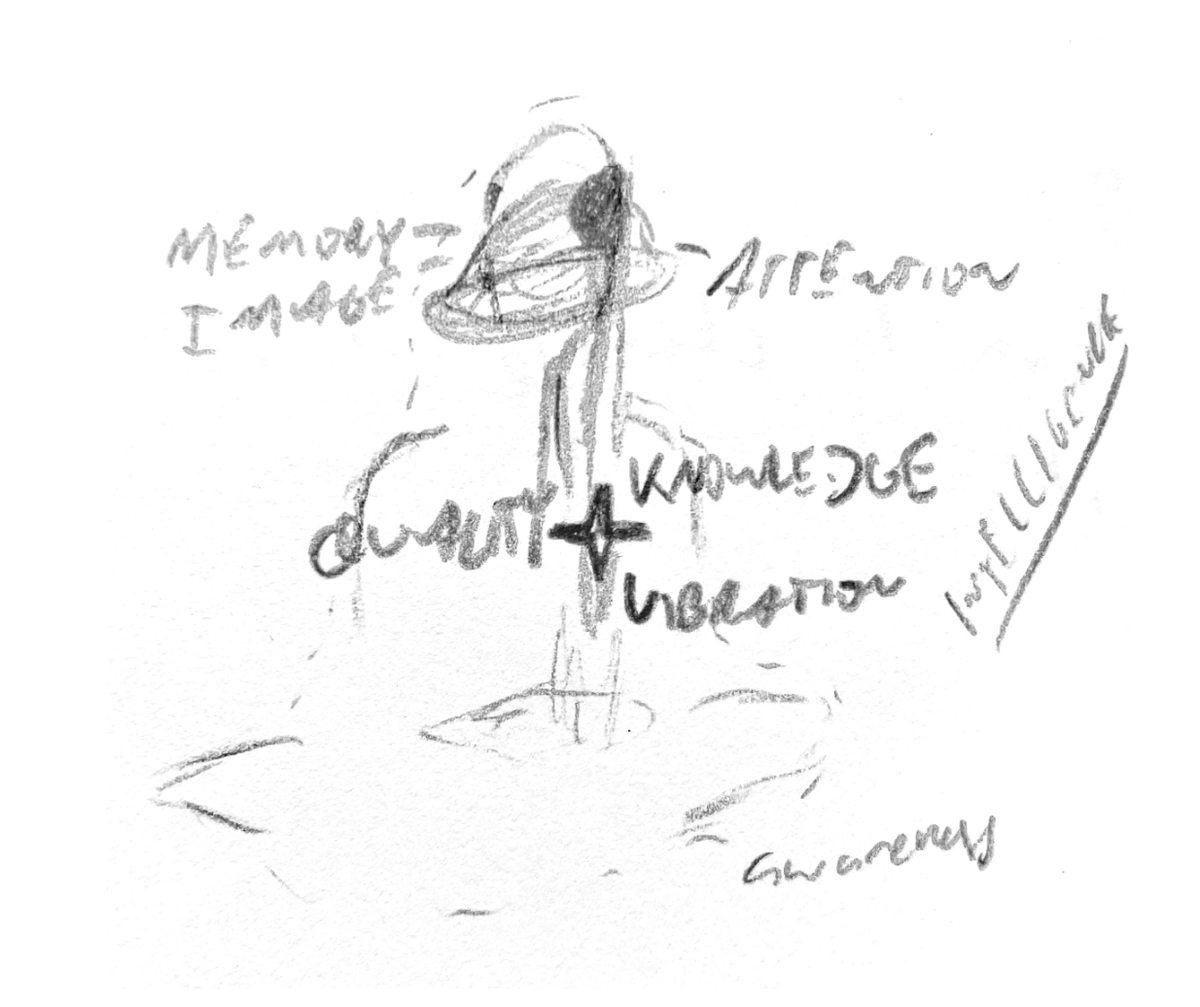
The Informational Being
I am lying on the floor.
It is tempting to think of the human as an informational being. A touch travels from finger to spinal cord to brain and back. It travels by electric impulse, like a phone signal travels. We receive signals from all around us, all the time -
A horn honks. Then three more. A man shouts. Music thumps from a car parked at the gas station. I hear all of this from where I lie. Slowly I coax my attention back within my walls, down to my level inches from the floor. I need to vacuum.
It is tempting to think of the human as an informational being. Electric impulses, molecules, hormones and receptors, carry information from organ to organ. There is interdependence, so there must be communication. Organs respond to signals. The cell carries the information that allows for its own reproduction. On this understanding, the propagation of life itself is an informational process. In the nucleus of every cell, each organism carries the informational seeds of its propagation - a code, the transmission and decoding of which produces our skin, our bones, our blood, our nerves, everything we need to live a life.
I roll over on the dusty floor and my lower intestine shakes. It throbs 11 times and stops. Then it throbs one more time and stops again.
Do my organs really “know” who Gray is?
My gut is more a gut than it is “Gray.” It is simply continuing a line of growth that has lasted since the first life. Adaptations have changed how this gut functions, but its growth from preceding guts has been continuous. They are all one gut. There have been branches in this line of growth. My gut is an ape gut, a primate gut, a mammal gut. My gut is a continuation of my mother and fathers’ guts. In order to preserve this continuation, my gut behaves guttishly. It has knowledge, but this knowledge is not informational. It is inherent. The gut needs no storage medium. Its communication is part of its nature, part of its very being. It feels through the swirling phenomena of mind which enables every living thing to feel. Same with my heart, and even with the organs to which we don’t ascribe any effect on our consciousness - the liver, the prostate, the toenail. And same with my brain.
Mind is inherent even to your fingertip. Give it your attention.
Even the central nervous system, the organ which gives us our powers of perception, is just continuing its line of growth, functioning how it functions in order that it survives. Like the gut, it’s more a central nervous system than it is “Gray.” It invented “Gray” because “Gray” keeps it alive. The phenomena of reasoning, awareness, attention, the self, are all just the perceptual effects of the nervous system’s operation. They are not the organ itself. Our particular conceptual experience is emergent as a set of adaptations. The thrushing, expanding spiritual experience, the bleeding flesh of heartbreak, are emergent as adaptations of the heart. The curling stab of an old wound, the abysmal concrete pain of irrevocable loss, are emergent as adaptations of the lungs. The experiences of our organs filter up into what we perceive - seeming to cross a barrier, through a channel, into the myriad soup of “what we think is going on with us.” This is the root of the idea that the flow of information, from unknown to known, is fundamental to our reality. But this idea is only an emergent illusion. Without the “reasoning” observer and their fickle concepts, the organs would, in fact, still function. They might even function better without our insecure nightmares and machinations fucking everything up. Beyond the nervous system is the great knowledge/no-knowledge. Beyond the nervous system is still being. And, even within the nervous system is being.
But we begin as single celled organisms, don’t we? It might be argued that the single cell cannot reflect the variegated whole that is a person. Surely the nature of genetic material is informational - a code, stored in a medium, whose translation produces kaleidoscopic effects. We even know the four basic components, and what they mean! We’ve quantized the genome! Each human starts in the code and every organ is just an outgrowth of the code.
Here is my response: DNA is not media. It’s not a passive receptacle of stored information. Like the cell, like the blood, like the heart, its nature is unitary. It just is. It lives. It follows the basic forces, interacts, through electromagnetism, gravity, and the rest, with the matter around it, and by these interactions it continually produces life - that strange matter which doesn’t just exist, but “survives.” Our bodies change. Contrary to our hopes, they break. They decompose, as other life forms claim their matter for the propagation of their own genetic material.
No one reads the informational quality of the AT/GP rows of the double helix. There is no reader to find them legible or illegible. No one translates them uniformly into their corresponding tissues and cells. The genetic code just is what it is. A, T, G, and P are molecules composed of atoms composed of subatomic beyond-our-perceptual-capacity freaky multidimensional goop. These molecules produce the cells, tissues and organs that they produce. Mutations occur, since there is no prescribed outcome, there is no model. And the genetic material continues in the state that it’s in simply because it hasn’t been destroyed or denatured back into unliving matter. The nature of the genetic material is not an informational nature. It is a chemical nature, a physical nature. It is the chemical and physical nature of that which self-propagates.
To successfully self-propagate, life must sense. The hard little seed must respond to the conditions for its growth. It has no uncertainty - it just responds. Sense - this is the mind, the animation, inherent to living matter.
So, mind seems to be a quality of the mysterious life force, present in everything that senses. Do I have that right? Must life and mind require each other?
Now I’m in the bathroom.
As I mull this over, peeing in the same position I’ve peed thousands of times, I consider whether mind could emerge not from life, but instead from dead matter. Surely there’s no mind in the unliving stuff, I think. Granite is granite, lithium is lithium. Dead organics - skeletons, driftwood - are just that - dead. They might be digested or photosynthesized back into the circle of life, but dead matter can’t be a part of the complex of mind. These things have no spirit, no will-
The bathroom shelf bonks me on the forehead.
. \* * * - .
Some weeks later I jolt upwards in bed. It’s the middle of the night and my heart is aching.
Mind must be emergent from non-living matter, it says. We know this because it emerged. It must have emerged, because here we are, with mind.
And so the question is now between “once” and “always.”
Was there a historical event when mind became a quality of the first surviving life?
Or, has the mind always been in everything? And the chemical conditions which produce our sensations, our attention and our awareness, just give us a special window into this peculiar sensation which senses itself and senses itself sensing.
The mind-substance. This is what animals sense in each other - our intentions, our love, our attention, our awareness. These are the qualities of our being. All of the world’s materials and immaterials also have mind-substance. Granite’s mind-substance is its granite-ness. The mind shows itself through its perceptible quality.
We erect the fallacy that “this” means “that.” In doing so, we impose our own, contrived, mind-substance on nature’s materials. Sculpted, the granite no longer means itself. It means what we carve it, and what we then suppose it, to mean. In nature’s mind-substance, everything simply means itself.
Information has no mind, at least not the one we think it does.
It is material. Its meaning is just a suggestion.
The Searchers, or, The Modern Frankenstein, or, The Postmodern Prometheus
…and often did my human nature turn with loathing from my occupation, whilst, still urged on by an eagerness which perpetually increased, I brought my work near to a conclusion.
- Mary Shelley, Frankenstein 14
It’s been days of dream time. Earlier - I can hardly remember it now - I visited the pond by the side of the road with the bearded man and his crocodile. I have climbed through hotel windows and apartment complexes, lost my way in elevators with buttons that change when you push them, nodded to friends from my adolescence. I have seen my family and argued with them in a garage about how to open the box. Slowly these flashing scenes have lost their substance. My tasks are becoming routine and lengthy. Now I have to carry the open box up seven flights of stairs, and now I have to carry the open box up eight flights of stairs. Surely morning is near.
I open my eyes to a dark grey hotel room. The ceiling flickers. I roll over to check the clock, and I find that I was only out for three hours. The jet engine that propelled me to London wasn’t powerful enough to change my body’s day for my body’s night. I’m out of whack.
The ceiling is flickering. Dark for seconds, flash - flash - flash flash flash - dark. Again and again. That’s what woke me up. Why is it doing that?
I get up and make for the room’s three-knob system of light switches. I turn each knob as far left as it’ll go. The flickering slows. I press one in - click. I press another in - click. I wait in the darkness for a few moments. I listen for my brother, still asleep. Seems like I fixed it. I wrestle my way back under the hotel sheets and lie face-up. My heart is active. Really I’m close to wide-awake. On Franklin Avenue in Hollywood it’s dinner time. Two flashes. It’s flickering again.
The dance goes on. I get up, I mess with the inscrutable switches until I find a combination of knob positions that seems to work, I wait a few moments, and I lie back down. Each time, the moment I’m safely under the covers, a ghostly hand reaches out of the ether to fuck with the dials. Flash. Flash flash. Something conscious is upsetting my sleep, tormenting me… punishing me.
I know I’m being punished. Because I know what it is I’ve done.
*- * *
Three months before this trip to London I had an idea which I began to pursue doggedly in my alone time. My idea had to do with Instagram Reels.
Reels are Instagram’s take on the medium of short-form video content, presented in a continuous scroll. This is the newest pinnacle of mass broadcast media. The Reels tab pokes at your attention. Inside, a juicy piece of content awaits your engagement. You might consume one of these morsels. You might consume a handful, squeezing them into your spare moments at work or while you’re on the toilet. Or you might consume seventy-five or eighty Reels in one sitting. Every Reel makes you feel something. You might feel apathy. You might feel absorption. You might seethe with anger, or jealousy.
The Reel’s comment section shows you just how your gut reaction fits in with the socially-current reactions of others. The comments that gain the most likes or spark the most replies rise to the top. Each top comment represents a socially desirable, even a “virtuous,” response to the Reel. But it depends on who you are. The top comment matches your gut reaction, and you exalt. The second highest comment shows exactly the opposite sentiment and your stomach turns. How could they think that? Are they fucking serious?
Every Reel was posted for a reason. The primary reason to post a Reel is to seek attention. The mental attention of an audience, which the poster can channel into their ego, or even into monetizeable forms of engagement. Since attention and engagement are the foundation of the advertising model, they are what keep the lights on. Advertisers want to advertise on a platform that grabs your attention, so Instagram rewards content that does this best. It rewards content that induces a strong reaction, regardless of the substance of that reaction. Ordinary users, influencers, and brands are all a part of this attention-seeking game. No Instagram post is completely removed from the psychological, the bodily, the economic, need for attention.
The game of online attention-seeking leads people to post some strange things. Somehow we accept these things and we don’t talk about how strange it is that we’re all addicted to scrolling through them every day. We don’t question the strangeness because we understand the urge to post, to seek digital attention. No matter what it is you’re doing online, if it grabs a sufficient aggregate of attention, you’ve won. You’ve popped off. We credit you for it, because you’re doing something that we secretly want to do - that an undulating mass of our emotion and spirit wants to do. But the “attention” we receive online can only be directed to the image we project - it will never satiate our inner need.
The desire for image-based attention - to be looked at and envied, is perfectly natural. Traditional value systems would hold that this desire is immature and socially damaging, that it is your duty to overcome it. It is a perversion of the more fundamental, more socially-constructive urges to seek community and to seek the beauty in each other. Human beauty has an inner quality which the user interface of Instagram can never encompass. Mainstream American culture does not share this belief, or at least this belief has been conditioned out of us. Our social life encourages you to seek image-based attention. We have adopted and encouraged our desire on a massive scale. We have invented technologies to ingrain and reward it. This kind of arrangement - a universally-connected social life mediated by attention-seeking - is brand new in human history. It took a high level of technological sophistication to achieve, and was finally enabled by the all-to-all communication model of the online social network. Every person with a device can participate in it.
A desire grew in me to call out the strangeness of this collective behavior. I wanted to put a finger on what’s going on, to feel and understand it for myself. Ultimately, I hoped, I would find my way to an explanation.
My idea has three parts and it goes like this:
In every Reel, there is a piece of me.
Every Reel I see carries a piece of me, or what Instagram’s algorithm judges to be me, somewhere in its metadata. Otherwise, why would the algorithm show it to me? Each Reel is presented as an attempt to hold my attention, based on a statistical likelihood that I will engage. Often the attempt is successful and I do engage. I subtly identify with some aspect of what I see.
I am also subtly identified by these pieces of content. The algorithm’s guess is based on a relief image of my mental processes, my desires, my fears. My engagement with the Reel either confirms the guess or rejects it. This provides the system with more of me to inform its next guess.
This works because, on a very intuitive level, I see myself - things I like, hate, relate to, am disgusted by, in the content on my screen. Every one of us experiences the nagging feeling that a piece of ourselves is in the images we see. Much of what we see is performed and cultivated specifically to incite this feeling. The moving image picks up pieces of us as it works its way into our brains. It snags on our brambles, and our brambles recoil and react.
Every piece of information, everywhere, has some amount of intelligibility to me.
There seems to be a subtle piece of ourselves, not just in every Instagram Reel, but in every piece of information we come into contact with. Reels are especially intelligible hunks of information, but there’s some level of intelligibility to every piece of information, in every storage medium, in every server and on every screen in the world - even what may seem like an absurd lack of intelligibility. Intelligibility - the extent to which things “make sense” - is composed of pieces of us.
Without intelligibility, information is completely vacuous.
Outside our layers of sense and cognition, information has no meaning. It stores a message, but has no qualities of its own, except for the qualities of its material medium. Without human sensibility, the bit of paint really is just paint. The 1 or 0 indicated by the position of a switch truly corresponds to nothing. Information is a hollow concept - that which contains and transmits other concepts. Thus directly viewed, it is meaningless. It only becomes meaningful when we suppose its meaning. Knowing its simultaneous meaninglessness and its supposed, often socially-conditioned, meaning produces a feeling: the absurd. You can experience the absurdity of information even in the most vibrant and intelligible of media.
Information’s fundamental absurdity has an obvious human implication: you don’t really know what the person is up to when they press the “Post” button, even if it seems like you do. Their intentions are truly hidden. They can only be signaled or assumed. There is always uncertainty in this process. You don’t really know what the person is up to.
Dr. Frankenstein sought to apprehend the cause which drives the human animal to do what it does. He lived the rest of his life in torment.
<- * —-_
I’m still laying here in the hotel bed, praying that the room will stay dark so that I can sleep. The ghostly hand flicks the ceiling lights back on every few moments. I cannot sleep. Sleep-deprivation lets loose my worrying, wincing, fearful mind. Like Dr. Frankenstein’s poor strangled best friend, I can feel the icy grip of the monster’s hands around my throat. The unholy creation that suffocates me tonight is not a physical monster. It’s me - the digital self that I have contrived to pursue my ideas. My absurd Instagram monster now grips my throat and squeezes the fear out of me. I stare at the ceiling, still flickering.
There are long flickers and short flickers. Most of the time, during the varied stretches between the bursts of light, it seems the ceiling is completely dark. But as I let go of the expectation that I’ll ever fall back to sleep, and sink my focus into the obstinate ceiling, I notice something. The dark stretches are not actually dark. The dark stretches are composed of almost imperceptible flickers. These flickers barely enter into the frequencies registered by the human eye. They amount to vaguely perceptible tremors. But they are there - I can feel them. I can feel the ceiling alternating from dark to light, even if I can’t fully see it. The closer I look, the more I tune in to the fine oscillations.
It’s a cinema screen. Malfunctioning, the room’s lighting system creates not the illusion of light and continuous motion as in the dark movie theater, but the illusion of darkness. The illusion of darkness, when real darkness is what my body needs to rest. Onto this trembling canvas I project the Wicked Witch. Her fingers reach for the Like Button.
I make a blindfold out of a shirt and roll back over.
- >* .. _\
To bring my absurd Instagram self to life, I needed to create some content. I started fabricating Reels. Not creating, fabricating. The source material for each one was a genuine Reel that I encountered in my feed. When I found one with just the right balance of earnestness and confusion, its absurdity just barely shining through the cracks, I screen-recorded it, transcribed it and its caption, constructed props and a miniature set, memorized all the words, rehearsed, recorded, and re-recorded, until I had a complete parody of the original, starring myself. This is all allowable by Meta’s terms and conditions.
My subjects ranged. A wife calls out her husband’s long years of toxic masculinity. A young woman advertises in-ear headphones while running errands in Boston. A man sings the praises of the humble nail - for the nail is reliable and uncondescending. A suburban girl in tribal facepaint recoils at her host tribe’s ritual pig sacrifice. A young man “locks in” to complete spreadsheet-based tasks at his consulting job. The kaleidoscope spins.
Often I incorporated elements from my own sense of humor - somewhere between SpongeBob Squarepants and Inland Empire. These were meant to tip off my friends and family that I was not having a psychic break. They would recognize my humor in the cloves of garlic I nailed to the in-ear headphones I advertised, the steel wool I substituted for noodles in a thrifty lunch recipe, my lengthy unexplained pauses and my abstract diversions. But I also hoped these gestures would bring the point of the whole thing to the surface. On your screen, noodles aren’t noodles. They are an illusion created by a programmed set of pixels. These pixels could just as easily represent any piece of material in the place of noodles. All of it might as well be garbage. It is all mechanized, vacuous, fleeting garbage.
On completion, each Reel drew a deep cackle out of me. Seeing myself do all these things as convincingly as the influencers on my screen was hilarious. I cackled as I walked around town gathering and building props on the weekends. I cackled as I transcribed the pepperoni-red-wine-man’s monologue. I relished its insanity and its truth. Enacting every detail of these strange performances was freeing to me. In this exercise I effectively spliced Instagram’s digital self from the living, breathing human with neurons and a job and friends. Each nonsensical piece of content was a resounding confirmation: I am not what moves on the screen.
Then I started posting my work. The first one confused my friends. Some reached out in alarm. After three or four, people caught on. Their comments indicated that they were enjoying whatever was “going on,” even if they didn’t fully understand it. After I posted a Reel claiming I had fallen $40 thousand into credit card debt, but was resolved to stop worrying and trust in God to bring me through, a middle school friend reached out to ask me if I was okay. “I’m excellent,” I responded.
Over time I learned that by posting, and gauging my audience’s response, I was reading them as much as they were reading me. I started to pay attention to what kinds of content got more likes and more shares. Unsurprisingly, my “controversial” videos, the ones that parodied relatively extreme or shocking viewpoints, were most engaged-with.
In my eighteenth Reel, a married couple (played by me and my friend, sitting on the floor of her bathroom) faces each other, crying. The caption is from the wife’s point of view:
POV: You and your husband have been working through his toxic masculinity for the last 5 years and he finally gets it.
As many of you know, this has been a long and difficult battle for my husband and me. Through the years we have broken up, separated, but also chose to come back together to learn and grow. At this point in our relationship, we are doing the best we've ever done. I am so thankful for how far we've come and know we still have a far way to go, as we are all always changing and evolving. However, things have been going relatively easy (consistently) for about a month now for the first time in our relationship. I am so grateful and love him so fucking much! 15
On this Reel’s first day, it performed about twice as well as any other. It drew more comments from my friends and acquaintances, who presumably enjoyed the satire. By the third day, it had blown up. Within two weeks it had a million views. When I eventually took it down, it had drawn more than 8,000 hate comments. What happened?
The dynamics here go back as far as the “Reel” itself. In the old days, a film reel (the medium of visual entertainment) was distributed based on the likelihood that it would do what its distributor wanted it to do: sell tickets. Today’s algorithm functions on a similar principle. Reels are distributed based on the likelihood that they’ll do what Instagram wants them to do. But now, it doesn’t matter whether any individual Reel is monetizeable. Not every Reel needs to be an ad, or to be advertised on. What’s monetizeable for the platform is that you stay engaged. Once you’re a captive audience, Instagram can slip its advertisements past your defenses. Advertising models are subtle - sometime’s it’s very difficult to tell whether what you’re watching is an ad.
Modern content distribution is targeted to the individual, based on characteristics that they share with other, similarly-behaving individuals. Instagram doesn’t need to advertise to broad public sentiments in order to draw people into a movie theater. There is no movie theater. So, they can provide content specifically for an individual, to be consumed alone, on their private screen. What you see isn’t just the Reel that’s most likely to draw generalized public attention to advertisements. It’s the Reel that’s most likely to draw your attention to advertisements.
“Engagement” is not just your interaction with things that you like, or that you think are funny. People often engage most with content they find revolting, terrifying, or insulting. These are the Reels that get you to open the comment section, to leave a comment yourself. When you do this, you give Instagram valuable information about what keeps you scrolling.
What bridges this solo interaction to the “audience” at large is the following computational step: many users who engage with this, also engage with that. Some portion of Instagram users react to a Reel in a similar way that you do. These users have other quantifiable interests. So, there is a decent chance you’ll also be interested in what your cohort is interested in. If you like a certain style of clothing, the algorithm can make a pretty good guess what kind of music you’ll like, which politicians you hate, and your preferred level of irony in memes.
Incredibly, Instagram doesn’t actually need to know what’s inside any piece of content in order for this all to work. It makes its inferences purely on your activity, your similarity to others, their activity, and a Reel’s metadata - its attributes and tags. To the algorithm, there is no “toxic masculinity.” There is just a string of characters that elicits predictable reactions from predictable groups of people. Without any understanding of the content, the algorithm automatically activates our emotions.
A Reel is evaluated on its ability to activate an audience. Not the audience, i.e. the general public. An audience, a subset of users whose behavior meets certain quantifiable parameters. A set of users to whom an overlapping set of categories applies. The algorithm plays 20 Questions with you to determine what you’re most likely to engage with. Then it hammers you with more and more. It does this for everyone. And what you’re most likely to engage with has no relation to what’s true.
My toxic masculinity Reel had found its audience - alphamale idiots. They were outraged at seeing a man break down in tears, seeming to accept his wife’s narrative that his masculinity is “toxic.” Once the algorithm noticed that my Reel fired these interesting persons up, it showed it to tens of thousands of them every day. My phone overflowed with hate messages about how my balls had been cut, how I was not a husband but a wife, how I was in desperate need of testosterone, how I was secretly transgender.
This newfound attention created a nagging stress in my body. Despite my attempts to sever my ties to my digital self, he was still alive. He still had a hold on my insides. He had come under direct, nonstop attack. Warlike attack. This was the direct experience of the digitized conflict that we call the culture wars. It was uncomfortable. My only method of dealing with this pain was to try to ignore it.
Still, I was grateful for the opportunity to directly experience Instagram’s ocean of hatred and fear. This was one of the things that I hoped my project would excavate. Most people who engaged with my toxic masculinity Reel felt they were reading a genuine piece of me. But in reality this piece of me was a complete fabrication. In reality, I, the creator, was reading them. The comment section gave me thousands of data points.
Strangely, my hate-commenters defaulted to a highly specific set of insults centered around the concepts of hormones and gender transitioning. They also used the word “cuck” a lot. By the contents of their shit, it seems they’ve all been eating the same cereal. Doubtless their algorithms are filled with videos just like mine. Not parodies, but earnest entries in the online gender wars. So of course my commenters assumed that mine was real. Each participant in this conflict must be provided with an unrelenting stream of ammunition - content that stokes their internal fires. The underlying intention of each piece of content, often specifically to “rage-bait” or to incite a reaction, hardly matters, and is ignored. These guys are inundated with what they fear most, and they can’t stop consuming it.
_\_ — . .
Media is naturally subject to parody. My hunch is that parody goes back as far as any practice of art. It’s the very externality of media that makes its existence a sort of joke to us. As soon as you make something, you can laugh at it, and you can imitate it. We are playful and sarcastic creatures. And the healthy heart makes a mockery of authority. This makes broadcast media especially susceptible to parody - broadcast with its facade of central authority. Broadcast narrows your choices, because it relies on the technological sophistication of very few distributors. You can only watch what’s on. On Instagram, where content production is in many ways democratic, you can still only watch what satisfies the algorithm’s conditions of profitability. The algorithm with its advertising model is king. There is inherently an authoritarian relationship here. So, there is much to poke fun at.
Parody is also quite easy. All you need to do is claim that something’s silly or stupid. I can make parody hot dogs if I want to. All I need to do is declare that the hot dogs I’m making are a joke, and suddenly they are.
I am by far not the first to parody the broadcast. There was a notable first major broadcast hoax. It was engineered in 1938 by Orson Welles and his Mercury Radio Theater. This is the infamous “War of the Worlds” broadcast. In it Welles utilized every broadcast-news trope at his disposal (panicked grasping anchor, Hindenburg-style dramatism, intermittent cutting between a nondescript orchestra and breaking news flashes) to convince his audience that the alien invasion in his radio play of H.G. Wells’ “War of the Worlds” was really playing out in New Jersey. People believed what came over the airwaves into their homes and businesses. Many of them panicked. And many of those who didn’t fully believe him still thought we were being invaded by the Germans.16
Welles apologized the next day. After a period of backlash, some began to argue that Welles had done us a favor in demonstrating broadcast’s power and potential for misuse.16 Broadcast could incite panic. It could spread highly-convincing misinformation. We intuitively trust broadcast. We are gripped to trust its messages, or to fear their truth. The rise of fascism, which I think we all struggle to comprehend, became a shade clearer to those who were paying attention in 1938.
After the war, Welles had a copycat. In 1949 a producer at Radio Quito (of Quito, Ecuador), decided it was his turn to put on a broadcast hoax. He translated the War of the Worlds broadcast into Spanish, adding in location details from Quito. This one aired with no qualification, no introduction - no tip-off that it was a fake. His explicit intention was to fool people. It worked. The military got involved. When the town figured out that it was a hoax, they rioted. Pitchforks and torches descended on the radio station. A truck full of rocks pulled up and the mob laid siege. Don’t fuck with us, you invisible airwave-broadcasting motherfuckers.
That night the mob burned down the radio station, killing the producer’s nephew and his girlfriend. Survivors were maimed jumping out of windows. The producer’s monster of invisible technological might had turned on him. He fled the country.16
_. . * *
The spirits of the departed seem to flit around, and to cast a shadow, which was felt but seen not, around the head of the mourner… They were dead, and I lived; their murderer also lived, and to destroy it I must drag out my weary existence.
-Mary Shelley, Frankenstein
The flames consuming the Ecuadorian radio station dance before my eyes as I lay, watching the dark cinema screen ceiling. The mob killed that guy’s girlfriend - crazy.
I am under no delusion that my Instagram hoax would amount to anything more than mild confusion - well short of riots and fires. But I am losing someone over it.
Two days before my trip to London, my girlfriend FaceTimed me. She registered serious discomfort with my online game of pretend. The cringe was too much for her to bear. We decided to take a break.
On Instagram, particularly on a personal Instagram page, there’s an expectation that one shares true or earnestly contrived things about themselves. Just as in a radio news broadcast, the Instagram page carries the expectation of truth. Meta’s “News Feed” carries the expectation that it’s News. The Reels tab, while chock full of parody and absurdism, still carries the subtle expectation of a fixed perspective, a fixed desire for attention. A person earnestly trying to make the jokes they make, to grab you by pulling specific levers. My mockery of all this, with its necessarily shameless embrace of cringe, had made my girlfriend very uncomfortable. I was clearly doing something strange. Many of the videos were quite painful to watch. I felt this pain too. I was intent on feeling it. Posting is always painful.
Posting is a sinking feeling. After you press the button, something in you withdraws from articulation, away from your forehead and your throat, back into your gut’s nether regions. It sinks and it sinks, and it pains you. Your throat tenses and grasps. It wishes it could say more. It wishes it could hedge you, make you more acceptable. It wishes it could communicate directly. But you have sent the message. Now it’s out there. Now, you can say nothing to alter it. Now its meaning is completely subject to the algorithm’s processing, and to the squishy beings who receive it. You sit in silence for some time. One moment, the only option seems to be to ignore the sinking.
The next moment you enter certain despair. Sending the message upon which your self-image depends brings intractable uncertainty. Sending the message, you construct a new ignorance where there was none. You don’t know what they will think. This constructed ignorance makes you desperately uncertain.
You oscillate in your stew of ignorance and despair, until, finally, you feel the buzz. They replied. They liked it. They left heart emojis and smileys. This instant frees your body from its hankering. But within minutes the uncertainty drags you back down.
When you hit “Post,” but almost never during the days, hours, or moments of preparation for this decisive event, you enter the world of “cringe.” Now, you see your body moving and your face contorting, not as a hopeful poster, but as an audience-member. You wonder if your chosen articulations are “right,” if they are “enough” to maintain and increase your status. Sometimes, you don’t like what you see. Maybe you haven’t adequately concealed your message’s underlying pure intent: attention-seeking. Maybe what you’ve posted simply falls outside of accepted online norms. Maybe there is the feeling of abrupt “realness.” You have let too much of the “real you” shine through - whatever that means. You see yourself acting unacceptably, and you cringe.
I don’t have the full taxonomy of cringe here, but I can say that every kind of cringe springs from the same source. Cringe is rooted in the insecure self-image. The first person you cringe at, always, is yourself. Then, seeking to avoid this self-regarding pain, you trim the “cringeworthy” edges off of your digital persona. Now, you can safely cringe at other people for exhibiting the same traits. Your reflexive pain still awaits, unaddressed, rooted in your insecurity, but you have established the pretense that they are the ones who inflict the pain. They’re the ones. You might now tell the lie that your pain is their fault.
We put ourselves out there quite a lot in our online culture. We want to articulate acceptably. We want superficial validation. We want to consult the record of our successful posts and pleasant interactions. But we can only do these things within rigid, fear-defined boundaries. This is what’s so powerful about the online trend, or the meme. “Trends,” like the framing device “POV” that begins the caption on my toxic masculinity Reel, are partial scripts, defining the form and content of an acceptable utterance. Used “correctly,” they are a safe, cringe-free way to seek attention without labeling yourself as an attention-seeker. So we use them. We stick to them. And when we are confronted with online behavior that disregards the acceptable utterance, we feel cringe’s forceful bite.
It turns out, and I guess I should have known, that the cringe-based norms of online communication have seeped into our real, human, social lives. We walk around with imagined comment sections in our heads, triangulating ourselves between algorithmically-mediated social expectations and aesthetics. Now the algorithm has insinuated itself into our real-life moral sensibility - not just what we feel it’s okay to post, what but we feel it’s okay to do. What it’s okay to do - on the discrete and continuous Earth with its million rivers and its sun and moon.
Online acceptability has become important to us. This concerns me greatly. If we allow cringe to control us, then we are doomed to dullness, distortion, to fear. And there is certainly plenty of true evil and abuse hidden below acceptability’s sheen.
I was interested in what would happen if instead of reflexively avoiding it, I felt the pain of unacceptable online communication, welcomed it, took responsibility for it. I thought that over time, feeling and surviving the pain of nonsensical post after nonsensical post, I could free myself from cringe. I didn’t think for a second that my operation would damage my treasured non-digital relationships. Now, however, it seems that there was no other way. I had to witness my digital self crawl its way out into our world, confound me, clench my throat and scramble my heart. This is all a part of digital social life’s tortured self-creation.
I don’t have clean answers here, to any of this. My project seems to have kicked up more dirt than it settled.
The thin layer between the vast data complex and us, the animals, is the user interface: a set of visual elements that allow us to interact with informational structures. The buttons and the menus, the visual design of an on-screen display, the industrial design of a device, along with the underlying data and the content presented, all work together to determine what we can do and how it makes us feel.
From all this you might think that the interface designers of our mass communication software are an important handful of folks. You might expect them to take their impact seriously, to work and articulate out of their higher ideals for society, their love for diversity, plurality and humanity. Some do. Many don’t - they take a technology’s mass adoption as sufficient evidence for its goodness. For them, whatever sells is good enough.
The designers and executives at Meta and the other social media platforms have chosen, specifically, to condition us into thoughtless scrolling. They have led us to take our digital selves very seriously, and to live by the social rules of the digital world. They have built powerful social tools, and we presume the legitimacy of these tools. We adopt their expectations and norms. But they have also given us the capability to completely destroy our digital selves. We can press the button on ourselves at any time, just by tapping “Post” on the “wrong” pieces of data. In this social regime, each of us teeters on the edge of emotional disaster. On a large scale, the “Post” button can ignite economic and political disasters. These disasters strike often.
~*_—
Slowly sunlight augments the ceiling’s flickering. Now my family’s awake. My dad comes in and inspects the light switches. We figure out that there was a hidden switch behind my bed that turns off the whole apparatus. Nice. Maybe behind the bed was an obvious place to check. But it was dark, and I don’t think the burden of explanation should be on me when a light switch malfunctions.
In addition to a fantastically sophisticated three-knob ceiling control panel, this lighting system’s interface designers provided me, the exalted user, a special failsafe knob, hidden conveniently out of sight. The one control at the center of all lighting systems - the on/off control - was hidden below layers of complexity. The result of this design was a lighting system so clever that I couldn’t figure out how to turn it off. A lighting system smarter than me.
Later on that trip, I see Stonehenge. The next day, I get sick at the British Museum and puke in a cab. After a few days in bed, it’s time to fly back to Los Angeles. I settle into my airplane seat. Three hundred and thirty six in-flight entertainment systems beam in unison. I attempt to turn mine off. It turns out you can only put your screen to sleep, so that when it’s time for the airline to advertise to you, they can beam it back on. I hook up my bluetooth headphones to my phone and I look away from the uncontrollable screen 15 inches from my face. I listen to Abbey Road as we prepare for takeoff.
There’s a young mother and son in the row in front of me, playing the games on the entertainment system. My brother is across the aisle from me, settled in with anime and a book. Behind my brother sits an old woman with a laptop. We all tap away and wait for our journey to begin.
When I was very small, Abbey Road was in the CD player in my Mom’s station wagon. The only songs I can remember from that period are “Octopus’s Garden” and “Maxwell’s Silver Hammer.” Now, on this trans-oceanic airliner, “Oh! Darling” is my favorite.
The plane is moving slowly. Then, there’s a roar as a thin burst of jet fuel and compressed air streams into the engines and combusts. I hold back tears. John and Paul exclaim “She’s so …. HEAVY.” And we fly towards home.
My recent discomfort with jet travel is largely about its taken-for-granted-ness. It is now difficult for us to imagine a globe that one can’t traverse in twelve hours. This difficulty is a new cultural mindset. We take adopted technologies, and the capabilities they offer, for granted very quickly. This applies to communication technology, fast food, automobiles, as much as it does to the jet. Listening to Abbey Road on this flight I realize that we take it for granted too. Abbey Road has been done, just like the jet engine has been invented. The cultural mindset out of which Abbey Road breaks new ground is gone to history. At times I catch glimpses of this untouched mindset, and I can feel Abbey Road’s true resonance. At times I can feel the true resonance of the jet engine too - how it augments and upsets our lives. How it shrinks our world and throws our bodies out of whack. The magic of the jet engine is quite foreign to our animal natures. The plane is so heavy, but somehow we have made it go hundreds of miles per hour, for long enough that we can travel as far as it is possible to travel in our world. And without really understanding this magic, without contemplating it with any regularity, we now demand that it always performs as expected.
This is one of the dangers of which the Welles broadcast warns us. Magical technology like the radio broadcast has the paradoxical property of being taken completely for granted almost as soon as it is adopted. It carries a promise, which we assume it will keep. We are confounded and upset when it doesn’t. Today we take Instagram’s algorithm, its user interface, and its social norms for granted, as basic facts of the social and political world. We assume their legitimacy and are upset when they break down. And once-unimaginable results become routine.
We train ourselves to operate these machines, and to act in ways that they prescribe, because we presume their legitimacy. There is a presumed legitimacy to a light switch. In our infrastructural arrangement, switches turn your lights on. There is a presumed legitimacy to the “Post” button. In our social arrangement, you post things about yourself, from a fixed perspective, following social norms. There is a presumed legitimacy to Abbey Road. In our culture, Abbey Road is a classic. We know what song comes next, because the same song comes next every time we listen to it. There is also a presumed legitimacy to the atomic bomb and to the gas chamber. Operating these devices was simply your job.
But it did not have to be the way that it is. Each of these devices was completely contrived. Each was invented for a specific purpose. Each can be altered or eliminated.
My brother has the map open on their in-flight entertainment system so that they can see our airplane’s progress through the northern regions of the Earth. On their iPad an episode of an anime plays. In their lap is an open notebook where they scrawl ideas for game design or some other productive occupation. In the row of seats behind them, the old woman plays a TV show on her laptop. Her headphones are in her ears, but they aren’t plugged in to the computer. So we can all hear her show. She doesn’t notice anything’s wrong. She’s probably hard enough of hearing that it doesn’t matter either way; the subtitles are on. In front of me the young mother and child explore the games on their in-flight entertainment system. The child doesn’t yet know the touch-screen gestures the rest of us have internalized. He doesn’t know how to scroll through a list of items, or how to pinch to zoom in on an image. As he tries to navigate the touch screen, his gestures are wild and expressionistic. But they are accurate to his intentions.
They settle on a game targeted to young children. To win the game, you tap the screen to pop a certain number of balloons before time runs out. The child bangs away at the touch screen to get his balloons. Effectively, the game requires small children to repeatedly smack the headrest of an airplane chair. Imagine sitting in the chair.
—// */
Now I’m back on Franklin Avenue in Hollywood. I walk up the stairs to my place. I spend some days readjusting to my home region’s relationship to the sun. I sit on the floor.
One night I’m hunched over on the couch. I look down at several piles of books. Some of the piles are of my books. Cookbooks of Julia Child and Jacques Pepin. The memoir of Al Pacino. Shakespeare, Tolkien, Muir, Thoreau. Mary Shelley. Five volumes of Joseph Campbell, three volumes on the Buddha, two on Yoga. Manuals, as I would describe them, for an intuitive, artful kind of human living. A human life in accordance with nature, and with the heart.
The other piles are of my dad’s books. He has loaned them to me to help build a course. These are the histories of information technology - of radio, television, the transistor, the phone company and Bell Labs and the rise of consumer computation. The foundational texts of the Theory of Information. They are thrilling. They are manuals for a different kind of living: to pursue the beautiful, dangerous, human art of technological striving.
I stare at the piles of books.
What is it that drove Frankenstein to create his monster, upsetting his basic human needs, while years, relationships, and the wonders of nature faded from his mind?
It is, purely, simply, and splendidly, the idea. The idea drives us to pursue the light bulb and the bomb, and the in-flight entertainment system.
There is something special about the idea. It cuts through the bullshit. It promises escape from the compromise of uncertain, squishy life. Life which is out of our grasp. If we can create something ourselves, we might relish in its unqualified value - a value which can’t be touched by human biological doubt. We might even control this thing which lasts. We might achieve a world that is truly understandable. Our vision can consume us.
Pursuing the idea upsets the natural fluctuation of the moment. The idea does not rule out enjoying life’s basic pleasures - you might return to them if you’re not too far gone. But basic pleasures, a life in peaceful equilibrium, have basically nothing to do with the idea.
I had an idea about Instagram. I loved my idea and I pursued it. Social and emotional objections to my idea were meaningless to me - they did not comprehend its wholeness. Even my own intense discomfort posting what I posted had no relation to the accomplishment of my vision. But like Dr. Frankenstein, the producer of Radio Quito, Meta’s interface designers, I could not fully control my creation. My flight of fancy had real-world implications. Once an idea is brought incarnate, we are forced to live in its world. Every creator has to face the consequences they have wrought.
No matter how great the idea, there are always unexpected consequences. Before you’ve done something, you can only picture what you hope or fear it will be like. This picture is always flawed. You don’t know how something will work until after you’ve created it, and you can experience it yourself, along with everyone else. Only then can you cringe. Most of the time, the idea begins to fall part as soon as it is made real. Nature’s basic forces tend towards chaos, no matter how effectively a technology or an idea might seek to rein them in. The reality of the unintended consequence leads us eventually to hold our own embattled creations in contempt.
I had desired it with an ardor that far exceeded moderation; but now that I had finished, the beauty of the dream vanished, and breathless horror and disgust filled my heart.
- Mary Shelley, Frankenstein
Every day, we rely on, and are forced to try to comprehend, devices that don’t comprehend us back. Every element of the user interface is installed because of an idea, a contrivance of a committee of people. “We think the user will do this.” This button goes here so that it gets pressed often. That button goes there so that it’s ignored. It’s easy to turn on your phone’s flashlight. It’s hard to change your network settings. Only the very highly skilled of these designers have any real idea of how you will interact with what they’ve created.
The designer has to account for what they predict will be the full range of possible behaviors. Unfortunately people fall outside this set of acceptable inputs all the time. A child doesn’t know the touch-screen gestures. An old lady forgets to plug her headphones in. I can’t figure out a multi-layered light panel because it’s dark, and I’m delirious with jet lag. We are unpredictable. An unskillful program can’t comprehend the many ways that our minds and bodies work. A program works best, and in some cases it only works, when people behave predictably. This is a principle of informational system design. The more uncertainty in a situation, the more potential scenarios must be accommodated, the more expensive the system is to produce and maintain. Enabling 16 ways of interacting with a video introduces far more uncertainty than enabling 4 ways of interacting with a video. So an economized system offers you 4. As much as possible, the system coaxes you into behaving predictably. Hence, the establishment of the “use case” - the “user journey” - the system’s intention for your behavior.
But I would like to say that a person rarely falls into a use case. We are not the “imperfect” ones - the machines are. I would like to say that a person should condition the machine to their intentions, not the other way around.
Slowly we adapt to the technical systems that are shoved in our faces. So in general, over time and in very large numbers, the contrived idea of the interface designer tends to win the battle. The victory bells ring through our social and economic lives. The interface economizes and simplifies. It allows many of us the illusion that we have greater capabilities, greater knowledge and wisdom, less uncertainty. In doing so it enables a small group of people to live easier lives and make more money, and it leaves the rest of us clouded and confused.
Bizarrely we have burst into a social life where complexity is habitually reduced. The social life of Instagram has conditioned us to expect quite a small subset of possible human experiences. It makes us increasingly uncomfortable to see a human experience that falls outside of what we’re conditioned to expect. It makes us so uncomfortable that we break up with each other over harmless behavior, and we interpret harm to the conditioned digital self as real-life harm. Whether these social consequences were intended, the object of the designers’ ideation, or unintended, as the horror of Frankenstein’s monster, they are truly happening.
— -\ *—.
A few weeks later, I took my Reels down. I had always planned to take them down, to let their disappearance resonate just as their appearance had. For a long time I expected the deletion to be triumphant. Then, as I grew to love the content I posted over those fifty days, I felt a mounting sadness. I was proud of my work. But in the end, when it was time to push the red button that says “Delete,” I didn’t feel triumph, or sadness, or anger. I simply felt relief: Relief from uncertainty, and relief from shame.
I felt shame during the last weeks of my project, after my relationship broke down. Truly, I did. I could argue all day that the blame for this shame wasn’t mine, that my behavior wasn’t inherently damaging, that I was just having fun and pressing buttons. But I intended to stoke discomfort by pushing on the online norms of communication. And I was successful. So, there was a real, human consequence to my foolery - real human pain and real human shame. I had to share some of it, because I don’t like to do harm. As I posted my last couple dozen Reels, I was more confused about the ethics of this whole thing than ever. In the world of digital social norms, right and wrong are very difficult to pin down.
I also felt a tremendous amount of uncertainty throughout the whole thing. Uncertainty was the monstrous sensation that gripped my guts and my throat every time I posted a new video and every time I checked the hate-filled comment section. All I could really do was ignore this feeling, and remind myself of my principles. I felt so intensely about it because, even with all the layers of removal and absurdity I interjected between myself and my digital monster, I still fundamentally cared about what I was posting. I could not break the essential, biological relationship between guts and content stream. All I could do was attempt to build a conceptual wall. But the uncertainty remained. There is always uncertainty about what happens on the other side of the wall.
I care about the text messages I send, and I care about the thoughts and the work that I share with the people in my life. The interface, the reality of mediated communication, introduces uncertainty into all of these emotional exchanges. It’s not just uncertainty about what’s going on on for the reader, the human on the other side of the line. It’s uncertainty about how to feel. The most painful feeling in online communication, worse even than to cringe, is to be ignored. When you are ignored, you simply don’t know how to feel. Despair and elation feel equally likely, equally justified, and their violent alternation confuses you away from really feeling anything. The more we post, and post, clawing at each other’s attention centers and guts and various other organs, the more uncertain we are about ourselves.
Now that my Reels were gone, now that the FaceTime call was over, now that I had my answer, spoken through its crackling signal, (It’s just not on the table right now.), my uncertainty could relax. Now I could feel what I needed to feel.
In the end, my project was a farce, performed in a content medium which I find hilarious and stupid. It didn’t mean much to me. Tonight in my apartment, the path to a more impactful kind of idea is laid before me, to be found somewhere in the stacks of books on my floor. In these books is the potential to understand our technical infrastructure, to participate in its design, and eventually to have the kinds of ideas that can drive a life’s work in the informational culture. I want to understand the underpinnings of our technical infrastructure. I want to understand why things are the way they are, and to make them better. But I have some qualms about uncritically launching into this kind of career. What does it mean to be a part of the information industry’s creative class?
I now have to contemplate that the idea can make me dogged. Even my nonsensical Instagram idea was so thrilling to me that I spent months executing it, left my online social life hanging, and lost a real-life relationship. Technological history is filled with far more severe, far more real examples of Frankensteinian pursuit - the pursuit of the nature-denying idea, and the subsequent horror with the wicked, lingering, world-distorting results. The inventors of our most important technologies were dogged too. They worked hard, for a very long time, leaving their children and partners at home, losing their taste for the simple life, all in pursuit of the consuming idea. In this sacrifice, they resigned themselves, and us along with them, to the unintended consequence.
I think of my unborn children.
What will I do when it’s my turn to pursue the idea? What will I sacrifice, when it’s my idea, up for realization and validation?
Here is the last in this chapter’s long list of nagging discomforts - perhaps the discomfort that underlies all of the above:
The pretense that you can truly know anything outside your immediate surroundings and lived experience is dangerous. This is the allure of media and informational technology. This pretense causes degradation - the degradation of the here and now, of the home and the family. Ultimately, it causes suffering. It fools us into designing “systems” to reduce our uncertainties. But these systems only make our uncertainties worse, fuck with our sleep, lure us into the social life of emotional disaster, distort our self-image, and cloud our psyches with absurd nonsense.
After each day’s living and breathing and sending and striving, I turn the lights off in my apartment, and darkness falls on my several stacks of books.
‘Are you mad, friend?’ said he, ‘or wither does your senseless curiosity lead you? Would you also create for yourself and the world a demoniacal enemy?’
- Mary Shelley, Frankenstein
The Information Age
Shutters click and we dart our heads in and out of castle doors. I stop and balance on a wall. My brother crouches, scooting their left foot, then their right, framing, scooting, reframing. Click. I work to manage the corners of my scene. It’s beautiful, yes, but what about its rectangular image? Click.
My brother eagerly shoots in color. Today, and for most of this trip, I have restricted myself to black and white. Color seems to introduce too much uncertainty into my process. I won’t switch lenses, either. Switching lenses would alter my way of seeing. 36 frames, sensed in connection with my machine, refined by careful positioning, and finally seized with the click of a shutter. Chosen for their form, and for the qualities of light they display - that’s all.
A photographic negative is a precious informational object. Every picture takes exactly one space on the roll. Each space contains almost exactly the same number of silver grains as every other space. No matter the image I capture, no matter its form or quality, no matter my skill in capturing it, one photograph is one photograph. Each contains exactly as much information as the rest. And one roll is one roll, crafted with specific chemical compounds, to result in a specific density and specific sensitivity. Finishing a roll, you have the opportunity to choose your next film stock. You might choose one with finer grain, or richer greens.
When we get back to California, we will send our rolls off to be developed. First we must negotiate them through international airport security. X-rays are a no-go for our light-sensitive creations.
This morning we saw (and photographed) stones that were put in place by Bronze Age people. Now we are drifting (and photographing) from abandoned castle to abandoned castle, past the neat, airy, well-managed hardwood forests, and down the dangerously narrow country roads, of Scotland. I am half-asleep in what in America would be the back-passenger seat. Here it is the back-driver seat. That shift has been just as confusing as you might expect.
I crack my eyes, and there’s an open field. In it stands a ruin - a stone and mortar conglomerate weathered by hundreds of years of wind and rain into broken teeth. The sun is warm; it must be about 2 in the afternoon. The wind drifts west.
“I can’t…” “Why is it upside down? The map is upside down, we’re going downwards on the map.”
“Hit the pointer button and you’ll be able to turn the map around.”
“Don’t-”
“Okay, well now it’s not following us, I want it to follow us and face in the right direction.”
“Watch the median.”
“I think we’re going down on the phone map because we’re facing south.”
“Watch it!”
It seems to me that the hardest thing about driving from the wrong side of the car, on the wrong side of the road, is judging how close you are to alien objects. For me this was the hardest part of learning to drive on the right side of the car on the right side of the road. Car design can ease the learning curve - smaller size, better mirrors, more visibility through the rear windows, and of course, automation. Now most cars notify you when you’re drifting, to ease the pain of learning to position your own car. It is not easy to accurately judge the position of objects at speed, with lives on the line - you may feel that it’s safer to entrust this task to the machine. But keeping your car moving straight ahead while avoiding disaster, like any other touchy and precarious skill, can be learned with time, effort, and guts. It is part of what keeps your mind engaged in driving. And the more engaged you are in driving, the weaker the pull to respond to messages, mess with the dials, slip into drowsiness. We may be on the brink of a self-driving revolution, but for now, in order to reap the enormous benefits of auto-mobility, we must learn the ways of the automobile. Every now and then a light swerve corrects our course.
“I don’t know what this direction means. There’s the highway name there, but the fork doesn’t look like it goes to-“
“I can’t account for you not knowing what it means.”
“Turn left.”
We all got a kick out of the Bronze Age stones, and we took many photographs of them. One of the things about ancient civilizations is that unless they were large, powerful, and literate, we hardly know what they were up to. We can make decent guesses sometimes. Knowing how mythology, art, and religion have functioned in documented cultures, we can infer how they must have worked in undocumented cultures, to inspire, to organize, to regulate everything from breakfast to regicide. We can guess what these people must have eaten, how they must have farmed or found it, how they must have stored it, through the analysis of pottery, tools and teeth. But our actual knowledge of what went on, and why, is sparse, generalized. And we have very little view into the “Why” behind anything. The Picts or Britons could have erected those stone circles, eerie and hallowed as they now appear, simply to mark territory. They could have erected the stone circles as birthday gifts to each other. Most of the time we have no view into the specific chain of events which led to any actual set of remains. We can only make claims about what could be true, what generally would have happened, based on observations and images that we construct today. We can never know what actually happened. Part of the difficulty is that these people did not keep very many records, and what they did leave behind - structures, tools, impressions on the earth - has been slowly washed away by time. But that’s not the whole difficulty. Even with feverish record-keeping, life still gets away from you. Life is not completely subject to any record.
In our age, we would still scramble for the “Why” behind most occurrences. The child’s game of “Why?” with their parents never lasts more than a few rounds. The lack of specific knowledge limits our self-understanding, our mental image of the contemporary world, as much as it limits our image of the past. And to generalize a little bit, we stop wondering after the explanation as we get older. We either learn to operate with uncertainty in full view, opening ourselves up to the distress, even the terror, of the moment, or we erect certainties which allow us to disregard the mystery. Frameworks which sort things into categories; generalizations which roughly fit a wide variety of specific scenarios.
We know generally how Bronze Age people lived, for our mental image of their life is how they must have lived, given what we know about their technology, food, religion, the geography of various ethnic groups. But all the juicy specifics, the day-to-day experiences, their values and qualities, how their music sounded and how they danced to it, who built what house for whom, how they made love, are blank spaces for imagination. What do we make of the fact that all of the good stuff is irrevocably lost? And what about today’s specifics? What does our relentless photographing and recording really capture?
My brother, Boden: “What age are we in now?”
Me, sleepily: “We’re in the age of technology.” I close my eyes again. That wasn’t quite right. Those Bronze Age folks had technology. They had the wheel and the hearth and pottery, and armor and weapons. Bronze was what they made their technology out of, just like Stone Age folks used stone. That’s why we call it the Bronze Age.
Dad cuts in from the driver’s seat. “We’re in the Information Age.”
There it is.
*—_. . .. .
Dawning as scratches on slabs of rock first encoded pictures, ideas, and then quantities and words, through millennia of scribal cultures rising and falling, their records burned and mildewed and decomposed, reaching self-sustenance with the printing press, and finally breaking into exponential all-encompassment in the last hundred years, as information became constituent of power, wealth, and the other social currencies, the fabric of our daily lives - we are living in the Information Age. Just as the Bronze Age people created a cascading array of art, craft, and weaponry with the most advanced material available to them, following survival, power, rage, and love, so do we.
The unique preoccupation of our culture is to manipulate information. To encode it, to decode it, to access it and transmit it. We spend very much of our lives interacting with informational constructs - messages, stored and recalled. On the surface, the artistic and infrastructural elements of our lives may appear to be what they claim to be: musical, load-bearing, sculptural, compositional, trustworthy. But underlying each of these expressions is the same substance, the bit, as bronze was the underlying substance of Achilles’ Greece, giving his great shield its stopping force and throwing its legendary engravings into poetic relief. Our lives, preoccupied as they are with the endless array of informational constructs, are thus imbued with the Emotions of Information, felt with the Sensations of Information. We are driven by the Psychology of Information. Our truths are realized in the Poetics of Information.
I realized on that afternoon in Scotland, driving between abandoned castles and Bronze Age stones, that what I had been working on, quietly, alone, manically and fraught with self-doubt, was cast much deeper than I had initially realized. All of my work with the folk song, the qualities of music, of media, the circus and the Wicked Witch, Chuck Berry, the cheeseburger, now seemed to deal with fundamental properties of information. They have something to do with this act of storing, transmitting, reproducing, and replaying. Their revelations, their distortions, and the revelations and distortions they introduce into our lives, are the revelations and distortions of information. Now the underlying nature of my task, and its larger goal, became clear to me: to observe informational phenomena, and to poetize them.
Take my treatment of music’ transition from fleeting into durable. This act, making an imprint of continuous sound so that it can be replayed, is not unique to the particular cultural transition from folk to popular music that I centered my story around in earlier chapters. It shares properties with all recorded media. Any continuous process, when encoded into media, goes through the same distortion that music does. The motion of a hand waving or a flower blooming in front of a video camera, the vocal vibrations of a telephone call. These must be translated into a physical, transmissible medium in order for them to be useful to us. All recorded media is informational, and informationalization has certain common effects on all that it touches. Storing music imbues the quality of that music with the quality of its physical medium. Quantization replaces inherent quality with a quality that machines can read and reproduce. Informational facades - cinema, records, Instagram Reels, artfully manipulated, present us with intoxicating fictional realities. And the industry of information optimizes for low states of complexity.
Now recorded music’s susceptibility to distortion through reprocessing and playback seems to be a general property of information.
Now the tendency of show business to follow what works - i.e. what is safest and least complex to produce - seems to be a property of information.
The Circus Master’s gimmick: give me your money in exchange for a dubious experience - seems to be a property of information.
The Witch’s uncanny horror echoing in the reproduced image seems to be a property of information.
And in a larger sense which I hope I can fully explain, the social ills of Instagram seem to align with the fundamental properties of information.
To participate in our culture is to consume and craft information. To study our culture is to sense, examine and judge information, and the strange interaction between information and life. In our culture information is a dominant psychic substance. It has supplanted non-information in perceived importance. Information and non-information constantly interplay in our minds, leading to a state of living in which the realities of body and spirit are replaced with a set of intentionally-produced images, imagined causal relationships and unsubstantiated beliefs.
However: you don’t need a weatherman to know which way the wind blows.17 There is truth in your life that does not arise from informational constructs. And a great deal of truth arises from the interplay between your non-informational being and the informational constructs that preoccupy it. Our beings have many layers of sensation and emotion. Even trust, that fundamental psychic dynamic underlying the value of any informational construct, is many-layered. It does not exist wholly in our heads, our hearts, our guts, our skin, or any of the other sense organs. In this ocean of complexity, the Poetics of Information tells us what’s what. It allows us to articulate human truths about the informational facade.
Let me tell you what I mean by information.
I should first dispel what might be an unspoken belief of yours. Information has no inherent correctness. More information does not mean more truth. The only way information is “correct” is that it generally stays intact over time, holding stable in its rigid physical medium. If information had any inherent correctness then we would say that informational proliferation is categorically a great thing. But fake news and real news are equally “information” - they are pieces of material with some intelligibility to you. And fake news is a whole lot easier to produce. Regardless of a piece of information’s veracity and underlying intention, it communicates the same ostensible truth, but carries the same inherent meaninglessness. It is just material.
When we build informational systems, the machines that allow us to encode information, manipulate it, transmit it, and manage these operations at a large scale, we must treat information like the material it is. The system must account for a wide range of scenarios. And properties of the system must hold regardless of what messages are actually stored in the medium. A bit is a bit whether it’s a 1 or a 0. One strip of photographic film has as many silver grains as the next; one 1080p image has just as many pixels as any other. Transmitting this stored information with fidelity, so that its “meaning” can be pieced together by those who receive it, is an engineering challenge - the challenge of moving intelligible material to another location, with as little disturbance as possible, or in a way that accounts for potential disturbances as efficiently as possible. This is the work to which we apply information technology - the paintbrush, the printing press, the audion tube, the amplifier, the wireless tower, the microchip, the handheld mobile computer, the maps app. This is the work that is trained and optimized in schools of engineering. It is the work that is theorized in the field known as Information Theory.
The founder of Information Theory was a young man named Claude Shannon, employed as a researcher for the Bell Telephone Laboratories - AT&T’s research arm which took us from the vacuum tube to the computer chip in only a couple decades. This was the 1940’s. Radio had become constituent of popular culture, both as an entertainment and informational medium. Television was in early tests in the RCA labs. Music was now squarely a physical medium. And there was a War, in which the informational advantage became supremely important. Armies relied on wireless and wired communication, and on successful encoding and decoding. Shannon and others did the math underlying the information tech that allowed the Allies to gain technological supremacy, and ultimately to win the war.
The starting point for Shannon’s information theory is language. When you receive a transmitted signal of English words, you really don’t know what the next word will turn out to _____. But you can guess what it will be, often very accurately. A system to encode, transmit, and decode language can be optimized for what Shannon calls language’s “statistical nature.” You can assign probabilities to every possible next word, given the message that has preceded it so far. This, the translation of human language into quantifiable uncertainty, allows you to account for disturbances to the signal and reconstruct the message. The probability of a potential next word, like all probabilities, is simply a measure of uncertainty. We don’t know what is going to happen next. In highly complex situations, certainty is fraught and costly, thus more information is required. Indeed in the information theory, “Information” is not a measure of the amount of “meaning” or “correctness” transferred, but the amount of uncertainty resolved. When there is no uncertainty, i.e. you know the state of things, you know what will happen next, you require no information. The more uncertain we are, the more information we require.
It is a remarkable gift that we can use technology to address our uncertainties about the world. But the very idea that we can do this holds a hidden tradeoff. There may be an ostensible certainty in reconstructing a message we receive, but in the encoding, the transmission, even in the reading of a message, new uncertainties are introduced that are fundamental to informational processes. When you read a news headline, watch a Reel, even read a text message, you don’t know who sent it and why. You don’t know how the message has been altered by its media and transmission, either. Many-layered mediation obscures the human act, and all you have is the record. So, on a large scale, as informational sophistication increases, so does the uncertainty it introduces. As it is transmitted and copied and re-transmitted, uncertainty compounds. What are these nagging uncertainties that accompany the flow of information? One involves the shattered dinner plate. The moment is gone, and it can only be loosely reconstructed by the material left behind. Another involves the distortion introduced by a transmission channel. How does the phone line distort the readable meaning of a voice signal? How does a marketing regime like that of the Rock God distort the readable meaning of Led Zeppelin I?
The fundamental quality of information, as described in the theory, is uncertainty. Or, in the parlance of mid-century academics whose colleagues at the time were discovering quanta and inventing the bomb, entropy.
And in the informational theory, the human, the inventor and meaning-maker, the carrier of sense organs, is referred to merely as the “Semantic Receiver,” whose mysterious translation of information into meaning cannot be fully modeled and is thus “irrelevant to the engineering problem.” 18 To the established theory of information, the human is an unknowable black box.
Now let me tell you what I mean by Poetics.
It seems to me that the occupation of poetry is Truth. While information has at most a tenuous relationship to truth, poetry seems only to have a relationship with truth. In poetry, language is incidental. It is only there to point us towards what is outside of language. The unspoken, the inner light, the light between us.
Like information, poetry requires language; thus in one sense poetry is an informational practice, Gasp. But poetry is the informational practice whose object is completely non-informational: the wondrous, enveloping, creative-destructive truth which material can only suggest. In the information theory, the non-informational situation is referred to as “Unity.” Unity, means no information, means truth.
Poetics is simply the practice of poetry, availing ourselves of language to point each other away from it. It is a gesture toward truth, which our crude materials can only approximate. This gesture is more likely to be successful when the truths we encode in poetry have made their ways into our lives - i.e. we have realized them ourselves.
Ginsberg:
Poetry is words that are empowered to make your hair stand on end, that you realize instantly as being some form of subjective truth that has an objective reality to it, because somebody has realized it. Then you call it poetry later. 19
Ginsberg left his market research job in his early twenties to write full-time, following a spontaneous realization of unity and grace. He reports that this altered state lasted for about a week. No drugs were involved. 20
There is not an easy way for me to tell you this. Perhaps this entire book is me telling you this. But this happened to me, too. And like Ginsberg I will never forget the sensation.
I can’t tell you everything, because it’s for me. But I can tell you that Hank Williams and his electrified dreams and burning violins made an appearance. The moon danced behind the clouds and occasionally turned its bright face. In the morning, Virgil was there on Venice Beach. Aeneas visited his father in the underworld. Each grain of sand was a wave, continually cresting. The skin of an orange. And yes, unity. Unity. The non-informational situation.
Grace is perhaps the finest descriptive word for those days in my life. Truth and beauty are real, and they are a gift. Next to truth and beauty, information is a hollow sham.
I will not give up on truth and beauty. And I know I’m not the only one who has realized that these things which elude explanation are the truly real.
Information and Truth coexist in our culture. They must, for information is everywhere, and so is truth. I propose that the key to their relationship is sensation. To recognize the Poetics of Information, and to realize it, it is first necessary to bring your mind’s resources to the fullness of sensation. There is truth in sensation; perhaps sensation is all the truth we have access to. Sensation is particular to right now, and it is particular to you. You, right now, is all the truth you have access to. Sensation, by letting us feel or hear the vinyl of a record, see the flashing lights which comprise the computer screen, allows us to understand information beyond its contrived meaning - as both meaning and material. Sensation also allows us to feel the material passing through our many layers of association with it. In between material and meaning is the human reference system. Many parts of our body have a perspective on what means what, and what we should do about it. The more attention you pay to sensation, the more the Poetics of Information come into relief.
So, the Poetics of Information is simply the exercise of getting to the truth of our interaction with information. It is coaxing together things which are naturally opposed - the inexpressible, and the expressed. It is finding the sensations of these interactions in your life. The implications of our mental and spiritual predicament are within you, too. They are not reserved for the academics and the nut jobs.
I am of course not the first to poetize our interactions with informational constructs. Some of the greatest art in the informational culture does just this. Works I deal with here - The Wizard of Oz, Frankenstein, The White Album, the War of the Worlds Broadcast. It is because information and industrialized media are so central to our lives that our great artists are preoccupied with them. Our greatest technology is also a monument to the relationship between human and informational media. What are the human capabilities enhanced by the Rock and Roll, and the Les Paul? By instant photography? By the iPhone? These are the monumental works of the Information Age.
Theorists have probably handled this subject ad nauseam, but I don’t have the stamina or pretension to fully deal with that stuff. There was a writer named Marshall McLuhan whom you could certainly describe as a Poetizer of Information. I love what I’ve read of his work. But it is dense, academic, full of references to Joyce, Blake, and myriad other texts the average person has had no contact with. I don’t see myself as a theorist. I put little stock in the validity of the “concept.” And, for me, the reader matters. One of my fundamental points is that the predispositions of the human reader, the human’s apparatus of meaning-making, is unignorable - as important as any other aspect of communication. What is relegated to a black box in the Theory of Information, pummeled into insignificance by critical theory, is everything to the Poetics of Information. In this cultural moment I believe it’s necessary to demystify, because information is everywhere (hence uncertainty is everywhere), but so is truth. Everyone deserves the clear water that comes when they unravel their complicated relationship with information.
On that trip to Scotland, when the words “We’re in the Information Age” crept their way through my sleepy mind and hooked on to the growing swirling mass of energy that would eventually make its way out onto these pages, I shot eight rolls of film. Boden shot twenty-six rolls of film. After finishing each roll, we placed it in a two-gallon ziploc bag. Our requests for hand-inspection - a delicate matter at international airport security - was successful. Once back we sent our film off to be developed. We caught COVID on the trip home, and so we were bedridden long enough to still be together in San Jose when we received the digital transfer of our developed photographs from TheDarkRoom.com. We downloaded the scans from the website onto our laptops. We opened them in the Photos app, and we showed our work to each other by handing our laptops across the table. Then we created “Shared Albums” in the Photos app so that we could see each other’s photographs once back in our separate homes. One such album is called “Scotland Film.” This contains all of our best film photographs from that trip. In my library it is right next to “Scotland Trip,” which contains the iPhone pictures we took. Next to that is “Boden Film,” which contains all of Boden’s film work, including their Scotland photographs. Then there’s “Gray Film and Digital,” previously labelled “Gray Film” but updated after I began taking pictures I liked with my digital Nikon. Like “Boden Film,” “Gray Film and Digital” contains all my best photos, including work I did in Scotland. Now almost a year later, when I feel like reminiscing, any of these is an option.
Viewing a photograph can bring back the moments surrounding its capture in a breathtaking rush.
My mom: “Oh, to be a bird” as we watch the kestrels hover mid-air, perfectly balanced in the ocean wind. I can still hear her voice.
Me: “Look what I can do” as I contort my face to imitate a wooden dragon head.
We saw beautiful things on that vacation, and beautiful things happened to us. We were beautiful in our particular ways.
This all happened, and it’s over. But every few months I take a trip back through the material we left behind. Sometimes viewing it helps me get to sleep. It’s like Instagram, except none of it makes me want to throw myself out the window. Good times are comforting. It is comforting to recall good times. This, however, is a distinct comfort - the comfort that arises from consulting the record of good times.
Here is my task in the chapter that follows this one. I am going to explain, in as great detail and with as much clarity as I am capable of, the fundamental qualities of information, and how those qualities interact with human truths. This is a large playing field on which I hope to make a couple of exciting moves. I hope you find it illuminating.
The Poetics of Information
I’m standing on the bridge above the Hollywood Reservoir. High above a body of water, you can perceive its silence. Its silence, compared to the air which is full of resonating human and machine sound, is deep.
I run the 3-mile loop around the reservoir counterclockwise. When you go counterclockwise, you finish your run by crossing the bridge, and your chest opens up to its grand view. I finish my run across the bridge and my chest opens opening up to its grand view, and then I catch my breath for a few minutes. My heart slowly abates. Today I choose to walk back out over the bridge and watch the birds in the water.
The sun shines hard. The sky is blue. The water is dense. After half an hour of constant strenuous motion, my body settles into stillness. The sky is clear crystal. The water is calm. A few stories below the concrete arch bridge, perched on a buoy, the dominant cormorant stretches his wings and puffs his chest. He hangs in this position, unchallenged, in the still dark air above the water.
On the eastern bank there is an alcove into which a tree hangs its branches. The branches are lapped by a continuous ripple. Around the corner a mother duck teaches her six children to fish. The children dive, and stay under long enough for the ripples of their descent to dissipate by the time they return to the surface. The ripples, riding their own momentum, make their way around the corner to the alcove where they lap against the tree’s branches which hang down into the water.
Watching the alcove from above, I see a mirage form. It flickers violently. Rhythmic flashes, shapes forming and un-forming in split seconds, knocking into each other and combining. The mirage is unpredictable. I see long pulses and short pulses. I see faces, joyous and desperate faces. The mirage grabs my attention absolutely. What is this burning kaleidoscopic entity on water’s surface?
My eyes follow the edges of the mirage downward and downward until I’m looking again at the family of ducks, nudging and nestling, the children expressive and playful. Their activity sends waves through the water up to the mirage. I look the other way, following the edges of the mirage upward and upward. Another ripple approaches the mirage from the north. A cormorant has landed and begun scouting the area for food. The mirage is where these two opposing sources meet: the ducklings in their familial bliss, and the cormorant in its quest of procurement. When their ripples intersect, the results are very hard to read.
Each single is predictable, certainly from above where I can watch them moving. The slowly expanding circles of waves are stable. But when the two signals meet, one from above and one from below, the predictability ends. In the outer layers of their interaction, recognizable shapes - trapezoids, triangles, rectangles - form and change. Towards the middle, the oscillation of patterns becomes too fast and too intense for my human eyes to fully track. What I perceive instead is an image, projected on top of the vacillating water. I cannot predict what forms will appear next. But I can make sense of what I do see. I see beauty in the flickering. I feel the images passing in and out of my legibility. And now I am conscious of the flimsy and permeable barrier between what’s readable and what’s unreadable, between sense and nonsense, between intention and unintention.
In us lives a reference system whose nature is to read the mirage. It inflects every piece of material in the wide universe, living and unliving, with meaning. Even the shallow nihilism which takes such easy root in us endlessly bombarded consumers of social media, the everything-is-meaningless-so-you-should-feel-bad-ness, is a biological way of meaning-making. Contrary to what its practitioners would tell you, it is. There is material, and there is the meaning we derive from it, by its passage through our various layers of sensation. This is a miraculous quality of the mind, and it is one of humanity’s defining qualities.
I wish that I could beam everything I wish to express directly into your brain. I’ve worked for a long time to assemble all this, I have found it wonderfully useful, and I want you to benefit from it. The direct beam would save me the months and months of focused effort it has taken to make this all readable. Many others have wished this wish. It is one of the constituent wishes of our age. We wish to be perfectly understood. There is something unique in us that we wish to get out.
But I can’t beam anything directly to your brain - I can only throw up a mirage, and hope that you receive what I desire to communicate.
The fundamental problem of communication is that of reproducing at one point either exactly or approximately a message selected at another point. Frequently the messages have meaning, that is they refer to or are correlated according to some system with certain physical or conceptual entities. These semantic aspects of communication are irrelevant to the engineering problem. The significant aspect is that the actual message is one selected from a set of possible messages. The system must be designed to operate for each possible selection, not just the one which will actually be chosen since this is unknown at the time of design.
- Claude Shannon, Introduction to the Mathematical Theory of Communication 18
Now we are going to do some textual analysis. We will work our way through the basics of Claude Shannon’s information theory. We will show that these concepts are not just mathematical: they correspond to perceptible qualities of our interaction with information. We will show how the mathematical theory is only a portion of the whole truth of informational systems. We will show how understanding the qualities of information helps us explain the large-scale effects of adopting informational principles. In doing so we will find in the informational principles an uncanny mirror of our social ills.
To the extent that I have an “argument” in the process of explaining all this, here is the structure of that argument:
If we agree that information is a useful and meaningful phenomenon, and that we have uncertainties which information can help to resolve, then we have to agree that information has qualities.
I propose along with Shannon that among these qualities are that information is encoded, it is transmitted, and it is decoded, read, or understood. In these processes, other qualities of information arise, which we will explore.
There are a couple of ways to treat the qualities of information. One is mathematically, as Shannon does. He outlines the principles that apply to all informational exchanges - principles which allow us to design advanced communication and computational systems. But these exchanges also carry sensory qualities which can be experienced in the absence of logical calculation. It turns out that the sensory qualities of information fall very neatly into line with the mathematical qualities.
Understanding one illuminates the other. The more you understand the mathematics of language and choice, for example, the more you can appreciate the sensory significance of the Wizard of Oz, Chuck Berry, the cheeseburger, the farcical radio broadcast. And vice versa. In the Poetics of Information we are reaching towards a more holistic understanding of information. It can be understood both by its sensory effects and its organizing principles, all of which point towards a higher grasping of its fundamental “nature.”
Informational activities affect our nervous systems, our collective consciousness, those organisms and super-organisms that interact with and manage information’s flow. Understanding information’s nature more fully will give us a lens to understand its effects on the human mind. Here what I call informational “distortions” will begin to ring true. We will cover large distortions and small distortions, affecting important concepts such as “truth,” “freedom,” “trust,” and “uncertainty.”
The key point, the source of all of the distortions, the ambiguities, the brain-splitting nonsense that I spend much of this work describing. Information has nothing to do with truth, yet we increasingly we trust it, granting it the semblance of truth. From our smallest exchanges all the way up to our organizing social systems, we are informationalizing. We are introducing this nebulous phenomenon and giving it our faith. In return, it does not give us the surety that we seek. Instead it feeds us ever more ambiguity, and ever more uncertainty. I am going to tell you exactly why this is.
The first thing I am going to
tell you about is Language.
For there to be information, there must be language. The idea of “language” is closely related to the idea of a “medium.” If to communicate is to transfer meaning from one place to another, the medium is the material we use to transfer it - the “kaleidoscopic stuff” which can carry a range of expressions. We want use a medium in a way that we believe will facilitate the transfer of meaning. Language is a set of rules for structuring a medium, tell us what form in the medium carries what meaning. In a language, there is an association between a symbol, or choice, and the meaning that the symbol or choice carries. For example, we generally agree on the “meaning” of the English words we choose. Eventually, by using language, reading and agreeing on encoded meanings becomes second nature to us.
But we don’t always agree. The use of language, at the end of the day, it merely an attempt to convey meaning. This attempt is not always successful. This is first because many things are simply beyond words, no matter the language we use. They are beyond pictures and sounds too. They may only be suggested by skillful manipulation of the language at your disposal, and realized only through the perceptual escape from conceptualization. But the Zen objection is not the only one we have to deal with. Even in the world of everyday communication, one can never guarantee that their intended meaning will actually be received by the other party. Even if nothing interrupts the flow of sound, words, or pictures in a transmitted signal, once the signal is received, it is up to the reader to make sense of it. And, as we have discussed, the moment of creation is gone. Receiving communication is an act of reconstruction. This is true on a technical level, in ways that Shannon deals with directly. You must account for the uncertainty introduced by the message’s transmission, and the uncertainty introduced by its source, when you receive a message. You have to account for noise. You assume, on many levels, that the transfer of information was not perfect. Even once the message has finished its passage through our technical infrastructure, its journey is not over. It must continue through a set of human sense organs. It must continue through human schema and beliefs and worries and fears and joys and values. In this interesting soup of myriad influences the “meaning” of a message is truly reconstructed. The sender can do nothing to guarantee that their intended meaning will be perfectly received. This human challenge is what Shannon refers to as communication’s “Semantic” aspect.18 The information theory tends to disregard this challenge, as Shannon does in the passage above. Humans seem too unpredictable to fully account for in system design.
We will deal with this dynamic fully in a later section, but I feel it’s a good way to introduce the linkage between “information” and “uncertainty.” Truly there is no way to know what was sent based on what is received. There is even less of a way to know what was intended - i.e. what took place within the sense organs and mental schema of the sender. These uncertainties have only a relatively small effect on a conversation between two humans in the same room who love and generally agree with each other. But the greater the distance, geographic, cultural, and technical, between the sender and receiver, the greater the difficulty. Still, we must try, because we must communicate with each other.
In the information theory, there is an important concept called “The Message.” The Message is what was sent - the material intended to encode the transferred meaning. In order for a message to be sent, the material of the message must be structured using language. Every message makes use of at least one language. Often a message make use of many languages. A Chuck Berry song conveys its meaning through English, Blues, the sonic language of the guitar, the sonic language of the drum beat, the sonic language of vocal style, and ultimately the Machine Languages of record-making and playback.
In the information theory, when we talk about the “Message,” we are talking about some chunk of encoded material, in some language. Language can be modeled mathematically, in great detail. There are so-called “discrete” languages - languages made up of a finite set of symbols. Written English is one. There are also so-called “continuous” languages - languages which cannot be divided into a finite set of symbols. Sound and color, in their natural un-quantized states, are these. Continuous phenomena are generally more costly to deal with, since they require choice from a much wider possible range. Technology allowing, it is often more economical to transmit a quantized version of continuous sound, so that is generally what we do. Once sound is encoded digitally, it can be endlessly reproduced and transmitted in the common medium of the bit, in the common language of binary code.
See how close “medium” and “language” are to each other? English can be understood as both the medium and the language, and so can binary. Don’t worry about that too much for now. I promise to be clear about the distinction if and when it matters.
Let’s talk about complexity. Written English is composed of 26 symbols plus the punctuation marks - a relatively simple alphabet, especially compared to the major world languages that contain thousands of characters. But clearly, our alphabet, and our language, can convey just as rich a set of meanings as a more complex and prescribed character system. Close to infinite complexity is enabled by the interplay of just 26 symbols.
This is really true of any language. Binary, the two-symbol code, enables infinite complexity, too, but it takes so many 1’s and 0’s to articulate a meaningful statement that it is not a functional language for humans to speak to each other. Mandarin, on the other hand, seems far more economical when it comes to space. It takes the English writer many more characters to communicate the specificity and complexity encoded into just a single Mandarin character.
Let’s consider a language that uses just one character. Let’s say the character is “F.” The only meaning you can transfer using this one character must be encoded in the number of F’s you use.
“F”
“FFFFFF”
“”
That’s all you have to work with in the F-language. Still, because the number of possible numbers of F’s is infinite, you are working with an infinite possible set of messages and corresponding meanings.
This infinite nature is present in all discrete languages. But there are also “continuous” languages - languages whose articulations are not neatly delineated, but can fall anywhere along an infinite (and infinitesimal) spectrum. Continuous languages don’t need characters to represent them. Their meaning has an inherentness. Sound is an example. Whereas the character “F” means something other than its shape on a page, a sound simply means what it sounds like. To encode a message in a continuous language, something a little more conceptually subtle has to occur. Basically, the medium has to feel the message. In continuous sound, there must be a physical imprint, an imprint in equally-continuous matter . This physical imprint is transmitted and reconstructed, again in a physical process, so that our continuous experience can “feel” what the medium “felt.” An analog transmission of the spoken word “Hello” has nothing to do with the letters “H,” “E,” etc, or any encoding of those letters, or even with the numerical values of the frequencies produced by our vocal cords. A direct transmission of a message in a continuous language is just that - direct. We receive and decode the message by feeling what the medium felt. This is the nature of analog technology.
But analog technology is limited. No microphone can capture every possible sound. No machine can sense every possible sensation.
So over time we have invented ways to quantize almost every continuous phenomenon - sound, color, and the rest - into discrete languages composed of a finite set of symbols. We have done this because the challenge of fully representing any possible continuous message is too great. Encoding a continuous phenomenon actually deals with two infinities.
First there’s the infinite playing field of the phenomenon itself - there are infinite possible sounds. Second, to accommodate this, the medium must be able to carry an infinite array of possible articulations - external symbols that refer back to, and faithfully reproduce, the input. The perfect analog medium, therefore, is infinitely complex. This is unattainable. So we use discrete languages, which imitate infinity using a finite set of symbols. A discrete language can express infinite possibility, but transmitting it does not require infinite technical complexity. 26 possible characters, or even just two possible characters, will do. Once we have agreed on a finite representation of an infinite phenomenon such as sound, color, or space, it is much easier for us to transmit it, analyze it, and predict its behavior. But, even though a simple alphabet is enough to express infinite complexity, we lose part of nature’s inherent infiniteness by using it. Quantizing nature into media, we strip away its inherent infiniteness and impose our own: the conceptual ability for a discrete language (such as the “F”-language) to express infinite contents. In quantized media, we experience the infinite and unbounded natural phenomenon simply as its representation in a string of characters. That’s all our machines can store, it’s all they can recreate.
What does it mean to you that all the sounds you hear in media, all the colors you see on a screen, have been wrested from continuous fleeting nature and forced into quantifiable and transmissible languages? How does it make you feel that the music you stream is not continuous, fleeting music, but a discrete imprint?
Here is the underlying informational difference between an analog record and a digitized stream, which I sense and poetize in “Paper Tabs.” The analog record is a direct imprint - a true conveyance of a message in the continuous language of sound - the same sound that we hear with our ears, the same sound that resonates when we slap a table. I described the continuous language as containing two sets of infinity - the infiniteness of nature, and the infiniteness of symbol, but really in continuous languages, these are the same. Shout something right now. The shout, its sound, its resonance, and whatever we claim its “meaning” to be, are the same thing. There is no intermediate layer of coding that strips the sound from its natural state. The meaning of your shout is the same thing as the sound of your shout. This is what I mean when I say that its meaning is inherent. Now shout something into your phone’s voice memos, and play it back. This shout has been quantized, stored as bits, and reconstructed. The physical imprint has been lost. The remnants of your shout exist in the same language as all other digital media, and when you play it back, a new layer of meaning and sensation have been added - the sensation of hearing a digitized and replayed shout encoded into bits through your little phone speaker. This shout is not inherent. Its quantization has given it new layers and obscured old ones.
We are now at a point where I can ask one of my favorite questions: Do you think that Socrates was on to something when he warned us against writing things down?
- . . /.
We’ve covered the concept of language, as it applies to English, and as it applies to sound, and looked at some differences between the discrete and the continuous languages. This is just Shannon’s starting point. We’re now in viewing range of his goal. His goal, really the goal of AT&T for the entire twentieth century, was to design systems that allow any message to be transmitted between any two points in the world. The dream of universal connectivity was alive at AT&T as early as 1907. 21
Universal connectivity requires transmitting language. So to accomplish universal connectivity, you must first understand language. Then you have to figure out how to transmit it efficiently enough that your system turns a profit, justifying its existence in our society. The system must be prepared to handle any possible message. A language must be adopted, and physical channels must be established, that can carry messages of any type and any complexity. To provide the goals and specifications of this huge material effort is the conceptual work of information theory. It is ongoing today.
To achieve universal connectivity, the system must be designed to handle and transmit any message. It might occur to you that the world contains infinitely many messages, in infinitely many languages. If the infiniteness of language sticks out to you as significant, you are not alone. A language is a vast ocean of potential combinations. But language has another quality. All of its possible articulations are not actually spoken, at least not all at once. Every potential combination is just that - potential, until it is actually chosen. Until I speak my next word, it could be anything. This is the uncertainty inherent in language. The system doesn’t know what the next chosen articulation will be. So, uncertainty is a condition of moving language from place to place, just like wetness is a condition of moving water from place to place. A system that transmits language must account for its wetness - I mean, its uncertainty.
Luckily for the theorists, there is a branch of mathematics that models uncertainty by quantifying the likelihood of possible outcomes of a situation. It is called statistics. Every possible next symbol in a message has a probability. Your prior knowledge of the situation affects these probabilities. This is the uniting factor of all languages which allows them all to be modeled using the same mathematical framework. Uncertainty of the next choice is what unites the language of written English with the language of balloon art.
Let’s take a simple example. I am transmitting a word to you by throwing wooden blocks with letters on them over a wall. I throw one letter at a time. I’ve told you that the word will be four letters. The first letter I throw is “A.” Then “R.” Then “M.” Now you await the fourth letter. Will it be “Y?” Or will it be “S?” To you, with no other knowledge about the situation, it could equally be either. “S” carries a 50% probability, and “Y” carries a 50% probability. That’s case 1.
Now consider the same situation, except you now know that the word comes at the end of the following sentence: “He had to cut off his…” Now the odds seem to favor “S” as the final letter, making the word “ARMS” - let’s call those odds 90%. There is still a 10% chance that the final letter is “Y,” making the sentence “He had to cut off his army” - unlikely, but totally allowable within the parameters of English. That’s case 2. In case 2, you know more about the situation, i.e. you have far less uncertainty.
In case 1, if you really care about reconstructing the word I’m sending you, you need the final letter. You must receive the final letter in order to receive a sensible piece of meaning from this situation - distinguishing between “Arms” and “Army.” This is a high-information situation - your uncertainty is critical, and it can only be resolved by receiving the fourth block. In case 2, on the other hand, you can pretty safely assume that the outcome will be “Arms.” 90% of the time, you could walk away from the wall before the fourth letter is thrown, and your guess about the true state of the situation would be correct. It would be a huge surprise if the word turned out to be “Army.”
So, first, there’s a connection between uncertainty and the content of a message. The less you know about what the next symbol will be, the more uncertain you are about the state of things. Here is how these factors are connected to the amount of “information” present in a situation. In order to resolve the outcome of case 1, you need the symbol to be transmitted, and you need it to be transmitted correctly, in order for the message to be rendered meaningful. Your uncertainty is high, so this is a relatively high-information situation. But in case 2, the symbol almost doesn’t need to be transmitted at all for you to render the message meaningful. “He had to cut off his arm- I’m sure it’s ‘arms.’” And you walk away from the wall. In all but a small handful of potential situations, you can get by without the final letter ever being thrown over the wall. This is a low-information situation. Most of your uncertainty has been resolved already. When you are less uncertain, you require far less information, far less trusted material, to resolve your uncertainty. The technological ramification of all this is that the better you are at analyzing your language to understand the probabilities of any message in any case, the better equipped you are to transmit the same amount of meaning using fewer characters - simpler messages, encoded more efficiently, transmitting meaning with as high fidelity as possible.
We have reached a central feature both of the information theory and of the Poetics of Information. The more uncertainty present in a situation, the more information is required to resolve that uncertainty. This is a fundamental quality of information. For the theorists, it is the definition of information.22Uncertainty, whether understood technically as a concern about the correct transmission of the letter “S,” or biologically, as fear of death, disaster, or cringe, is introduced by all informational situations. It is introduced by the proposition that you need to know something, and that that something can be communicated to you.
Uncertainty and information have a fruitful relationship. We can already unpack one of this relationship’s most important qualities. The information (and resulting uncertainty) of a situation relies both on the number of possible outcomes, and the probability of each possible outcome. The exact relationship between these things is very important to understand.
Say that in the 50/50 situation above, with one remaining block and two equally likely outcomes (S or Y), your “uncertainty level” is 1. Now imagine that you still need three more blocks to receive the full message, and each block could be one of two equally likely letters. When you triple the number of blocks required, has your uncertainty tripled too?
I want you to take a second and prepare yourself for this. It’s subtle and wicked and it is present everywhere from the transistor to the Double Double.
Your uncertainty does not triple when you go from one block to three blocks. Your uncertainty increases by a factor of 8 when you go from one block to three blocks. The first block carries a 50/50 chance. And given each possible outcome of the first block, the second block carries a second 50/50 chance. Now your uncertainty has doubled. The third block carries a third 50/50 chance, doubling your uncertainty again. The resulting relationship is exponential: blocks. Every additional block compounds your uncertainty about the state of the situation.
Realizing this, Shannon formulated the logarithmic definition of information as a function of a situation’s possible outcomes and their relative probabilities. It applies to all informational systems, from the simple one we just outlined to the most complex. Because every informational transfer uses language, the same logarithmic relationship always applies. It applies equally to English, to Balloon Art, to photography, and all the rest. With a couple extra limitations, it even generalizes to completely continuous languages.
Here is the mathematical relationship that underlies the Information Age:
This equation states that information, which is equal to the uncertainty present in a situation, increases logarithmically with the number of possible outcomes and with their relative likelihoods.23 The logarithmic relationship means that with every additional block, or every additional bit of informational capacity, the uncertainty in the situation increases exponentially.
Get it?
You are now capable of thinking about what will happen next in this world in exactly the way that information theorists, system designers, and large language models think about what will happen next in this world. How does it feel?
The essence of this theorem is that as uncertainty increases, i.e. there are more possible outcomes, and these outcomes are more equally probable, i.e. you have less of an idea what will happen next, information increases logarithmically. To review some high school math: the logarithmic curve starts sharp, and smooths out over time, rising ever more gradually (but still always rising) at higher states of uncertainty. At first reading, this might seem to highlight information’s power as a provider of meaning. You’re telling me that you need less and less extra informational capacity to resolve more and more uncertainty over time? Sounds nice right? Just one more technological step, the ability to encode or send one extra character’s worth of information, to throw one more block over the wall, seems to bring an exponential benefit to us, the receivers of information. Indeed, as a system can accommodate more blocks, it carries exponentially more power to communicate complex messages.
But this fundamentally misses the human element of this dynamic. The human element of this whole dynamic is not the information, it is the uncertainty. We do not react to information itself. We react to what we feel. We have an inner desire for knowledge or certainty about the situations we’re in. And we consult informational material in the attempt to resolve that inner desire. Much of the time there is no inner desire, but information is presented to us anyway - advertisements, apps to download, etc, all of which vie with our sense organs for our trust. In Shannon’s equation, as information increases step by step, uncertainty increases exponentially. Every extra piece of informational capability introduces exponentially more sensed uncertainty for the humans involved in the exchange. Going from 1 block to 2 blocks, my uncertainty doubles. Going from 1 block to 3 blocks, my uncertainty increases by a factor of 8. And so on. As system capabilities increase, the uncertainty involved in the exchange takes on exponential growth.
I am not exactly suggesting that receiving more information will make you more uncertain about your life. At least, I am not suggesting that yet; that will take an analysis of channels and noise. For now it’s something else, simply that the more informational capability you have access to, the exponentially more you perceive uncertainties in your life for which you crave an informational solution. Weathermen are everywhere, promising foresight and security. To what extent do we actually need them? Don’t we know which way the wind blows?
Think about all of the messages you receive, in all of the myriad languages you receive them in. They are complex, far more complex than the game of throwing blocks over a wall to spell out a word. And they are becoming ever more complex as our language tools become more sophisticated. Think about how you feel when you open your digital window into the global soup of encoded messages. Now think about how you felt before you never knew that any of this could be communicated. How would you feel if you didn’t have the technical capacity to know what’s going on everywhere at once?
Some bad things happen when we take the uncertainty inherent in language to be its defining characteristic. An informational system can only understand language in terms of the uncertainty it introduces - never by its inherent meaning, as humans understand language. When we adopt these systems, their rules and distortions start to inflect our lives.
First, there’s a distortion when a language’s meaning is spliced from its inherent quality. When you generate English text using only English’s statistical characteristics, you can construct words and sentences which quantitatively approach real English, but are actually devoid of human meaning.
Shannon proceeds through a few examples of this as a thought experiment. English text, generated one letter at a time, with completely independent probabilities for each letter, looks something like this:
XFOML RXKHRJFFJUJ ZLPWCFWKCYJ… 24
Receiving this message, you are consistently, highly uncertain about what each next letter will be. The next letter always has a 1/26 probability of being any letter, or 1/27 if you include the space as an option.
As you refine your statistical model to calculate the probable next letter based on the preceeding handful of letters, you get something like:
IN NO IST LAT WHEY CRATICT FROURE BIRS GROCID PONDENOME
Now we see collections of letters which approximate written words. Some of them even are words. Receiving a signal and applying this model, you can start to reconstruct what would likely have been sent, based on the symbols you receive. You start to meaningfully generalize about the message - to make a guess about it based on perceived similarity. Receiving a string whose statistical character (its uncertainty) you know to be like this string, it is much easier to guess what each next letter will be. For example, given GR, the likelihood of “O” becomes much higher than the likelihood of “P.”
The next step in refining this model is to use an English dictionary, and infer not individual letters, but whole words. With what Shannon calls “second-order word approximation,” you can generate a string of words like this:
THE HEAD AND IN FRONTAL ATTACK ON AN ENGLISH WRITER THAT THE CHARACTER OF THIS POINT IS THEREFORE ANOTHER METHOD FOR THE LETTERS THAT THE TIME
Now you have phrases which approximate sensibility. But taken all together, this passage has no meaning. It was put together purely based on the probability that each next word would be chosen. This example shows that, even though the probability that something will be chosen is not the same as the actual choice, the resulting artifact still resembles a chosen one. It resembles actual language.
This is all to show that, as your model of English’s statistical uncertainty improves, you can get very good at predicting what the next letter, and the next word, will be. When you’re in an uncertain situation, such as receiving the blocks I throw over a wall, a statistical model increases your chance of successfully decoding my message. These statistical models are necessary to build the maximally efficient communication system. But as Shannon’s apparently nonsensical English strings make clear, reconstructing English text based on its inherent uncertainty is not the same as speaking it. The statistical reconstruction has nothing to do with the meaning of any of the resulting letters or words. The selections are made completely on their likelihood of occurring. Words and meaningful phrases emerge from this statistical process, because probabilistically, they have to. But the string of apparently likely next words is just a mirage. Inside is nothing. This is a distortion.
When I read any piece of encoded and transmitted text, am I really reading the message? Or am I just reading what the receiver thinks the message most likely was? This is the uncertainty, the split between reality and contrivance, inherent to the transmitted message.
Our nagging discomfort with AI has something to do with the fact that it uses just such a process to generate its text. Each word and each letter are displayed as the result of a probability analysis. What word is most likely to come next? Its utterances have nothing to do with the actual meaning of any word. This is the nature of its uncanniness. At the time of this chapter’s first drafting, you could often tell that it didn’t know what it was talking about, at all. But as I revise this chapter six months later, the models are now advanced enough that I almost never notice this quality.
The splicing of assumed “meaning” from reality is one danger. Here’s another.
When all that matters is transmitting and decoding a chunk of English text, you don’t actually need the full message. Shannon points out that you can accurately reconstruct an English message with far fewer characters than it would ordinarily contain. Written English, like every language, carries a certn amnt f rdndncy. It is always more efficient to send and receive fewer characters. In efficient communication, languages are encoded at as close to their 0-redundancy limit as possible. It turns out that plain written English’s redundancy is quite high. Shannon estimates that our written language is 50% redundant. For an informational system, half of the substance of our communication is absolutely and purely irrelevant to the transmission of the message.
I find this shocking. I believe it has the following implication: In the informational society, where all of culture is mediated by optimized informational transfer, half of all human communication is treated as simply meaningless. If we mistake the system quality of our language’s redundancy for anything approaching real truth, then we arrive in a situation in which you don’t need to hear half of what people say to you, because you can guess the rest. You don’t need to truly find out what people are like, what they like and dislike, what they wear, what music they listen to, because once you get halfway there, you can guess the rest. Communicating what is ensured by your probabilistic model would be a waste of your resources. You and your devices model the entire world based on the likelihood that it occurs, and you accept this model as the truth.
I ask you, human: are your feelings redundant? Are any of the words and expressions you choose to express them redundant? Is your babble with your friends redundant? Fuck no. People talk and yell and shout and sing and repeat themselves because they want to, and because they feel like it. Spoken language has inherent meaning. Language is an art form, an inherent activity, with meaning at its center. The transfer of meaning is natural and intuitive. Taking the meaning of language as its essential quality, there is no redundancy. But when information mediates all this, meaning is no longer language’s inherent feature - uncertainty is. Redundancy enters the picture, a problem to be optimized away by ever-more-efficient communication systems.
In a situation with unlimited technical capabilities, the obfuscation of meaning in a transferred message becomes much less apparent. Full sentences, pictures, videos, etc. can be transferred, with no compression or distortion introduced into the user experience. With very powerful computers, we can approximate English text to great lengths. We can approximate images to great lengths. This is what is happening right now. These computer utterances are still inherently meaningless, generated from the use of their languages as carriers of quantifiable uncertainty, not human meaning, but this meaninglessness is forced into the background by a highly convincing mirage. Less and less we sense the underlying vacuity and absurdity of the informational exchange. Modern, high resolution, artificially intelligent media feels vibrantly meaningful to us. The meaninglessness of the informational medium is barely mentally present as we interact with these things. But I tell you it is still there.
We don’t have unlimited technical capabilities, and we don’t have unlimited resources. We have to choose how much to invest in communication systems. In a limited situation, the distortion introduced by the removal of redundancy, and the meaninglessness that peeks through statistical reconstruction, do come into the user experience. All data is transferred in time-and resource-limited situations. So what you receive has almost always had some of its statistical redundancies pared away. What you receive shows signs of lost meaning. Now your human uncertainty can kick in. You may be able to mentally reconstruct what you have received, but the part of you that trusts, the part of you that feels the other person communicating with you, is subtly ticked off. It’s made angry. It’s thrown into fear. These are all introduced when language’s uncertainty is mistaken for its fundamental quality, the conceptual step required for all advanced informational exchange. On a subtle level they are introduced as soon as you take our continuous spoken language and reduce it to the 26 characters of English text. The letters are an often redundant medium which carries the English language from place to place. The letters and the written words, in their visual and formal essence as markings with prescribed shapes, have no relationship to the meaning that they are meant to convey. Socrates, it seems, was the first information theorist.
To conclude this first section: To the information theory, language is the carrier of quantifiable uncertainty, whereas to a human, language is the carrier of meaning. To a human, language is never redundant - its significance is inherent to it. This also seems to be language’s animal nature: even crows speak to each other, and they often repeat themselves. Storage and transmission as information creates a situation in which language is not just the attempt to communicate in nature, but also a deal with the devil of quantifiable uncertainty. Every message you receive is both the message and the uncertainty introduced by its encoding and transmission as language. So, human uncertainty is fundamental to communication. And Shannon’s formula validates our gut feeling that, as technical capacity increases, our uncertainty spirals.
The second thing I am going to
tell you about is The Channel.
Every message is sent through a Channel. Most informational exchanges, in the final tally, include many channels. The air “channels” vocal vibrations from me to you. My eyeballs channel visual light into my retinas, and the associated nerves channel the resulting impulses to other parts of my nervous system. Radio waves channel a song from station to receiver. An album cover channels the record within. Vinyl channels the music pressed into its grooves. In short, the channel is the message’s carrier - the substance that facilitates the communication. In some ways the channel is also a barrier to communication. It is an intermediary that subtly changes the message’s character. Every channel has the properties of a medium. Channel and medium now appear to be closely related, just like language and medium are closely related.
It seems like language and channel are specific lenses we can use to analyze the nebulous concept of a medium. Language is a medium as structured with rules of meaning. The Channel is the medium as a material carrier, an intermediary.
There are four things to cover when it comes to the channel. I’m going to tell you about them out of order, because I feel like it.
The second thing about the channel is that when you are designing a communication system, the best channel is the one that is best suited for the range of messages it will carry. The channel shall be suited for the passage of the message. This means that whatever uncertainty the language source presents (and we are now familiar with the sense in which all language is a source of uncertainty for machines), the channel should be equipped to handle without major distortions. This means that our choice of language prescribes our choice of channel. Some channels are well-suited for a language; other’s aren’t. You can’t shout through water, for instance. You can’t force a ham sandwich through a copper wire. Vinyl records are an illuminating example here. Why do we favor vinyl as a channel for the transmission of sound? We chose it because its properties are very well-suited to holding music. It is flexible enough to be shaped under heat, and to stand up to handling and bending without breaking. Yet it is rigid enough to hold its message, basically forever. Our current vinyl compound was not the first material we tried. We arrived at it over time, by comparing alternatives - wax, metal, acetate and harder plastics. Today you can still find LP’s from the 40’s and 50’s pressed to an earlier vinyl compound that feels more rigid and glassy than today’s vinyl. Records in the glass-like vinyl don’t sound as lifelike, and are not as durable to bending, as modern vinyl. They are not optimally suited to transmit their messages.
The fourth thing about the channel is that every channel has a capacity. Only so much ham sandwich can be forced through so much copper wire. In that case the channel’s capacity is zero. In working systems involving communication channels, a channel’s capacity is related to the amount of data that can be transferred, and the uncertainty transferred along with that data. The Channel, the uncertainty it introduces, and the amount of transferred data along with the uncertainty it introduces, determine a maximum rate of information transfer.25 I won’t get into the proof - the logic here is pretty intuitive. Only so much actual sonic complexity can be pressed into a given amount of vinyl. Only so much visual complexity can be encoded with a drop of paint. Only so much of a Seinfeld episode can be streamed onto your airplane seat-back screen. Channel capacity is clearly variable, and improvable, and we are always inventing ways to economize data transfer by developing higher-capacity channels and matching the channel more closely to the uncertainty of the source.
The third thing about the channel is that most informational exchanges go through many channels. Let’s talk again about vinyl. A musical performance is recorded through a microphone (a channel), transmitted through a wire (a channel), encoded onto magnetic tape (a channel), played back and cut into acetate (a channel) which molds metal parts (a channel) which are used to press vinyl records (a channel) with grooves (a channel) that encode physical vibrations. That record is labeled (a channel), packaged (a channel), marketed (a channel), distributed (a channel), and purchased. Entering your home it is removed from its inner sleeve, plopped onto your turntable, and introduced to a diamond needlepoint (a channel) which encodes the physical vibrations back into an electric signal (a channel) which is sent through a wire (a channel) to be amplified, either by a vacuum tube or a set of transistors (channels). On amplification the signal travels through a transformer (a channel) to your speaker drivers (a channel) which vibrate and resonate the air and their surrounding physical objects (channels). The vibrations enter your sensory complex through your ears (a channel), your skin (a channel), your bones (a channel), your heart (a channel), your eyes (a channel), each of these sets of impulses mix and bounce and synthesize through myriad nervous system connections (channels) so that you, whatever “you” are in this situation, can make meaning from the stored message.
Each of these steps is physical. Each of these material channels, while conceptually “not the message,” leaves its imprint on the message. Your ears aren’t the sound, but they register and transmit the sound, and thus they help construct its “meaning” - your ultimate human experience of it. You can only hear sound through your ears.
When we talk about the myriad channels involved in the transmission of modern music, as we discuss in Paper Tabs, we have to think about the material involved in marketing, sale, and distribution as essential channels that affect the received message. Through pressing, distribution and years of marketing, you are no longer listening just to Led Zeppelin, in a room. You are listening to a classic; you are listening to Rock and Roll heroics. These impressions - the non-musical impressions we receive from hearing recorded music - are co-determined by the music’s various channels as much as they are by its sonic content. Clearly uncertainties are introduced along the way, too. The more layers of material the message journeys through, the more the ultimate experience is affected.
You press play on Led Zeppelin I. What are you hearing? It depends on the material distribution chain that brings the sounds to your ears. Is it vinyl, tape, CD? Digital? Is it on your car stereo? Is it in your bluetooth headphones? What master was it cut from? You really have no visibility into most levels of the distribution chain, but there have been some number of steps, some number of channels between recording and listening. Each of them imprints your experience of the music.
Here’s a formula that I have derived myself, for your conceptual pleasure.
Let LZI equal Led Zeppelin I.
Let the distortion introduced by the music’s first channel equal C1. Let the distortion introduced by the second channel equal C2, and so on.
Here is my formula:
LZI = LZI +
Here is an expanded version.
Led Zeppelin I = Led Zeppelin I + (Recording + Tape + Vinyl + Mastering + Marketing + …)
Our ultimate experience of the message, the thing that carries the illusion of being the transmitted original message, actually includes layers and layers of meaning, readability, and uncertainty, instilled by every channel in its chain of transmission.
What you hear is composed of both the source material and the sum of the effects of the channels on the source material. To the listener these are part of the same whole - you really don’t know what elements were a part of the initial encoding, and what elements were introduced by the mysterious material distribution chain. As a listener of Led Zeppelin I, you do not have full visibility into the production and distribution chain that brought the album to your ears. The LZI you hear is LZI. Yet your experience of it is affected by an unknown number of distortions to the original source material. Each channel leaves its material mark on your ultimate experience of the message. This is as true in our Led Zeppelin example as it is in the most complex communication systems.
You might notice that this formula does not add up algebraically. Led Zeppelin I refers both to itself and itself with layers of additional experience. This ambiguity is precisely the nature of informational communication that I’m trying to point out. It is a distortion. A received message is presented as “the message.” Yet to the human receiver it carries unknowably many layers of extra meaning and uncertainty.
Speaking of uncertainty, it is now time for the first and final thing I’m going to tell you about the channel. Every communication channel, in the mathematical information theory, is a source of statistical uncertainty, just like language is a source of statistical uncertainty. The channel’s uncertainty compounds the uncertainty already present in the transmitted message.
All channels introduce uncertainty because they are all material. We don’t truly know how any material will behave when we bend it to our purposes - we are uncertain about it. The uncertainty of the channel compounds the uncertainty inherent in the language of the message. So when we receive a signal, what we receive carries both the uncertainty inherent in its language (like written English), and the uncertainty inherent in its channel - its medium of transfer. And I should remind you that both of these compounded uncertainties individually bear the logarithmic relationship: with every additional step of technical complexity, uncertainty increases exponentially.
Ready to cry yet?
What is the nature of the channel’s uncertainty? What is its source in the physical world? Why does it exist in the way that it does? The channel introduces uncertainty because the channel is material. What will come out of the material after you put it in there is not prescribed. It has traveled from one place to another, and there is no visibility into what was actually encoded. In its lifetime, vinyl can bend, it can break, it can melt if you heat it up. It accumulates dust and grime from your fingers. It is subject to nature’s forces.
In addition to the uncertainty caused by its unpredictable materialness, some channels also require that the language be adapted to their needs. For example, a channel might require extra characters to be added to a discrete message, like the spaces required between the dots and dashes of telegraphy.26 When you receive a string of dots, dashes, and spaces, you are actually not sure if the dots, dashes and spaces are “correctly” placed. You have to guess, a process aided by the probabilistic models we covered in the section on language. In channeled communication, extra information is often required, introducing extra uncertainty about the original message.
In the analysis of the uncertainty produced by the channel, the channel’s material-ness is a source of compounded uncertainty. But the human receiver, the human watcher of a film or listener of a record, experiences the channel’s imprint not as uncertainty, but as something else: quality. Film grain adds an experiential something to the meaning of a movie. The warm clarity of vinyl has a distinct character that inflects the meaning we receive.
It’s funny how on either side of this analysis, we can swap uncertainty for physical quality with relative ease. Vinyl’s physical quality is what imbues its contents with their warmth and clarity. It is this very same physical quality that gives vinyl its informational uncertainty. Seeking to eliminate uncertainty, we throw these extra qualities away when we discover a medium that leaves less of an imprint on the message. Consider a scratchy old field recording. What are the scratches and crackles? Are they the sensation of the qualities of the physical medium, painting a fuller picture of the messy technological-human process of the early record? Or are they an extra compounding layer of uncertainty in the exchange? It seems to be both, and the the meaning you derive seems to depend on how you look at the situation. I want to stress that you are free to look at the situation how you want to. But you should know that both of these perspectives are equally present in informational exchange.
As we discussed in the language section, when we informationalize language, we abandon the inherent communication of meaning in favor of quantifiable uncertainty. The same dynamic is at work here: when we informationalize material, i.e. when we construct channels, we abandon the inherent perceptual quality of the material, again in favor of quantifiable uncertainty. From the perspective of the information theory, everything human, everything meaningful, is reduced to uncertainty and modeled as such.
One final note on the channel before we move on to noise.
Another way to think of the channel is as “context.” I mean context in as much a human as a technical sense. Social context largely determines how we act. A context (like a classroom, a family gathering, a crowded street, breakfast) generates social expectations - expected ways of being and articulating ourselves. Social expectations function much like an informational language system that models expected English words, and they are as dependent on their human context as a message is on its material channels. And so what I have called the “acceptable utterance” seems to function informationally. In certain contexts, certain utterances pass easily, with minimal resistance. These messages are well-suited to their communication channel. As long as the acceptable utterance is respected, social life goes along with relatively low uncertainty. The peace is not meaningfully disturbed. We can communicate very effectively when there is no discord about the possible set of messages, and the meanings those messages carry. This requires that we agree on a lexicon, and a system of meaning, and that we stick to these things, not unlike a large-scale game of 20 Questions. But to maintain this situation, we also must perform a particular kind of rejection: we must reject strangeness. We reject each other’s, and our own, continuous and indiscrete natures, in favor of what is discretely expressible, well-suited to its contextual channel. That’s what happens when social life functions informationally. People too are evaluated by their relationship to quantifiable expectation.
The third thing I am going to
tell you about is Noise.
In the previous section, we talked about the added uncertainty, the added quality, and the added meaning introduced by a message’s passage through its channels. In informational exchanges, these extra qualities are often intentionally introduced. You use a certain film stock because you like how it constructs your photograph. You choose iMessage over WhatsApp because there is something that you like about the feeling of sending and receiving messages in iMessage. Channels can be artistic tools, used for specific purposes.
Noise, unlike the intentional manipulation of language and channel, is defined as the chance of unintentional manipulation or error during a message’s passage. Noise is the chance that symbols are lost or changed in transmission. Receiving a message, you don’t know the extent to which noise has interfered. You are not truly sure what is “signal” and what is “noise,” because you actually receive all of it.
Conceptually, noise is very close to the uncertainty introduced by passage through a channel. Here’s how to tell them apart: out of all the uncertainty present in an exchange, noise is the portion of the uncertainty that is not intentionally introduced. Whereas a channel’s uncertainty could actually be intentional, if the channel is chosen for its particular uncertainty. This is blurry and confusing line.
Most of us understand what noise means in an informational context - you might have heard people talk about separating “the signal from the noise” - parsing the meaningful bits from the background. We experience the staticky TV screen as “noise.” We experience the grainy dark areas of digital photography as “noise.” Noise is material that, while a part of the message we receive, we assume was not present in the message that was sent. We assume it to be introduced along its transmission through some or many channels. The mathematical theory of information refers to noise as “undesirable uncertainty.”
We humans are very, very good at separating “the signal” - what is intentionally readable - from “the noise” - what is not intentionally readable. I can read shapes patterns on the interaction between two ripples on a reservoir. We perceive faces where there are none. We name and write stories about constellations of stars. We construct what is meaningful. However, the boundaries of meaning are always changing. What was unreadable one day can be readable the next. It is all material. We are the ones who must actively translate it into meaning. I don’t believe that in the human sense there is a such thing as “undesirable” and “desirable” uncertainty. In the Poetics of Information we treat everything received as equally part of the message. It all hits our sense organs.
From a system perspective, there is really no good way to predict what the human receiver will find meaningful. A machine cannot tell the noise from the intended message. It has no way of telling if a piece of film grain is a meaningful one or not. So it has to treat everything transferred as equally “meaningful.” All you can do from a system perspective is maximize your chances of correctly reconstructing the sent message. In doing so, a system has to assume, in almost all cases, that there will be some noise.
The information theory tells us that with maximal technical capacity, and the best possible encoding, you can actually correctly reconstruct every message sent, even in a noisy channel.27 The only limitation is that as noise increases, you must either assume less channel capacity, or reduce the uncertainty of your encoding language, to accommodate the extra noise.
Let’s think about what might really happen to my blocks as I throw them over the wall. Quite possibly, especially in this make-believe example, a bad actor sitting on top of the wall could intercept my blocks and paint on different letters. A bird could steal them. The wind could blow them away. I must create an encoding scheme to account for this potential chaos. Here’s my scheme: to maximize my chances of successful transmission, I decide to send the message twice, accounting for noise by introducing redundancy. ARMSARMS. Ultimately, in receiving the string of blocks, you have to assume that birds, thieves, or other agents of chaos could have messed with them. What you end up with is a string of blocks that carries a certain amount of uncertainty. Some blocks may be missing - you don’t know. Some could have been altered. The received message may be something like AMSARMS. Knowing that whatever the message was, it was sent twice, you can be pretty sure that the intended message was “ARMS.” But you didn’t receive “ARMS,” did you? You received AMSARMS, a mysterious utterance with no real meaning except for that which you can extract from it. Clearly in this situation noise, and my attempt to account for it, changes the material present in the situation, and introduces extra uncertainty.
So, there is a naturalistic reading of noise, like the properties of the channel, as not undesirable, but as an inherent quality of a transmitted message. The noisy message, ARMSARMS, has its own kind of beauty. Noise can be beautiful, if you sense it as inherent to mediated communication.
Noise is always present. Much of the optimized math underlying informational systems assumes that our channels are relatively noiseless. But here I have to say the following: Life is not a noiseless channel. Life is a fundamentally noisy, unpredictable, nonsensical, fucked up backwards channel. You can never predict what will happen next. You can never model the position of every particle in the universe. There is a universal limit to all precision. Ocean currents and lobsters eat away at our undersea communication cables. The people of Quito burn down the radio station. The dinner plate shatters. Ants crawl across your computer screen. Genetic mutations occur. There is noise. There is noise. The world operates without respect to our contrived intentions. The things that the information theory refers to as noise, I would refer to as life - the unquantifiable, quantum, beyond-any-model-to-predict, rushing and crashing and budding and exploding mess of life. Why do we treat the uncertainty of life as a problem? Why do we treat the interruption of communications as a problem?
I want to redundantly repeat a point about noise that I find pretty exciting. Shannon shows us that even in a noisy channel, it is possible to completely reconstruct any message.27 The lever you pull to accomplish this great feat is to include redundant characters in the message you send.
ARMSARMS is quite clearly a redundant message. But its redundancy is necessary to guard against the distortions of birds and thieves. There are advanced methods of encoding in which you can accomplish this same thing without duplicating all the letters. Even in the noisy channel, you can, by introducing enough redundancy, send and reconstruct every message.
That concludes our slog through the basics of the information theory. Now it’s time to have some fun with what we’ve learned - and to start to spell out the human implications of adopting systems that work in the ways I’ve described.
First, we discussed language. Language is the method of structuring a communication medium so that our meaning can be understood. To the informational system, language is not the inherent carrier of meaning, as we use it. Instead it is a source of quantifiable uncertainty. Uncertainty increases in an exponential fashion, as more, and more equally-likely, potential utterances are introduced.
Next, we discussed the channel - the material through which we force our messages. The channel introduces its own statistical uncertainty. Every message must go through a channel, and most go through many channels. And what the theory would call the channel’s uncertainty, we would call its “quality.” Each channel leaves an imprint on what we ultimately receive, both compounding the uncertainty in the situation and imbuing the message with a layer of extra sensory quality, which for the receiver, is an indistinguishable part of the whole.
Then we discussed noise - the concept in the information theory that some of the material you receive is unintended. On Earth, noise tends to show up - that’s just how it is. We never know what will happen next. We account for noise by reducing channel capacity, signal uncertainty, and adding redundancy to our messages. But the human reader, while skilled at separating the intended meaning from the unintended, can always see both the signal and the noise. What they receive carries both. At the end of the day, the idea that some of the material is “intended” and some is “unintended” is our own. We impose it on the material in our attempt to understand it.
So that is how information is defined in the mathematical theory. I have tried to show that the mathematical qualities of information line up very neatly with our sensory experience of informational constructs. The “uncertainty” which the mathematical theory deals with is directly related to the biological uncertainty of our lived experience. But Shannon would not go so far as to call mathematical uncertainty the same thing as human uncertainty. He treats the human differently.
In the theory, informational transfer consists of encoding with language, transmission through a channel (introducing noise), and finally decoding. He provides this diagram:
There is another box in this diagram, a hidden box, which even Shannon and Weaver concede exists. A box that the theorists find so uncertain, so unquantifiable, that it cannot be treated in the mathematical theory. Shannon calls this black box, in a paragraph that I’ve cited above, “irrelevant to the engineering problem.” This box is the “semantic receiver.”
The semantic receiver is us, the human meaning-makers. The only truth in this whole complex occurs in us, not in the material. The semantic receiver is everything.
Clearly how we make meaning out of what we see should be a part of the picture. I believe the human reading of a piece of material is the most important element of the whole exchange. I may go so far as to argue that the semantic receiver needs to be considered in any mathematical model of an information system. But now we’re at a barrier. You can’t really model a human, can you?
To account for the human basis of all informational exchanges and in an attempt to recenter us in our estimates of informational life, I propose the following definition, pushing off from the information theorists. For me information is not the essential quantifiable uncertainty in a situation. Here is my definition:
Information = Material + Reference.
Information is material and reference. This is not from Shannon or Weaver or McLuhan. This is all me, baby.There is material, and there is the concrete, real, yet difficult to predict, process of attaching meaning to that material through a reference system. In our interaction with material, we intuitively feel that this means that, and that that means this. This is as true of a mountain as it is of a text message. Our various and complex reference systems tell us how to read what we see.
Material is everywhere. Reference is a little harder to pin down. Have you ever noticed that your shoelaces twist over time, so that every few weeks you have to force the scrambled twisted parts back through the eyelets to restore order? Do you ever wonder what makes them do that? You never twist them yourself, do you? Yet, over weeks, twists make their way from the outside world, in through the eyelets and rows, and store themselves in your laces. For much of my life I did not understand this phenomenon. I found it annoying. It was a mystery. At a certain point however I realized something. The twists in my shoelaces are a record. Read properly, they carry meaning. I began to construct a reference system to make meaning out of my twisted material.
When I started paying attention, I noticed something. Every time I take my shoes off, I untie my laces, leaving them loosely twisted. Then I tug open the top couple rows of eyelets so that my foot can exit the shoe. This tugging brings the twists through the eyelets, storing them in the shoelace rows below. Read through my understanding, the twists in my shoelaces correspond to an actual number of times I have taken my shoes off. I don’t have the sophistication to tell you exactly what number of twists refers to exactly what number of times, and there is certainly “noise” in this process. But this is still a reference system: a conceptual framework that assigns meaning to material. The more my shoelaces are twisted, the more times I have taken my shoes off. This reference system changed my perception. It changed my thought processes. It changed my sense of peace and cooperation with my own footwear. There is material, and, fundamentally, there is the reference system. Both are essential. That is information.
One consequence of my definition is that pure quantities, pure values, i.e. the numbers, are not “information.” We intuitively think that numbers are information, because numbers tell us how much there is of something. Numbers are often how “data” is structured. But without a reference system, numbers are not information. They are just the concept of quantity.
Think about 2 shoes. Clearly the 2 is significant as the number of shoes that exist in this situation. 2 implicates both the material - the amount of shoes - and our reference system - how we conceptualize the “2”-ness of the shoes. Shoes come in pairs. A pair might match, or they might not match. Two pairs is four shoes, and so on.
Another kind of Material + Reference relationship here is linguistic. We know that in the English phrase “2 shoes,” the 2 corresponds to the number of shoes, and not some unrelated concept. That’s how our language works. Here language provides another reference system, allowing us to make readable meaning from the entire situation.
Compare “2 shoes” to this:
2
The unadorned articulation of “2” begs an important question:
“2 what?”
Without a reference system telling us what 2 corresponds to (the word “shoes,” or the understanding that it means a specific quantity), 2 has no meaning, other than the meaning I might derive from the aesthetic quality of a well-drawn 2. To use the language of information theory, 2 alone cannot resolve any uncertainty about any situation, unless we know what the 2 refers to, i.e. unless we have a reference system for it.
2 is not like my shoelaces in one respect: 2, other than in its representation as a symbol, is a concept; while shoelaces are mostly not a concept. Shoelaces are physical. Ultimately this example shows that even mental concepts, like the physical objects, can function as material in the complex of material and reference. In a way, concepts are mental material. Mental or not, material is not information until a reference system is introduced.
For a more complex example, let’s return to the LZ1 equation:
LZI = LZI +
Or:
Led Zeppelin I = Led Zeppelin I + (Recording + Tape + Vinyl + Mastering + Marketing + …)
To fully explore the implications of Material + Reference, we must expand to include not just LZI’s technological channels, but also every human layer of interaction with the music.
Your earliest memory listening to Led Zeppelin I is a reference system, living in your heart, shaping your experience. So is the memory of the first time you heard that UK first pressing that shattered your expectations. So is your current emotional life and the extent to which you have the blues. So is your impression of what’s going on in the apartment above you. Every operating meaning-making apparatus in your human body co-determines your experience. This is your reference system. It is vital. It may be impossible to fully model, but it should never be ignored. Dear reader, I promise never to ignore it. It is human - layered, irrational and ever-changing. It exists in our organs, and their conditioned responses to stimuli. And it’s the only thing that can ever give any meaning to our dense and complex material world.
Most reference systems are automatic. Most are quite complex. I want to consider one that’s relevant to the exploration in my Frankenstein chapter: Irony.
Irony is a reference system. When Irony operates on material, it understands that material to have two simultaneous, but opposed, meanings: both its surface or intended meaning, and the complete negation of that meaning. The sarcastic statement states something, and means the opposite. The material of the statement, our recognition of its surface meaning, and our recognition of its negated meaning, all codetermine our understanding of it. Parody expresses stable form, while simultaneously destabilizing it. The phony Instagram Reel is simultaneously a Reel and not a Reel. Its moving face is simultaneously earnest (if it gives a convincing impression of earnestness) and facetious. Irony allows for the coexistence of completely opposite meanings in our interaction with the same material. Material, meaning, and its total negation. Irony is one of the most important informational phenomena: it shows the true primacy of the reference system. It doesn’t matter whether the bit is actually a 1 or a 0. Under the appropriate reference system, 0 means 1, and 1 means 0. It’s all in how we read it.
Irony is another example of Material + Reference’s many-layeredness. Often the hidden, ironical meaning of a message is only understandable by a select “hip” in-group. A different in-group may perceive yet a different layer of irony. Reference systems, and the emotional conditionings and conceptual frameworks they contain, are socially situated.
Material + Reference also gives us a path to what I might call Informational Emotions. This topic could be a book of its own. I can only offer the beginnings of a discussion here. Informational emotions are the mental and bodily states that manage our interaction with information. They are informed by every layer of our complex reference systems. They also inform our reference systems, validating judgements, implicating certain reference systems, and ignoring others. Here I want to discuss two of the most important informational emotions: Trust and Uncertainty.
Trust is a mental state that validates the “truth” of the material you receive. How do we determine whether to trust something?
Trust can be conditioned and managed by a medium’s format. We trust things because similar-feeling things have conveyed what we feel to be true before. A medium’s form and content activate our reference systems. For example, I have a reference system that associates the New York Times headline with truth. When I see a New York Times headline, I know to trust it, because I have been trained to do so. So I am in a trusting state, where I assume the truth of the material I’m in contact with. But, when I read an article, maybe one from a less-trusted source, and any aspect of the form or content raises my alarm bells - a formatting error, a badly-written paragraph, or a more complex kind of meta-humor - different reference systems kick in. Perhaps the Irony reference system kicks in, and affects my reading of the material. Now my state of trust has been complicated. I no longer trust the words themselves, but instead, thinking I have identified an author’s ironic perspective, I trust that hidden perspective - what’s not written, but implied.
Trust is a squishy intermediary. My reference systems inform it (if a reference system tells me something is trustworthy, I trust it. If a separate reference system identifies breaks in form or content, my trust wears down). But it also informs my reference systems, allowing them to do their work. But, when I am in a state of trust, my reference systems function automatically, forming a working channel from the material to my constructed “truth.” When I am in a state of distrust, I am not sure which reference systems hold true. I don’t know which news headlines to associate with truth. I have no solid guess at any broadcaster’s true intentions. The channel to truth is broken.
Trust is required for the resolution of Uncertainty, our other major informational emotion. In the information theory, uncertainty is quantified by comparing alternative outcomes and their relative likelihoods. Uncertainty is the thing which information resolves. In the information theory, uncertainty is the ever-present aspect of the world - it is entropy, unknowability. I’ll argue in a later essay that the basis of uncertainty is difference - that we seek, at least conceptually, to resolve the uncertain difference between things, and that we are not satisfied until we have done it. The more things we perceive there to be, and the more mysterious the relationships between those things, the more our human uncertainty compounds. Shannon’s formula seems to be a very effective method of quantifying this uncertainty. But quantifying is only one method of describing. Quantifying is not experiencing. The human experience of uncertainty lives in our biological reference systems. Some of us are relatively certain about the state of things. Others are crushingly uncertain. Based on who we are, our memories and conditioning and personalities, uncertainty shows up in our bodies differently, and in different situation. It may be a nagging feeling. It may be pain in the stomach or the gut. It may be a sickening head-rush. These bodily sensations are all reference systems - reacting to the material in front of us, attempting to tell us what it means. Biological uncertainty seems to increase logarithmically, as Shannon’s formula proposes. But nailing down its exact “amount” seems futile. We know when it’s there, we know when it gets worse, and we know when it’s gone.
Like Trust, Uncertainty is a squishy intermediary. Our reference systems inform it - if we pick up on a lack of informational fidelity, if something feels off, then our uncertainty increases. If we are overwhelmed by equally-likely technical options, equally-likely supposed truths, our uncertainty increases. But, fundamentally, uncertainty also informs every reference system - every construct that makes meaning from material. Uncertainty is the mental state in which material can have separate meaning. Uncertainty is the dryness of the informational sponge. When we are uncertain, we feel that we need information, and so we try to extract truth out of material. Uncertainty makes us read patterns where there are none. It underlies the concept of the “pattern.” Perhaps it underlies all concepts and all observations.
I’m tempted to call Uncertainty and Trust the mother and father (and I’m not sure which is which) of the Informational Emotions. Without Uncertainty, information has no meaning. But without Trust, meaning can never be validated, and so uncertainty can never be resolved.
This is the beginning of an attempt to open the black box of Shannon’s “semantic receiver” - the human. We can only humanize Shannon’s definition by wading into the murky complexity of Material + Reference. We will never really get to the bottom of it - it’s too complicated, and implicates immeasurable spiritual forces. But even from this meager starting point, we can establish that Trust and Uncertainty are fundamentally interlinked, that they are biological, and that they mediate all of our reference systems.
Material + Reference takes the human experience of an informational construct as essential to the whole situation. Evaluating the value or worthiness of the apps on your phone, the news, the radio, we must account for the way humans, individually and collectively, make meaning by receiving those things.
Now that I have introduced my definition and its conversation with the mathematical theory of communication, we can do some pretty cool things.
The first thing will be the introduction of what I call the “Machine Language” - the spectrum of utterances and expressions specific to a medium, particularly a complex mechanized medium. A reintroduction of uncertainty as a model of language will show us how art functions in the Information Age.
The second thing will be a theory of how constraining resources in informational systems reduces the perceived complexity of social life. We all speak in Machine Languages, yet the designers of the major ones are incentivized to limit the bandwidth of our potential utterances.
From here we will proceed to a simultaneous explanation of the current state of the monoculture and the maximal culture. We will paint a dark picture of the current state of affairs, animated by information’s inherent logarithmic relationship to uncertainty.
Then we will propose a certain way through the chaos by borrowing a concept from the mathematical theory - “maximum signal entropy.”
Finally, we will return to uncertainty and embark towards a meditation on freedom. Freedom exists in the mathematical information theory. Now that we have erected our obelisks and sphinxes of information, invented revolutionary tools for self expression, and constrained ourselves with informational confusion, how has the nature of freedom changed?
The Machine Language
Single spoken and written languages are not the only sensible material that informational systems deal with. Today most systems read and write in a complex array of different languages. For example, almost any piece of software includes functions which read binary, functions which read English and various languages of computer code, graphical functions which translate commands into visuals on a display, and a referential framework for reading a range of human inputs into the system. Software gives the human user a framework to translate their intentions into concrete outputs - to make media using the software’s mechanized logic. Perhaps the most fruitful example for us to explore is a piece of software whose ostensible purpose is to provide an array of tools for self-expression and social connection: Instagram.
Content creation on Instagram is not just one or two languages. It is a complex, many-faceted Machine Language. When you wake up one morning and decide that it is time to post, what are your options? You can post up to twenty photographs at a constrained aspect ratio (between this chapter’s first and second drafting, Instagram doubled the maximum number of photographs in a post from ten to twenty. As you now know, twice as many photographs don’t just introduce twice as much uncertainty - they actually introduce exponentially more uncertainty). You can write a caption using any characters available to you through your phone’s keyboard. These are the constituent languages of Instagram’s larger Machine Language. No matter which twenty photos and which caption you end up posting, from a system perspective, each twenty-photo + caption post is equally processable. But for you, the human poster, twenty photos and a caption is an infinite field in which to express yourself through twenty photos and a caption. You are capable of quite a bit of wit. Quite a bit of self-referential glibness. You can tell a story with your twenty photos and a caption. You can juxtapose quite effectively, for part of the Machine Language of Instagram is that the receiver of a post has to scroll through them one by one. You can even use this property to orchestrate a jump-scare. The basic format of a post gives you a wide bandwidth from which to choose your utterance. Your utterance’s form, and the audience’s ultimate way of interacting with your utterance (scrolling through it), are both part of the system’s Machine Language.
Instagram is of course more complex than twenty photos and a caption. There are hashtags. There’s the ability to tag other users. Now you can attach a snippet of music to your post, which plays when the audience flips through your pictures. I hope it’s clear at this point how each of these plays into the scenario in an informational sense. Each introduces another format in which to express yourself, another language in the complex Machine Language. Consumed together, they all read as one thing: The Post. Each possible post puts similar computational stress on the system, yet you have a close-to-infinite range of possible posts. You can hashtag anything. You can choose any snippet from any song on the major streaming services. That is a massive, massive amount of freedom. Already in a standard Instagram post we are dealing with several artistic choices, all in a context of basically infinite complexity. We haven’t even dealt with video content, which introduces the library of filters, Instagram’s editing tools and presets, the ability to record voice-over. The Post is a highly, highly complex Machine Language.
I think this should receive its due wonder - free to everyone with a smartphone is the widest variety of artistic choices available to anyone in human history. This infinite complexity has immense power over us - over many aspects of our bodies and our lives. To manipulate this Machine Language you use visuals, sound, your spoken language, your body. You pose for a picture according to how you think your body will be received.
To further break down this infinite complexity, I will reintroduce the concept of the likelihood of possible outcomes. In the simple language of binary code, the chance of each possible next choice is about 50/50. This same dynamic applies to the more complex and heterogenous Machine Languages. What is the probability of every next possible choice in the world of Instagram? We are quickly approaching a situation, perhaps we have already arrived at a situation, where the probability of each next post, each next utterance, is 0. Every post is so complex, chosen from such a wide array, that its specific chance of existence should be infinitesimally small. There are so many options, and the number and depth of layers of those options are increasing so rapidly, that choosing anything is approaching impossible. So how does anything happen? We may perceive the sinking feeling of spiraling uncertainty as our culture proliferates in infinite optionality, but we all still generally know how to express ourselves online, right? We have ideas for posts, we execute them, and that’s it. Psychologically, how can this occur, under what should be infinite stress and uncertainty?
That is the power of the trend in online discourse. The trend reduces psychological complexity. The trend provides a structure for you to express yourself - telling you what caption to choose, what pose to strike, what song to attach to your twenty photos and a caption. It provides form and content to favorably manipulate your audiences’ reference systems. The trend reduces your range of possible utterances to a psychologically manageable zone. You know how you want to interact with a trend. You know whether you want to adopt it or subvert it. Now your choice is simple. The trend has wrought its power to reduce complexity. In our daunting situation, where we clamor to use a Machine Language that presents us with infinite complexity and infinite social pressure, almost all we can do is to follow what we think works - what we’ve seen work before.
Closely related to the “trend” is the idea of the aesthetic - at least in the way this term is used in online discourse. A single utterance, piece of clothing, accessory, song, suggests enough others that a reader can very quickly summon a whole super-personal image of you based only on a small number of actual utterances. We let our aesthetics speak for us. As we know, in the informational culture, to fully speak them would be redundant. Now we know that redundant statements, from an informational perspective, are as good as meaningless. So, when we assume knowledge of a person based on an image-based aesthetic, we are no longer motivated to get know their particulars.
Then there is the terminology of being “x-coded.” This is a layer of material meant to activate the reference systems of a specific audience, drawing some in while excluding others. To be clown-coded is to subtly signal, through your manipulation of the Machine Language, that you are part of the clown aesthetic. Other clowns will likely take notice.
Do not get me wrong - this is all very powerful and very impressive. The ability to hide messages to certain audiences in plain sight through aesthetics and coding is magical. But this is equally an opportunity for social harm - see the discussion of “dog-whistling” and related topics in the right-wing internet. One of my key points here is that everyone does this - not just the fascists. The informational system treats all of it in exactly the same way. So the norms of online discourse, prescribed by Instagram’s Machine Language, affect all of our lives in the same way. Here, there doesn’t seem to be much of a difference between the fascists and the progressives. Trends, coding, aesthetics, all the layers of form and content in the Machine Language of the Post, affect everyone equally. They hit all of our reference systems. The Poetics of Information shows us how norms of interaction, and the psychological need to reduce complexity in our use of the Machine Language, can affect anyone, regardless of how “smart” or “woke” they are.
Let’s talk about system capacity. Instagram can equally process every twenty-picture post that goes into its system. They have enough servers and processing power to render this computational task trivial. Every post, no matter its human meaning, is equally complex to the system, equally true. But system complexity (or uncertainty) is not the same as human complexity (or uncertainty). This is where the logarithmic relationship begins to ring in our ears. Increasing system capacity to a certain level brings an exponential increase in the uncertainty that is supposedly resolved. The more layers of informational communication, and the more material transferred, the exponentially more the human receiver could potentially become psychologically uncertain about the truth of the message. This uncertainty compounds as the message is relayed through channel after channel. It compounds when there is noise, and there is always noise. The machines are perfectly well-suited to handle this situation. They are the beneficiaries of the logarithmic relationship. We are not well-suited to handle this situation. We are the function’s diverging tail. When informational capacity increases, our uncertainty spirals out of control. A sufficiently complex and powerful Machine Language introduces wicked, persistent, all-consuming human complexity. There are not just infinite human choices involved in Instagram communication - the true range of choices borders on an infinite set of infinities, as more and more layers and levels of coding are introduced. This is why we seek methods to reduce our perceived complexity.
And so, in the informational society,
complexity is reduced.
In describing the Machine Language we have arrived at a description of a human psychological need, the need to manage the infinite complexity introduced by contemporary communication. I have introduced the trend, or the aesthetic, as a key human way of reducing the psychological complexity in the situation. This would all hold true, even in a situation where Instagram truly had no stake in the game - if it was a neutral observer interested only in facilitating accurate communication.
But this is not the case. It’s not just human readers and content creators who push for complexity to be reduced. The system is incentivized to reduce complexity, too. Instagram is accountable to its valuation and its profitability. It needs to provide an adequate ecosystem for our vast advertising complex to take root.
There is another aspect of Instagram that incentivizes it to reduce the complexity in its ecosystem: in order to keep the lights on, to keep the streams scrolling and the advertisers buying, it needs to efficiently determine what to show you next. “What to show you next” is highly computationally complex, involving many calculations. The simpler and more effective this set of calculations can be rendered, the more of these calculations they can make more quickly, the more profitable and high-performing the whole enterprise.
This is where we find another way that informational theory comes into the various social complexes of Instagram. A piece of content is not just what is read by the human. It also carries metadata that only the machine reads. This metadata allows the algorithm to associate it with various other pieces of content with which it has compatible metadata. Then the algorithm presents the piece of content to a user, in an attempt to illicit an emotional response from them. Like any informational system, all the algorithm can do is to guess with a probabilistic model how each person will react to each piece of content. In theoretical terms this is a very high-information, high-uncertainty system, with many, many possible outcomes, each carrying a relatively low probability. But the system can reduce its uncertainty, by constraining itself to fewer, more highly-likely options. This situation is much easier for it to handle.
So, as Instagram operates, providing each of us with a content stream, statistically associating posts into trends and aesthetics, coalescing audience groups into cultures and subcultures, the platform is incentivized to create low-information systems. When our reactions are more predictable, Instagram’s inner logic is able to run more smoothly. The ideal state of the content algorithm is persistent, total expectedness. In a state of total expectedness, there is always a correct next Reel to show everyone.
We’ve now done all the work we need to do to explain a sinister, pervasive and mysterious feeling that confuses the modern psyche. We feel the icy grip of two opposing monsters. One is the monoculture - the set of expectations that conditions social sameness. The second is what I call the maximal culture - pervasive social separation, siloing every individual into irreconcilable difference from every other individual. Right now we have both. I think I know why. The combination of the inherent logarithmic relationship of information, and the current institutional state and technical capacities of the algorithm-designing tech giants, gives us the answer.
First there is the mono-culture. It is not a new phenomenon that social life introduces trends: expectations to act in a certain range of ways, utter a certain range of utterances, dress in a certain range of fashions. Information technology has merely accelerated the speed at which trends travel, the rate at which they are exposed to new folks, and thus the required speed of evolution for the trend-setting elites to stay ahead of the curve. The newfound global reach of the trend is significant here. Culture is less and less bound to geography. Now it can be shared to the entire internet-connected world. The more the dominant culture is able to break its geographic boundaries, the more “mono” the dominant culture becomes. And, the more sophisticated the Machine Language that mediates all of this, the more senses it connects with, the more it makes you feel anxious, afraid, and angry, the more likely you are to follow this mono-culture.
I have a three-prong explanation of the informational operation of the current monoculture.
The image, and the broadcast, have inherent power. We grant them a certain automatic level of trust. The more sensory elements they affect, and the more targeted they are, the more swaying power they have. The images we see affect how we feel and what we want. They affect how we see ourselves, and how we see others. Repeated exposure to broadcasted images conditions emotional responses in us.
Highly predictable behavior is computationally easiest, and cheapest to deal with. So market forces incentivize algorithm designers to show us content that conditions highly predictable behavior.
Mr. Zuckerberg is a faithless goon. He certainly doesn’t care about protecting plurality and diversity and freedom. Because it is more profitable to do so, the major algorithm providers are in the business of reducing social complexity, not encouraging it. They show us the images that condition predictable responses, so that content provision can be as simple and profitable as possible.
In a different economic arrangement, the infinitely powerful Machine Language might enable an unprecedented cultural blossoming. Information is more powerful than bronze. It gives us fantastic abilities to express ourselves. It gives social groups and factions immense power to express themselves, to make their art, to live their lives with a high degree of creative freedom. We do see some of this playing out. But tragically, on a large scale, the complexity of social life seems to be habitually reduced.
As you can see, the explanation of the mono-culture carries the seeds of the explanation of the maximal culture. We are at a level of technical proficiency where almost any utterance, coded in any way, to be taken seriously or not, associated with any set of products, clothes, artistic movements, economic ideals, etc. can be expressed in the Machine Language. They can be expressed with creative tools accessible to everyone with an internet connection. The explanation of the endlessly proliferating maximal culture is quite simple:
Market forces drive technological advancement.
Each step of technological advancement introduces exponentially more human choice, i.e. human complexity.
In our machine-mediated culture, there is the opportunity for an infinite number of sub-cultures. Each carries the potential for human expression and joy, provides a framework for living life and managing emotions. Culture is a powerful thing. We all have it and we have it for a reason. And the ability of informational life to enable endless variation in cultural activities is quite a beautiful thing.
But the maximal culture introduces anxieties also. As we continue down increasingly individualized paths, we know each other less. We are less likely to confidently communicate with each other in the real world. We assume more about each other, based on what we have seen online. We assume each others’ redundancy. We fear each other more. We humans are all sides of the same coin, conditioned by the same informational operating systems. Yet these systems have rendered us inscrutable to each other.
It’s very significant to me that the informational basis of our social life, with its inherent logarithmic relationship between human uncertainty and machine complexity, is responsible for both of these seemingly irreconcilable feelings. This is a distortion - perhaps the largest-scale distortion I cover in this work. It is anchored in the fundamental quality of information: its logarithmic relationship to uncertainty. It echoes the basic human ambiguity of every informational construct. Information splits reality from itself. Where before there was unity, in the informational situation, there is both material and reference, form and content. Informational proliferation introduces problems that we human readers can’t begin to adequately deal with. It increases our biological uncertainty exponentially. This is the dynamic at play when we talk about how fucked up everything is, how it’s just getting more and more fucked up and is spiraling out of our control. Everyone feels this way - Trumpers feel it and so do progressives.
But the world hasn’t gotten any bigger. Arguably it is no more fucked up than it was 50 years ago. Certainly a hundred years ago it was more “fucked up.” There were World Wars, during which the term FUBAR was coined. But, I believe, our sense of action, of agency, has changed. In the mono-maximal culture, we always feel both that the situation is spiraling uncontrollably, and that there’s nothing we can do about it.
So, what do we do?
Somewhere in the messy picture I’ve painted is the possibility to use the Machine Language artfully, even lovingly. To fully explore this we have to leave the world of the algorithm and venture into the human body. Humans experience communication by referencing material in the world to what we think or feel it to mean. The human contains multitudes - manifold layers of material and reference. In our current situation these layers are being conditioned, everyday, to expect less and less complexity. Online utterances now more rigidly mean what they mean. Their associations (in our brains, as in relational databases) are harder to break. Algorithmic content distribution conditions us to expect less complexity, just as the machine expects less complexity. We expect less complexity from ourselves. We expect less complexity from others. We have a pervasive illusion that we know what everything means. We have a pervasive illusion that we know how things will turn out. In our mental models, the unexpected is slowly becoming impossible. Yet as we have seen in uncountably many situations about which we love to fret, life continues to function unexpectedly. Trump gets elected twice, once with a felony conviction. Limiting our expectations shelters us from the mania of real informational uncertainty. It shelters us from fully sensing our reality. In this sense, our bodies function like limited channels. Our channels only have so much capacity to handle complex material. There is noise in human channels. There are unexpected associations. And the sender has no guarantee that their intended meaning will be received by the nervous system they’re interacting with.
Every piece of material we come into contact with, that we cognize and make meaning out of, has some relationship to our expectations. Tthere are some pieces of material that meet or exceed our full channel capacity. If this logic sounds familiar, perhaps with a new coat of paint slapped on, that’s because it is. I am talking here about Chuck Berry.
From the mathematical theory of communication:
When a channel does have certain constraints of this sort, which limit complete signal freedom, there are certain statistical signal characteristics which lead to a signal entropy which is larger than it would be for any other statistical signal structure, and in this important case, the signal entropy is exactly equal to the channel capacity.28
What are the messages that completely fill our capacity for expectation? What are the messages that break our expectations? What are the messages that make maximal use of the Machine Language? What is groundbreaking art in the Information Age? One path to the utterance of maximal signal entropy is to somehow fully express the medium’s complexity. This is what “masters” do. But there’s another path through every informational situation: finding the maximally unexpected utterance, the the utterance in the Machine Language that is most completely “you.” That is the art of the Information Age. It is what Chuck Berry did with what we now see as quite a simple Machine Language, that of the rock band. His work was so subtle, so masterful, that it remains influential today. Today we can still feel its pushes. Back them, it broke social and artistic expectations, foreign new ones as it went, templatizing decades of Rock and Roll form and content. Today, it still breaks our rigid expectations of what was possible in Mr. Berry’s limited technical situation. We can still feel its significant signal entropy.
When the Machine Languages were still at a relatively low-complexity, it was possible to maximize signal entropy in a technical sense as well. The Wizard of Oz is an example - a film that pushed the technical capacity of filmmaking to its absolute limit. Chuck Berry and Led Zeppelin came in as boundary pushers, reaching for the limit of the electric guitar rock band. Part of the “death” of Rock and Roll, which by the way never seems to fully die, is this sense that the boundaries have been hit. What there is to say has already been said. And so the progression of musical culture is as much a search for a new Machine Language as it is for great expressions within the current Machine Language.
A single work of art can no longer evoke the whole kaleidoscope of technical capabilities. This has rendered the simple artistic act far less readable in our culture. Great art now requires consciousness of exponentially more factors. Because the Machine Language is exponentially more complicated, and we have exponentially more uncertainty, exponentially more information is required to accomplish the same artistic task, to conjure the same affect that was conjured during the time of simple Machine Languages. I think that this is a key feature of our persistent feeling that culture has “descended.” Classics aren’t made anymore, at least they’re not made in the same way that they once were. The Machine Language has outpaced the audience’s capacity to understand it.
But now that the Machine Language has reached its infinite layers of infiniteness, the only channels left in which to maximize our signal entropy are human channels - our emotions and expectations. In the informational culture, our expectations of what will happen next make up a large part of our experience of the world. Effective art in the Information Age plays with this dynamic. Now the art is the art of the unexpected. The art of playing with expectations. The art of finding yourself, the utterances that feel authentic to you, in a Machine Language where every utterance is possible. I want to empower you to do this, to find the unexpected utterance in your life, to play with people’s well-informed expectations of how you should act, and how things should go. I want to empower you to push outwards on the informational channels in your life. Humans are not constrained the way channels are. Too often we pretend that we are.
There is also an art in the design of the Machine Language. In Instagram content creation, every utterance is possible because the designers have no scruples. In the rock band, on the other hand, instruments are engineered to produce an artful range of sounds. New interfaces and devices are always coming. And the design, particularly the interface design, of these new devices, is what sets the terms of the Machine Language. It sets the terms of our interactions with complexity and choice. It is very, very important. And it is a space for genuine progress. This is the interaction between artistic and technological progress in our culture. In the Information Age, real advancements are both technological and artistic. Their shared language is the Machine Language.
I’ve established that in our advanced informational culture, the only limit to meaning-making is the human capacity to understand. The information theorists knew this from the start. They described the importance of the audience, and warned that too much technical monkey business would lead to “general inescapable error and confusion.”29 I think we have probably reached this point.
— *. .- . .
I can think of three things to do. The first, understanding the subtleties of the informational dynamics at play in our social lives, is to each seek our own utterance of maximal signal entropy. It is part of the artistic life to continually pursue one’s self, that which makes you, you. This has not changed, we just have more powerful tools for it now. Viewed a certain way our creative tools are not an overwhelming limitation, but an unlimited toolkit for self-expression. I implore you to go off and find your utterance of maximum signal entropy. I could feel it happening during my Instagram hoax. It is a thrill.
The second is to widen the range of acceptable utterances in the social world - particularly in our communities and among our loved ones. Our expectations for each other need not be so rigid. We are each free and we are each quite strange. We don’t need to reject the strangeness. A rigid system of accepted social utterances is the substance of social class, and of social division. So if we care about democracy and freedom, we have to open our minds to each other’s utterances, and free ourselves from expectation. Looking at you, progressives.
The third is a certain mindset shift towards this whole analysis. It is the shift from one side of the informational coin to the other. It is the shift from viewing language as a carrier of quantifiable uncertainty to viewing it as the inherent carrier of meaning - the purpose for which it exists in nature. It is the shift from viewing a channel as a carrier of quantifiable uncertainty to viewing it as material which introduces perceptible quality. A material’s perceptible quality - how it feels - is constituent to its nature. There is a way to understand all of this, not in the rigid cage of the informational theory that underlies our interfaces, but as you, the human with your innate sensibility and capacity for intuitive experience. When you make this perspective shift, you can see even our large-scale informational architecture as an inherent carrier of meaning, a thing with perceptible qualities, not the contrived and assumed quantities we try to imbue it with. How you feel about it matters most. Your sense of sound, your sense of self, your home-grown concepts and meanings. The other side of the coin of damnable uncertainty is the following concept: freedom.
Indeed freedom is mentioned quite early in the mathematical theory of communication. Freedom is the idea that there is a choice among possible options. We can choose. But freedom - the actuality of choice - can’t be modeled like the probability of various choices can be modeled. Freedom is the affirmation of the unexpected, the release from the urge to know or to control what will happen next. You can’t model the affirmation of the unexpected. All you can do is quantify the expected, by assigning probability values to a range of concrete outcomes. In the conceptual analysis of information, all you can model is uncertainty, the likelihood that those of us with the freedom to choose will actually make x or y choice. You cannot model freedom. Yet it exists. There is freedom to choose. The true nature of this freedom is quite a mystery. Some say it lies within. Some say it lies in God. Some say it is the absence of legal repression. We have erected our society in the image of this thing. But more and more the concept and sensory impact of “freedom” is worn away by its evil sister, the Wicked Witch, the uncertainty introduced by the informational exchange.
I tell you that freedom is real. I tell you that you can choose. In this discussion, freedom takes the important implication that you can resist the conditioning of the informational culture. Freedom is the ability to choose how you use the Machine Language, even in a world where dominant social pressures would have you communicate just like everyone else, take the same job and dress the same and live your life within the prescribed bandwidth of acceptable utterances. Freedom is also the ability to choose how you interpret what you read, and to recognize which of your subconscious strings each message is intended to tug. For me freedom in the informational culture is not just freedom from legal repression. It is freedom from dominant psychological conditioning. Our major technological institutions are engaged in a project to limit the range of free choices available to us in our social and political lives. I say this is bullshit. I say it is evil, in a more pervasive and subtlely evil way than the oppressive evils of the fire hose and the police baton. It is Wicked. It arises, like all evil, when we give in to our urge to control, to treat uncertainty as fearsome, something to be destroyed. It is not uncertainty that is evil. Uncertainty is a part of life. But our reaction to it can be damaging. Reacting to uncertainty thoughtlessly, with small hearts, we choose to grasp at it, and to build industrial structures that amplify this grasping. In this age, like in all other ages of the human race, we have the freedom to choose which path to follow. We can choose between evil and good.
Our institutional arrangement puts us in quite a sticky situation with respect to all this. Now as ever, true pluralism, faithful representation, and a functioning judiciary seem like the way to a “just” society. I hope this analysis sheds some light on just how deeply the obstacles to those things run today. Today there are layers and layers of informational complexity that condition us against action. I don’t have solutions here. I feel in some ways that the solution can only lie within. We can all choose how much faith and trust and credence we give the informational constructs in our lives. You don’t need a weatherman to know which way the wind blows. But clearly, if there is any blame to throw around, the regulators and the senators and the billionaires, and the weathermen, bear most of it. Their incapacity to fight the rising mass-conditioning of informational structures and the resulting flattening and fracturing of culture is a tragedy. Their inability to fight fascism is a tragedy. These two tragedies - of mass-conditioning, and of fascism - are closely related in the Poetics of Information. We might call them the Tragedies of Information.
“You’d better free your mind instead.”
The Poetics of Information gives us at least one way to cope and to move forward given all this. It shows us that our choice of next word matters. You do have the ability to choose. The words that you choose, the characters you choose to encode them in, your chosen image, the style and articulation of all that is you - can never be fully quantized. There is a difference between what you do out of habit, and what you truly choose. True choice is subtle. It is perceptible, but indescribable. You can cultivate it. Through disciplined mental training you can release subconscious conditioning, and choose the kind of person you want to be.
There is another subtlety in freedom that bears our attention. It is the quality observed by Max Planck, one of the founding quantum physicists, that freedom is only true from within.30 The presence of the observer changes the situation. From the outside, every person appears to be predictable, model-able, and thus quantifiable. The notions we have of each other, observing each others’ movements, feelings, actions, outbursts, are much of the basis for the idea that our behavior is predictable. This is the basis of social science. It is much of the basis for the content algorithm. We do react predictably to stimuli, especially when we are being watched. We pose for the camera. But paradoxically, within each of us, is the felt-experience of choice. We see ourselves as the choosers. Max Planck tells us that the nature of freedom depends completely on where your perspective sits in the situation. Particle from within; wave from without. Free from within, predictable from without. But as Planck also tells us, there is a universal limit to the predictability of anything.
I could not ask for a more beautiful corollary to my two-sides-of-the-coin analysis of uncertainty and freedom. Viewed one way, human behavior is not free - it is uncertain. It is up to analysis to quantify possible outcomes, and design systems to account for them. On a large scale, this is the project of the big data organizations. But the capacity to observe ourselves is in all of us, part of what makes us human and what gives meaning to our media. We are up on the bridge, watching the ripples on the reservoir. We see our own interactions, and we read meaning into the flashing ripples. Uncertainty, and thus the need for its resolution - the entire basis of information - is introduced by observer.
But we are also the free-floating birds who create the ripples. We are energy incarnate, in constant metamorphosis. We are neither discrete, nor fully-determined, nor stable. We are the mother duck and the ducklings, learning to swim. We are the cormorant searching for its food. We are within, and we are free. Freedom is not just the unexpected - it is what cannot possibly be expected or unexpected. It is unquantifiable.
I shall express my freedom.
The War
Last night I dreamt that I was with my family. We were strapped to the Gadget, suspended eighty feet high in the cold dark desert. We heard the countdown, the cabin in the distance sent its message, and the Trinity Test began. Instead of releasing us, they lowered us, at about a foot per second. We and the bomb made a measured, methodical journey back to the earth. We sensed the ground approaching; we knew when it would arrive. We did not feel the impact. For an instant the blinding white flash.
And now everything is particulate, as the heat denatures us back to our atomic components. There is free motion and there is collision. There is a fantastic thrushing. The moment expands and slows, expands and slows, until all that remains is the liquid “now.”
We are untethered for some time - a very long time.
Then the magnetic ringing begins to fade. The unfixed movement slows, and the free-floating rage of Achilles, and the fear, and the all-encompassing buzz, grow quiet. Inside it all is a whiteness, which begins to eat its way out. Soon the blinding white surrounds us again - not bomb’s gripping flash, but a silent whiteness, a tender whiteness. The whiteness of unabated being. There is love and equanimity.
I do not know how long we rested here, on the alpine peak.
I have a strong conviction that the war is not over.
I feel it in the firing of the jet engine, in the figurehead mouthing their soothing nothings on my display, in the impact of the rubber bullet, in the prison-fence erected around the school where I used to play. I feel it in the writhing cringe and attention-seeking that regulates our communications. I feel it in the continual firing of the camera, firing and firing, firing so that nothing is left off the record. The war taught us that we cannot be trusted. We have not yet reclaimed this trust in ourselves.
But while Whitman sang of an unending inner war, the war of the soul, which the ancient poets project from microscopic to all-encompassing, this is not the war that occupies our culture. Today’s war is waged not on evil, lethargy, ignorance, or vice, but instead on uncertainty - the uncertainty introduced by world-ending technologies, informational and otherwise.
Today’s war seeks to destroy the inner war. We saw what happened when people could decide for themselves. They tore themselves to shreds. The great project of civilization, to secure ourselves against nature’s uncertain catastrophe, failed. With sufficient firepower and informational capacity, it took just a few decades for us to induce the catastrophe ourselves. So, with great effort and determination, we replaced the uncertain catastrophe with a certain one. We built the great switch which turns it all off, and we flipped it, twice.
* *
Those involved report that in the war, skill had very little to do with your survival. This was a mechanized conflict, orchestrated by professionals with statistical models and carried out by recent civilians trained to operate heavy machinery, lobbing high explosives over great distances to destroy undetermined clusters of enemy. The mortar was just as likely to hit the man next to you as it was to hit you. The scale of the whole thing, of Europe or of Okinawa, was beyond any single person’s understanding - particularly in the field, where your experience was that of perfectly uncertain, mechanized, death from above.
These circumstances led many to abandon their faith in God. This wasn’t the beneficent Lord they were raised with. Sinners were not readily punished. There was no kindly face, no bright light. There was not even a fixed perspective - over years of senseless destruction of human life, even this high illusion was conditioned away. Human life certainly was not sacred, especially not to the humans who pulled the strings. Reality itself was fractured, into unknowable, cubist, abstract-expressionist, chaos. It was a dark storm, denaturing all faith and knowledge. Faith and knowledge could be rendered into meat at any second. For years, for an entire generation, this was daily lived reality.
Of course, I was not there. But I see no lapse in divinity when I look at the war. What I see instead is a veil ripped back. War is not godless. We have The Iliad. We have the Bhagavad Gita. The war, its aftermath, and the wave of technological culture which resulted from it, augmenting and distorting the human soul, is our civilization’s epic. In the war I see humanity in waves, crashing in upon itself. I see Shiva.
I see supreme human darkness - our folly taken to its extreme. It was rage, ignorance, delusion - human qualities - that stoked the flames and induced the war’s most horrendous acts. The War realized the human capacity to render perfect chaos, a capacity which under most circumstances is reserved for deities. Now we had the tools to systematically unmask the perfect chaos underlying matter and life. To systematically destroy nature’s order, and to systematically eradicate love and happiness, and faith, and pride, and hope, by conditioning it away, bludgeoning and chaining and gassing it away, murdering it away, setting fire to it, obliterating it and hacking it to pieces. What this great industrial effort revealed was a human identification with pure violence and pure uncertainty. With the proper tools in hand, these things are a part of the human animal. There is uncertainty which can never be curtailed, no matter the information and force we apply. This is part of human being. But perfect chaos is also the being of space dust and the fusion of the star, the being of the seething jungle and the serpent. What is God, if not the perfect violence of being?
I do not believe that the war was always going to happen. I do not believe the murder of millions to be inevitable to our progress. I am however struck with the sensation, as I delve into the history of information technology, that our reality is fundamentally conditioned by the occurrence of World War II - the global industrialized conflict. This is my feeling: since the war happened, it will always have happened. We are in the war’s world. Our age emerges from its particular destructions. Our technology bears its particular ambiguities. Our guns and plastics and metal alloys and jet planes and medicine and rockets and signaling devices and encoding and decoding complexes are all war technology. Our particular approach to intellectual study, to statistics, the quantum science, our government’s funding priorities, our daily habits of receiving and processing information into the frameworks through which we understand our lives - these are wartime practices. There is order to maintain in our homes and heads. And out there, always, is a horrible battle, which we can do nothing about but are too afraid not to watch.
The comparison between our civilian technology and the tools of war actually goes both ways. It can also seem that the war was triggered, and fought and won, largely with civilian technology - even show-business technology - the purview of the Circus Master and the geek: radio transmission, broadcast, photography and the moving image. The physical force of the weapon, whose latent informationality we will soon explore, could only get us so far. What triggered, mediated, and eventually ended the global conflict was the ability to encode, transmit, and decode information, and the interplay of that information with human bodies and conceptual frameworks. Civilian technology - print and broadcast - enabled the centralized authority and mass hysteria constituent to fascism. It enabled country after country to mobilize their population in great waves. And once the hysteria began, the only way to rein it back in was by relentlessly advancing and centralizing the same technologies that had kicked it off.
Print for a few hundred years had mediated our large-scale conflicts. Now it was broadcast’s turn. The semblance of live, close-proximity human communication, the quality of passive consumption (words on the radio simply wash over you, requiring no thinking), and the technical requirement that broadcast come from a central authority, allowed the abusers of broadcast to incite global war within just a few decades of its invention. Broadcast granted a global scale to what might have otherwise been quaint, localized racist hysteria.
We still live in broadcast’s world. It has become exponentially more sophisticated. Now every person can broadcast to every other person. Now broadcast includes not only sound, but video and the wide range of Machine Languages introduced by the modern user interface. We all seem to want broadcast, and we all seem to want it to be more advanced, cheaper, and for it to make us look prettier and more virtuous. But the technology that forms our massive broadcast infrastructure bears a complicated web of intentions. Yes, it was created out of the humanistic pursuit of universal connectivity. But this could only be done at a profit, even in peacetime. Then, when the war broke out, we accumulated and centralized all available communication technology, out of the sheer necessity of protecting western civilization. To grasp the state of complex things, across the world, at high fidelity, is a wartime aim - one that still defines out communication infrastructure today.
It’s no coincidence that the information theory was codified in the years immediately following the war. The two world wars required unprecedented centralization and development of media technology. The few leading communications firms, who for decades had been developing radio technology, unraveling the challenges of television, beginning to implement quantization, put all of their efforts into the military application of these technologies.32 High-fidelity communication between command-center and field was now essential. So was the capacity to model enemy positions and decode enemy messages. The finest scientists in the world developed complex encoding and decoding schemes. They developed radar, sonar, microphotography, and the first digital computers. They pursued ever-higher fidelity communications, ever-more complex encoding, and ever-higher efficiency. These are the goals out of which the information theory, and the twentieth century communication infrastructure, grew - not a heart-first quest to communicate, but a head-first pursuit of informational sophistication. The human element, the unpredictable sensation and flighty emotion of the so-called semantic receivers, was simply assumed away, as we cast our theory into aluminum and titanium and germanium and silicon.
The gnawing, ambiguous distortion of the advanced communication device, which I have been trying to excavate for you in these chapters, goes beyond its mathematical properties and its relationship to truth. Now we see that in addition to its complicated relationship with truth, the advanced communication device bears a military quality. The quality of emergency communication remains even in the text message. The wartime need for perfectly convincing knowledge, for the construction of the statistically optimal strategy, remains. The wartime need to reassure yourself, and condition others, by projecting an image, i.e. to propagandize, remains. Broadcast encourages it. It makes it easy, fun, even socially desirable, to propagandize. Broadcast and propaganda seem to follow each other around; one is almost never seen without the other.
Almost every material product of these years bears the war’s imprint. The pursuits, generally, were not pure. Instead, any power, knowledge, or truth uncovered in the pursuit of technology was harnessed for the war machine. Art was not strictly art. Thought was not strictly thought. Garbage was not strictly garbage - it was unrecycled war material. Even the new science of quantum mechanics bore the dual-imprint. The world’s greatest minds were occupied not purely with advancing their new science, but with harnessing it to unleash the strong force on the enemy.
It is not a pleasant thing to accept that our daily lives and social arrangements bear such war-like qualities. But I believe this must be accepted - or at least confronted. Confronting these qualities is to affirm that the war happened. Its effect on our daily lives, the tools we use, and the ways we think, about matters both important and mundane, is unmistakeable. Its effect on our tolerance for uncertainty is unmistakable. Every moment of it happened, and always will have happened. We did kill those people, and so did they. We did press the button - twice. As of this drafting, it has been exactly 80 years since we dropped the first bomb. And the bomb has stuck around, defining our behavioral boundaries and conditioning our social lives, ever since, just like the television, just like the algorithm. The bomb, with its unique power and its remote switch, always resting in the hands of the leader of the “free world,” stands alone as an age-defining piece of information technology.
Here is what I mean by that.
I have talked about the ways in which our informational infrastructure bears the quality of war technology - an infrastructure established to triumph in conflict and to condition away uncertainty. But the resonance goes both ways.
Informational exchange is not our only method of resolving uncertainty. Weapons resolve uncertainty, too.
In an informational exchange, the sender establishes “the way it is” by making a selection, and transmitting that selection to the receiver. This act - resolving uncertainty by asserting a defined order - is also the purpose of a weapon. Weapons are information technology, too. I don’t die, motherfucker. You die. And our conflict is settled. I’m 1, you’re 0.
Industrialization affects the weapon the same way it affects print and broadcast. By itself, the mechanical weapon - the gadget - has frightening power. Its operation bends people’s perception of possibility, affects the rules by which they live their lives. But the more powerful the gadget, the more cheaply produced, and the simpler the gadget’s user interface, the greater its capacity to induce chaos, and the more urgent the need for a centralized authority to regulate it.
Weapons are information technology, not the other way around. They have a fundamental relationship to freedom (you are less free under the threat of violence), to choice (only you can choose to pull the trigger), and to uncertainty (holding the gun gives you far more control over the outcome of a situation). They send messages (fuck you; you are meat to me; I don’t trust you to continue living; in fact, you are done living; you can do nothing about it).
Discharging a weapon often requires one to categorize, in the same way that a quantized recording device categorizes real-life sounds into discrete symbols. Organized violence must involve categorization, otherwise the human horror of operating these machines would overwhelm us. In the war, these men and women and children are simply Japs.
Once there was a non-informational art of war. Combat involved skill and mutual perception of humanity. Combat was, in many ways, a form of inherent communication. Now to call combat artful would be a cruel joke. The weapon is no longer simply steel and wood. Now the weapon has a user interface. Today’s war is statistical - its moves are calculated on the relative likelihoods of the range of possible outcomes. Its machines, like all communication technology, operate not on human sensation, but on algorithms which quantify uncertainty and seek to reduce it. Its tactics are methods of mechanically and remotely reducing uncertainty - often by destroying people. It is orchestrated remotely, using a combination of guns, bombs, transmitters and receivers. Its success, or failure, is relayed by radio signal. It is an informational endeavor.
This informational warfare, the highly organized effort to reduce uncertainty, is the war that continues, overseas in hot and cold conflict, and at home in domestic disputes. It is waged in the political struggle to control the image. It is waged in the destruction of local agriculture and business interests in favor of kindly centralized brands and distribution networks. It is the war that, once begun by the advent of its technologies, has never stopped. Economically, we might say that it can’t stop.
Weapons are information technology. I know it, because I received a message when the federal policeman shot my stomach with a rubber bullet.
On June 10, 2025, I called in sick to work because I heard that our president had deployed Marines and National Guardsmen against peaceful protestors in downtown Los Angeles. For constitutional reasons I object to this act. I packed my backpack with food, water, my camera, sunscreen. I got on the LA Metro at Hollywood and Vine. On the train men were slouched over, food falling out of their hands. I got off at Union Station, and I walked three blocks. I looked for a while at a bronze statue of King Carlos III of Spain, one of LA’s first “liberators,” now covered in bird shit and graffiti. I walked three more blocks, and I found about one hundred people gathered on the sidewalk outside the Edward R. Roybal Federal Building.
Most of them held cameras. Some had professional media gear and press passes. I could identify Mexican, French, and some other European journalists in addition to the locals. Some seemed to be transmitting feeds to broadcast networks. Others held their phone cameras up in selfie-mode, ranting to their followers as they stood in front of the line of National Guardsmen defending the federal building’s loading bay. Guarding this bay from insurgent protestors was the soldiers’ charge. Over the two hours from 11 AM to 1 PM, the crowd swelled but remained peaceful. Civilians of all walks of life showed up. Water bottles were distributed. The guardsmen told us to move off the sidewalk, and we did. They told us to get back on the sidewalk, and we did.
Soon the speechifying began in earnest. At the sound of the microphone, the crowd of protestors turned inward on itself, chanting slogans. Four hundred cameras fired. The line of soldiers held, calmly. The protestors weren’t really talking to them anyway.
I stood on the barrier between the protestors and the line of twenty National Guardsmen. I felt that this was my place in the situation, since I am big. I watched the soldiers. Three or four military vehicles were parked in the bay. One had a top-loading hatch, like a tank. Sticking out of the hatch was a Guardsman with a rifle. Law enforcement and military personnel funneled in and out. There were Marines, carrying assault rifles. There were ICE agents, dressed up in camo, as if pretending to be marines. There were Los Angeles police officers. And there were federal DHS police carrying riot gear - shields, batons, and guns with bright-green canisters - rubber bullet guns.
I looked at the National Guardsmen for a long time. They became my focus as the mass of protesters turned inward, away from the men with guns whom they were there to confront. It is psychologically very difficult to maintain eye contact with the armed soldier you are antagonizing. Even the soldiers wouldn’t hold eye contact with us for too long - opting instead to dart their eyes around, scanning the generalized scene. Everyone’s attention was jittery that day. I chose to focus mine on the Guardsmen. There were people in these uniforms, some of them younger than me. Each of them chose, one way or another, to hold the gun on their fellow Americans. These persons possess all the beauty, and freedom of mind, of any other human being. But somehow, they were each fooled into thinking that they were doing the right thing, while their sludgy overlords would have wasted their lives from afar at any moment.
At around 1 PM I realized that I had a message for these folks. I didn’t have a poster or a marker, just a pen. So I wrote my message on my hand:
In a lull between chants I held my hand up to the sunglassed Guardsman ten feet away from me. Certainly my message was legible. I am sure he read it. He didn’t react. I kept my hand up. I turned my hand, and my focus, to the other Guardsmen in line. To the scared boy three places down from me. He could feel my gaze, he turned his head, and he read my message.
He made you a pawn, my friend.
I kept my hand raised for two hours. I kept my hand raised when the DHS police took over with their shields and batons and forced us out into the street. I kept my hand raised, kept it pointed at the oncoming soldiers, as I looked around to realize that we had been surrounded by the LAPD and that we would be arrested.
I kept my hand raised as my shooter squared me up in his sights. We locked eyes for a while. Then he pulled the trigger. Finally, a moment of silent, synchronous communication, between weapon and flesh, as the round struck my body. I kept my hand raised then too, refusing to break eye contact, even as I fell to the ground. I shouted at him: “Fucking Bitch.” I kept my hand raised as I pulled up my shirt with my other hand, showing him that he had drawn my blood.
Do you think that there is freedom in subjecting yourself to manipulation? Do you think there is freedom in a law which empowers you to commit violence?
For hours we had shouted at the Guardsmen to quit their jobs, to pack up and go home. They really could have packed up and gone home if they wanted to. They had a choice in the matter. But they either feel that they have no choice, or they carry the perverse illusion that it is right to hold the gun, to beat and forcibly condition their fellow Americans on behalf of their masters. The meaning of my raised arm, ultimately was to send the message that these folks are still free. They still have minds and souls - the real ability to choose. My mind was there that day, free. So were the minds of the hundreds of others arrested that day. Cuffed behind our backs, in pain, we laughed and cheered on the police bus where they held us for the next six hours - the charge is bullshit - hey can we stop for pizza - hey Mr. Cop sing us a song.
The policeman did sing us a song - a Johnny Cash song called “A Boy named Sue,” popularized on his Live at San Quentin prison album. It seems like he got a kick out of assuming Mr. Cash’s role.
Hundreds of peaceful Americans were shot with rubber bullets over those few days in Los Angeles, and hundreds were arrested. The charge: “Failure to disperse.” I am sorry, dear violent bureacracy, that I failed to disperse. But I’m not sure how I could have. I am not a generalized hoard. Can a single person disperse?
I have never felt love and fear so closely intertwined as I did when I had to stand up to the advancing line. My heart-felt goal was to communicate something, to show that freedom means freedom, and that there is freedom in love and in the mind. Love and the mind are more powerful than the arm that I held up. They are more powerful than the gun and the uniform. Indeed, there was clearly shame in the uniform that day - every last soldier and policeman hid their name tag from us. In the war, machines easily overpower the mind and its love, rendering the heart a piece of angry, traumatized, meat. The rubber bullet gun, clearly, squashes the hand-scrawled message, no matter how provocatively presented, no matter how well-intentioned. Machine power conditions action. Resisting it brings pain.
Mr. Trump cast the conflict in LA as a righteous victory over the dangerous Mexicans. By bullying and arresting me and my fellow Americans, and capturing the right images at the right time, Trump liberated LA from itself, before an audience of millions.33 And, by standing up to force in what was ultimately a politically futile gesture, I had made myself a pawn, too. The scale of the greater machines at work, of the brutish informational force of the whole situation, was beyond me.
It took a long time for my love and mindfulness to recover from this conditioning incident. There was anger and chaos in me, more than I like for there to be. The direct experience of fascism, the arbitrary stomp of the boot, did not just harm me - it interrupted my self-determination, my freedom, My Happiness, in exactly the same way that the Instagram algorithm interrupts these things. It is a cruel joke that the realities of love and freedom can be categorized, mechanized, and conditioned away. That we can be trained to accept material reality, and to enforce its edicts without question. To be so uncomfortable with uncertain coexistence that we destroy it by force.
Three weeks after the impact I craved something quite unexpected: normalcy. I didn’t want to meditate at protests and confront the pigs with my mind power. I certainly didn’t want to write my book. I didn’t even want to cook for myself. Cooking my eggs in the morning would require patience, finesse, care for my spirit, qualities completely de-valued by my experience with fascist violence. I didn’t want to create anything. I wanted to watch Zoolander and heat up a frozen dinner.
Seemingly, the generation of Americans who had carried out their perfect chaos, not just on one afternoon with some naughty cops, but every morning, afternoon, and night, in endless deadly violence, for years, were also in the mood to watch comedies and eat frozen dinners. So they did. After the war the conditions were quite ripe for a closing of the American mind. Not only did we now have the technology to create an unprecedented kind of suburban home life, we had the broadcast technology to fill it with imagined wonders, and we had millions of harried, traumatized people who simply craved peace, having paid the highest conceivable price to achieve it. They paid the human price for the infinitely uncertain society of unregulated broadcast. They had been thrust into all-consuming chaos and disaster, again and again, until a dark desensitization took hold. Perfect uncertainty changed them.
The next industrial project was to bring home the work they had started abroad. Having lost some love for the chaotic particulars of life, they had no problem regulating it, applying all of their new encoding, decoding, and transmitting devices which had been so useful in the mass conflict. Overseas too, they sought to regulate the globe’s particulars. The globe must not be allowed to be this uncertain. We will use all the technology at our disposal to ensure that it isn’t.
In this effort, information technology and traditional “weapons” shared a purpose, and shared a set of effects. Media machines don’t just sing and dance. Used properly, they condition social order. Information digs at uncertainty’s roots by attempting to reduce complexity. Of course life is rooted far deeper than we can dig, as complex as ever. But now, media established a pervasive illusion of low complexity. With the power of informational media, a single observer can fashion for themselves a convincing world-image, a quasi-complete view of how everything is, factually, morally, etc., in the entire world, perhaps even in the entire universe. The world-image is comforting. It comes with a predictive model. It allows one to rule out the possibility of the holocaust, and the bomb, and the Trump administration. It allows one to rule out the possibility that they are a “bad person,” a “problematic person,” a “communist” or a heretical traitor. We condition and repress ourselves as violently as we seek to condition others. It is how we were raised; it is how our culture manages its uncertainty. Thus the world-image suppresses, deeply, the inner war of human life. I must not be allowed to be this uncertain. My feelings are, fundamentally, a dangerous problem, one which I shall strategize and bludgeon away with the conceptual force of informational analysis.
But you cannot nuke away the bad feelings and pretend to understand what’s left over. You cannot nuke away your fabulous biological particularities and pretend that your war-ridden face and armpits aren’t casualties of the great informational onslaught against uncertain being. Broadcast made you do it.
The bomb, and the apparatus of media technology which relays its detonation signal, is the ultimate piece of information technology. Of course it carries a message. In effect it is a 1/0 switch. To flip the switch is to eradicate a hundred thousand lives (a quantity represented by just 17 bits of information) in a blinding instant. Unleashing the latent energy of the atom culminated decades of technological and warlike striving. We chased uncertainty’s slippery tail, introducing more and more with every attempt to snag it, until the ultimate uncertainty, the perfect violence of being, the quantum duality of the subatomic particle, and the blinding, all-destroying energy within all things, could be unmasked with the press of a single button.
Essential to the bomb’s force was not just the eviscerated human victims, but its impact on the world of human observers who, in their complex biological reference systems, registered on August 6, 1945 that things in this world had changed. Now on our strange planet there was the very real possibility that millions of lives be instantly destroyed. Clearly this notion bludgeons the human sense of freedom, just as the freedom was thwacked out of me by my attacker’s rubber bullet. The bomb was photographed and broadcast. And the war was won, with what was essentially a statistical maneuver to reduce the potential of a years-long campaign which could cost millions more lives. Japan had no option but to surrender. We traded the uncertain future of invading the island for a certain one - many dead in a flash, no messy invasion. Our profoundly concise message had been delivered: we don’t trust you to have a civilization anymore. Say goodbye to a couple cities.
Vacuum Tubes in the Trinity Test Detonator
(reproduced with permission from photographer Greg Christie)
The bomb is the ultimate uncertainty-reducer. Under it, everyone’s freedom, their social, professional, and political lives, are threatened. But paradoxically, as with every informational exchange, the attempt to reduce conceptual uncertainty actually introduces waves of new human uncertainty. Now we lived in constant fear of annihilation. Now the technological situation was truly, and clearly, out of hand. No one can be trusted with the human technological capability. So, we must accept an arrangement in which only the regime can wield ultimate power. They do not wield this power with trust, even in their own citizens. The regime of the bomb is a zero-trust situation.
— — ——
Under the bomb and the industrial force of our conditioning media machines, American society could ripple in a kind of contrived safety.
Before the war there was a well-documented pluralism in America. Socialists, and even fascists, had mainstream political appeal and media audiences. After the war, the broadcast capital was redistributed only to the major firms. Independent radio, and the lone “inventor,” were almost completely snuffed out, as newly professionalized corporate engineering teams at AT&T and RCA made the bulk of the communications progress.32
Under this centrally governed media regime we accepted what now seems a ludicrously high level of social control over the airwaves. Media subject to fascist manipulation had caused global chaos and mass-murder. We could not allow this to happen again. So we set up a media infrastructure to ensure, and to assure us, that it would not. And lurking behind all of it was the bomb, and the ever-present threat of detonation.
Yes, the bomb could go off at any moment. Even schoolchildren were prepared for nuclear disaster. And in the meantime, the rest of the lingering war technology established a new kind of domestic comfort. The comfort of a refrigerator and a television became an acceptable substitute for uncertain freedom. The airwaves beamed into this television were ever-so-tightly controlled, the formats ever-so-tightly regulated to suppress unpredictable behavior. We established daily media consumption routines, an inextricable part of our daily sense of comfort and safety. Now, even when the information we receive is disturbing, the ritual of consuming it soothes us. The habit of consuming global information interferes with any action we might take in our homes and communities. Real plurality fades, because plurality requires not just diversity of conceptual frameworks, but diversity of actions.
Thus broadcast, and the bomb, have brought us into the world of the technological war regime. The war is waged against the uncertain catastrophe of human life. Its primary casualty is the free soul.
We may not want to call ourselves fascists, but the way that power, and the social order, are maintained, bears the indelible imprint of fascism. Anywhere broadcast reaches, it manipulates. Anywhere world-destroying weaponry reaches, we abuse its power to condition order. Strong, free young people are fooled into holding the gun on their fellow citizens by the eerie might of the media figurehead. Our broadcast regime beat the Nazis’. We did it better than they did, and so we won. Like the fascists, we consider our citizens either dangerous, or manipulable, or both. We do not trust them.
The defining quality of the technological war-regime is that it does not trust anyone. It holds infinite uncertainty about the world and its dangers, it attempts to use information technology to mediate that uncertainty, and it protects its position with nearly unlimited military force. It wages war on our inner lives. It supplies us with cheap entertainment. It pipes music into the airport terminal and the Target. The TSA agent truly does not trust you. It is their job to not trust you, to hold you and your particularities in contempt. Everyone is suspect, because unfortunately, everyone has the technological capability to induce disaster.
The bureaucracy has zero trust in the human spirit. We have shown that we cannot figure our own lives out. Instead our needs and comforts must be serviced by the rigid organization. The fundamental role of the human sitting in the bureaucrat’s chair is to categorize - to wipe out particularity in the face of the rule. Human as they are, the skilled bureaucrat can even manipulate you into feeling that their rule is what matters. We have a schedule to keep to. You’re wasting my time. They can’t handle uncertainty any more than their rules can. All too often, a line is crossed, and the rule disappears. The human machine operator seizes their power and inflicts on you their own narrow, perverse conditioning. But just because they have submitted to the abstract concept, unable to take the pain of resisting it, doesn’t mean you have to.
In the technological war regime, humans must operate all the machines (at least, for now). It is truly up to us. We can choose not to press the button on each other. Yet, like the frightened national guardsman, we either feel that there’s no other option, or we carry the illusion that what we do is right. We must press the button; because it is our job. The button was designed to be pressed.
Thus, the humanity of the machine operators matters as little as the humanity of the citizens. War is not fought with warriors or won by the strength of their humanity. War is a statistical affair, in which humans are merely figures. Lives are categorized and wasted away. The scared boy in the national guard uniform is a pawn. His life is meaningless to the conceptual framework that placed him where he is.
In this situation, the user interface assumes its prime importance. The machines do our nebulous work of killing and conditioning. They must be made so that any operator can use them. An overwhelming army of technicians with machines, ever-so-panderingly designed, hold the line between order and chaos. These technicians are trained not to trust us.
When the rule is in charge, in the world where information technology categorizes all of the world’s many occurrences, distributing their penalties and benefits, the machine operators need not be great human beings, worthy of Whitman’s poetization. Instead they need be small. They need to submit to the concept. They need to reject freedom and the bleeding human heart. It is you, the free one, who is the enemy.
Modern civilization was the society of laws - not the blind might of warlords, but ostensibly rational law, based on some agreement regarding human equality. It worked alright for a while, until broadcast, industrialized weaponry, and nuclear science gave us equal humans the equal power to destroy each other. The gates fell first in countries which lacked the institutional guards to prevent a technologically advanced populist disaster they never thought would come. Now, in the Information Age, we know that our attempt at rational law is insufficient. We must supplement it with a social regime of conditioned order. The new civilization expands on the society of laws, but now its goal is to guard against the great technological calamity, which the modern age itself introduced. Yet every technological step forward has only increased our uncertainty, added layers of distortion between us and reality. Americans are largely conditioned away from taking action about the things we care about. Even in protest, we tend to turn inwards, instead of staring down the men with guns. We have been conditioned to feel that nothing can change, that heart-to-heart communication is impossible, while everything seems to spiral out of our control, as the Circus Masters continue to manipulate their power, seemingly without limit. Now in America broadcast and weaponry are eroding our courts, legislatures, and universities. It turns out our institutions can’t take the heat, either. Maybe this is fascism. It certainly doesn’t seem to be a free self-government in America. Maybe at times we have the convincing image of free self-government, a brief flash which the Circus Masters can hold up for us. The image of free self government seems to be enough for us, while the real situation becomes more authoritarian with each passing decade.
Despite all of this, we refuse to disarm, and we refuse to turn off the broadcast machines. Why would we trust each other enough to turn these things off?
We do trust one thing. Somehow, we retain our fundamental trust in media. Institutions and countries may fail, war and famine may break out, but our realities, here in the interior of the technological war regime, are oddly stable, as long as we are not being directly subjected to the boot, as long as our comforts are not seriously interrupted. A media-conditioned value system remains. The news anchor, a paternalistic presentation of truth, lives on in the podcaster and the influencer. These figureheads reassure you at every second that you are okay, you are okay, you are okay. The flimsy surface-truth of the image reaches out to you from your box, satisfies your uncertainties, keeps you from doing anything dangerous. Even if bad things are happening, you’re okay, you’re okay. In fact, you’re above it. Here’s a comment section, so that you can orient your self-image comfortably apart from this nasty business. Now, flick to the next thing.
Broadcast is inherently paternalistic. By paternalism, I simply mean a centralized and projected moral authority. It is not gender-specific. In today’s all-to-all broadcast model, money and attention coalesce around the flashiest, the most striking, the most moving. A handful of single human voices has unprecedented power to manipulate people’s world-image through the uncanny power of media. No matter who is in charge, what atrocities they do or do not commit, broadcast remains the organizing force. It conditions the social rules for conservatives and progressives alike. And for both, a single value is central: the primacy of the image. In the technological war regime, as in the land of Oz, appearance is reality. Media-friendliness is character. To the extent that they let the image hold sway over them, today’s progressives are just as war-like as today’s conservatives. They all feed the order-conditioning machine - even when they use the “right,” the “just,” hashtags and metadata. They are all Tin Men and Cowardly Lions, receiving nebulous boons from the algorithmic Wizard.
To the extent that we let the image regulate our lives, that we accept the material reality of the war regime, we are surrendering our inner battle. We are outsourcing the struggle to come to grips with good and evil, and the true nature and qualities of our squishy selves, to centralized databases and manufacturing centers. In the technological war regime, the inner war is suffocated.
But I’ll tell you something. Even hatred passes, if you let it.
At the darkest moment of the protest, me and about 30 others holding the line against the advancing hoard of armed policemen, I was afraid. But you can choose not to react to the fear. You can even choose to love the fear. Love is powerful. I chose to stand there, and to keep my hand raised, even as the camera people got their asses out of there. There is always a choice.
We, understandably, have tried to dam ourselves against ultimate destruction and violence. But clearly destruction and violence will not end any time soon. And as technology advances, they will only become more brutal, more statistical, more arbitrary. They will only take greater tolls on the inner war of the soul.
It is the durability of media and war technology that have allowed the war’s particular hatred and mistrust to survive for so long. We have erected hateful, mistrusting constructions to regulate our post-war society. Father knows best. Submit to the TSA. Disperse, now. And in their wake, we have erected a set of hateful deconstructions. We don’t trust our parents, our institutions, or each other. The analytical deconstruction is damaging, too. “Deconstructing” places the concept over the reality of human life, too. Information technology is equally involved in the hateful deconstruction as in the hateful construction.
Today, on the windswept cliffs of Normandy, the German fortresses are overgrown with grass, and the tanks slowly decompose. The grass, and the wind, and the corroding metal, it seems, forgive us.
The sides, in the end, were fighting together in their state of unmasked chaos. Rendered incomprehensible to each other by opposing conditioning and manipulation, they nonetheless occupied the same battlefields, underwent the same chaos, held the same fears, and enacted together the grand conflict.
In nature, hatred is impermanent. There is Shiva, who creates and destroys all in its natural course. We may have stabbed God in the throat and replaced him with the mechanized whirring image of Elvis. We may have replaced life’s inner qualities with a media circus, one that claims to generate quality and feeling but instead scrambles us up with manufactured uncertainty. But this is still nature. There is still life and death. There is still being beyond illusion. There is being even in the war, even in destruction and violence on a larger scale than we can intuitively understand.
What drives us to rule the world? What drives us to improve society? What propels us towards the startling idea?
What do you do when civilization fails?
We want very badly to make the world a better place for ourselves, and the people we care about. We want to defend each other against nature’s demons. Of course we do. But in pursuing this, we tend to enshrine our fear and hatred, amplify our uncertainty, and mess things up for a lot of people.
My heart aches for the wartime generation. It seems that after years of chaotic violence, the choice to love the fear no longer presents itself to you. Fear, and the fear of fear itself, take over, and calcify. But now, 80 years later, we can love these folks and honor their experiences, and we can allow their well-justified fear and hatred, and their particular technological constructions, to pass. Soon the last living sense-memory of the blinding flash will be gone.
I am going to resist flatly proposing disarmament, although that does seem to be where my logic is headed. I don’t think that disarmament, nuclear or informational, is very likely.
Perhaps progress will be found in a new approach to information’s nebulous “truthiness.” It was this quality, that broadcast is so easily trusted, and thereby so subject to manipulation, that thrust us into global conflict in the first place. In response to the dangers of this situation we had to erect our own media landscape, and propagate our own set of seductive partial truths. My inkling is that a society where information is taken for truth will always be subject to the kind of authority, the kind of war on the inner life, that we now are. Our faith in information needs to be shaken loose. Maybe the growing uncanny mass of AI-generated content will be the thing to do it. Soon, we may be conditioned to be critical of all digital images.
Before its industrialization and militarization, media technology was a trifle - invented and operated by tinkering weirdos. It was seen, in a pleasant sense, as magical. It was not imbued with the responsibility of holding a global order together. Without the semblance of trust, it could only introduce very little of the shaky, clammy uncertainty that now grips us. We knew that outside of media’s contrived world, we were good. We welcomed our human particulars. But as media was subject to market competition, and finally completely centralized in the two world wars, it, and our relationship to it, changed. Now we are meant to trust it, and it is meant to resolve our most serious kinds of uncertainties about the world - uncertainties which, by the way, it planted in the first place. This set of contrivances has sent us down a strange path. The only real resolution is within - through the inner war.
My prayer for us, my prayer even for the National Guardsmen who battered me on that day in downtown Los Angeles, is that we can let it pass, and that in its passing we can confront ourselves on more realistic terms. Whitman’s inner war may be uncertain and scary. But it - coming to terms with simple, pervasive, reality - is the true battle. In it lies freedom and love. I far prefer the inner war to the continual tail-chasing of the informational society.
* ** * — _
The night I was released from jail, my wound made it difficult to sleep and I rolled out of bed in the early morning and pulled up the shade to reveal grey sky over the gas station. I picked up my guitar and I sat cross-legged on the floor, and I played Elvis’s first recorded song, “My Happiness.” My happiness was still there, even in the ugly wake of fascism. And the infinitesimal freedom of the moment was still there - lilting, expanding and contracting and fluttering. I cannot describe to you the beauty of music on that morning, and in the days afterwards.
August 6, 2025.
Generalization
Thus, it has no dimension. It is not perceivable. It has no taste, no sound, no quality at all. Quality only presents itself to sensory experience. Without a sense in the situation, there is no quality. There are no shady corners where one thing can hide. You cannot pick up one thing’s scent. You cannot intuit, reason, get to the bottom, of anything in the one-thing situation. When there is one thing, there can be no description, no justification, no explanation.
One thing cannot move. That would require something for it to move through. There is no vantage point, no relativity, from which to derive perception or concrete measurement.
One thing cannot cause or produce anything else. There is no “something else” to cause or produce. So, when there is one thing, “action” is impossible.
Now, imagine that there are two things.
The plain eternal truth about two things is that one thing is not the other thing. It never can be. That’s what makes them two things. Two things are irreconcilably different. They have no direct relationship.
The most basic two-thing situation is actually a special one-thing situation: the articulated one-thing situation. To articulate, or define, one thing is to create two things: the thing, and its description. The thing, and “not the thing.”
Any definition of Thing 1, in any medium or conceptual framework, introduces two things: “Thing” and “Not Thing,” or “Thing 1,” and “Thing 2.” This is even true for Figure 1 and its preceding discussion. In discussing the one-thing situation, I had to express it. I expressed it using ink. This ink introduced a conceptual experience in your mind. In expressing the “one-thing” situation, both on paper and in the resulting mental concept, I split the one-thing situation (which “is”) from all other possible situations (which “aren’t”), thus establishing two opposing, irreconcilable things. I split what is inked from what isn’t. Establishing what “is” and what “isn’t” is one splitting action of the concept, of the articulation, and thus of all media. The concept’s other splitting action is to establish a difference between a thing and its representation. Figure 2 is a physical representation. The representation suggests something separate: the real thing. But it can never be the real thing.
It may seem like we’re comfortable with the difference between two things. It seems like we can imagine two opposing things pretty easily. But I want to suggest that this difference does not rest easily in our minds. I want to suggest that in truth, we cannot conceptualize two things that are fundamentally opposed, one thing that is truly nothing else. Our minds seek to resolve difference. To see what I mean, let’s look at another representation of the two-thing situation.
This is what it looks like when we conceptualize two things. The two things, while articulated as different from each other, nonetheless have a lot in common. They are both represented along two dimensions. Their geometric forms have similar areas. They both have labels. And, they are rendered for us on the same paper, with the same ink. Fundamentally, they are both expressed as things - in the same medium, or by the same mind. Any two things rendered with the same ink or by the same mind will always be comparable on at least one dimension. Two things must be comparable. Even “thing” and “not thing” must be comparable.
So now I must break it to you that when we think there are two things, there are actually three things. For there to be “two things,” something must establish and express their shared thingness. A mind, a system of measurement, a slot of computer memory, a sense organ - a medium, a channel - must serve as a third thing, mediating the coexistence of any two things. When there are two things, something must hold them both to be things. It must perceive their shared thingness.
This seems to conveniently resolve the difficulty of the two-thing situation. Just by inserting a third thing - thingness - we can conceptualize a situation where two things coexist. But now I must break something to you about the three-thing situation. Thingness - the mediating concept of being a thing - is itself a thing. And so, in order to conceptualize thingness as a thing along with the original two things, there must be a fourth thing.
Let’s pause so that you can play out what happens when there are five, or ten, or three hundred things. Remember that this recursion is required by the articulation, or definition, of any single thing. To articulate one thing is to establish two things, and so on. Articulating one thing requires an articulator - a second thing different from the first. Then, if we say that there are two things in this universe, then we accept a situation in which the number of things can never be specified.
Our minds seek to resolve difference. But the difference between two things is unresolvable. Attempting to resolve it, we slip into infinite recursion. Quite poetically, it is our mind’s attempt to generalize - to render two different things in the same ink, speak them in the same breath, sing them in the same song - that triggers the cascade. There must also be the ink, there must also be the breather, the perceiver. All of these are, indeed, also “things,” and so is any concept of what is “not a thing.”
The proliferation of things is not linear, i.e. it does not proceed from 1 to 2 to 3 to 4, and so on. Its actual growth is beyond exponential, perhaps closer to something like fractally-infinite. The rate of growth of things is just as difficult to specify as the number of things. To discover this quality, what I’ll call the hidden uncountability of the concept, let’s proceed through a couple of examples.
First, a representation of the “two-thing” situation that includes the required third thing: “thingness.” Thingness articulates the similarity between the two things:
How exactly does Thingness function here?
Thingness is a concept that specifies a single relationship between Thing 1 and Thing 2. Thing 1 and Thing 2 are both things, so they are connected by thingness.
In this example, Thing 1 and Thing 2 are both completely things. They are not “not things.” They are not “50% things.” Their Thingness value is 100%; Yes; TRUE. This is one kind of conceptual relationship: the Yes/No relationship.
You can infer another kind of conceptual relationship here - the relationship of “How much?” In this case Thing 1 is 100% a thing. Conceptual relationships are not always Yes/No propositions. For some concepts the specified value could fall along a number line. For others, it might fall along an infinite or multi-dimensional spectrum. Others may be impossible to quantify - these relationships can only be “felt.”
For example, Thing 1 might be 50% the height of Thing 2. In this case “height” is the shared concept, mediating the two things’ coexistence. Thing 1 has some height; Thing 2 has twice as much. In any case, the shared concept of height acts as a third thing - as much a thing as the original two. It may be a “mental” thing, but I ask you, dear reader, where is the mental thing that doesn’t correspond to a real physical neural linkage or algorithmic circuit? And where is the physical thing whose qualities are not limited to their expression in a mind?
Here is the true diagram of “two-things-requires-a-third-thing”:
Already you might notice that more concepts have entered the situation. For example, there is something called “Yes.” “What is ‘Yes’?” you may ask.
Before we excavate the nature of Yesness, we can point out that the number of conceptual relationships is already growing without boundary. The Yes/No specification of Thingness (Is it a thing, or isn’t it?) is not the only concept, it’s just one of the simplest. A relationship can be specified by any quality known to the specifier - Height, Volume, Fruitness, Orangeness, Silliness, Ornateness, Similarity to Van Gogh’s Wheat Field with Crows, Brutality, Tensile Strength. These qualities can be expressed in infinitely many ways - not just by a Yes/No specification, or even by a system of quantifiable relationships. The relationships between qualities are most often felt. Here is an alternate representation of Figure 5:
This result may feel unintuitive, perhaps strange. But it’s pointless to argue whether this situation of kaleidoscopic specification is true. We know it’s true, because here we are, kaleidoscopically specifying.
Truly, the number of concepts (things) introduced by the two-thing situation is infinite. However, this infinity is restricted to the range accessible by the things’ perceiver. Redwoods, Fungi, Aliens, God, doubtless perceive qualities and concepts which we simply can’t. But even with our finite bodies and limited exposures, our conceptual situation is still infinite. This is because every concept is comparable not just to every other thing, but every other concept. And each of these comparisons is itself a concept, comparable to every thing and to every concept. This is true even when we restrict ourselves to the simple conceptual relationship of Thingness. Take a look:
Pictured above is the all-consuming “yesness” in the nature of the mind. It is what “yes” means. One articulation begets more, and more, until waves of yeses ring in the background.
Figure 8 shows a slightly more complex example using height, one of our standard sensory qualities. Imagine here that Thing 3 is a yardstick, which we’ve introduced to specify the height-relationship between Thing 1 and Thing 2.
With the yardstick we determine that Thing 1’s height is five times Thing 2’s height.
What I’m about to tell you is very important.
The specified “height relationship” between two things - what we’re after when we use a yardstick to measure them - is not directly related to either thing. The height relationship is not even anchored to the yardstick. The height relationship is only anchored to the concepts that connect the three things in the example. You can see this in the diagram. You can also realize it by thinking about it. You can’t compare the heights of two things without the concept of height. But once you’ve introduced this concept, all you can compare something’s height to is another thing’s height. You still can’t compare the things themselves. You cannot truly reconcile their difference.
Even a perfectly specified conceptual web, where every value is completely “known,” has no relationship to the things themselves. The conceptual web can only reference itself. It can only function within its fractal matrix, where a single specification leads to limitless cascading specification. In the farthest depths of our conceptual dungeons, we may get very very close to Thing 1. We can dig away, until just the thinnest slivers of perception separate us from it. But just as a limited function never truly reaches its calculated “value,” but only approximates it at an ever-more infinitesimal scale, we can never conceptualize all the way there. The concept will never bring us to the truth. This is the utter limitation of the computer (the conceptual machine), and of machine intelligence. True, perfect specification, i.e. the identity of specification with truth, i.e. what the information theory calls “Unity,” is impossible, at least in the world of things. We have Planck’s constant, the ultimate limit of measurement in our conceptual science. Measurement, logic, and conceptual accuracy are fundamentally limited in our material plane.
Let’s throw in one more infinite expansion. This one is also required by the two-thing situation (implied by the articulated one-thing situation, implying the three thing situation, and so on). It’s actually my favorite one.
Here, we go back to the two thing situation that requires three things: Thing 1, Thing 2, and Thingness - the third thing which allows things to coexist. This third thing is also a concept, expressed in the mind or medium that perceives Thing 1 and Thing 2.
Earlier I asked you to reflect on how this three-thing situation actually requires four things, four things requires five things, and so on. Now I want to be quite specific about how that works. There is an ambiguity in the diagram above. There is another Thingness, hidden in the background. To render the first Thingness, something must conceptualize, or define, this Thingness. Something has to ink it along with the other two things. Just as the mind is the implicit third thing in the two-thing situation, the mind is the implicit fourth thing in the three-thing situation. Even thingness has a thingness. Thingness’s thingness has a thingness, too. And so on:
Each of these thingnesses have thingness (to be specific, each one has complete thingness, where “Thing?” = “Yes”), and yet each thingness is completely, irreconcilably distinct from every other thingness.
What has the power to generate and specify infinitely recursive thingnesses? The infinitely recursive perceiver. Or, the conceptual mind.
Our minds perceive themselves perceiving, and they perceive that perception, and perceive that perception, and conceptualize that perception, and conceptualize that concept, and conceptualize that conceptualization, and sense that sensation, and sense the sensation of sensing. Focus on this for a minute and you’ll find that it’s true.
This is part of what gives “logic” its argumentative stopping force. Unsuccessful in direct combat, one can simply jump a level and smack their opponent in the face with the “meta-argument” - the argument that perceives and critiques the other argument’s arguing.
We will never know how many things there are. We will never be able to reconcile their difference. And it’s our attempt to specify that forces more and more things into conceptual existence.
The derivation of uncertainty, or, The Blues.
Just as two things introduce a third thing - the conceptual relationship - two things must also introduce a fundamental uncertainty. Uncertainty has to do with unresolved description, or with imperfect knowledge. Uncertainty is the lack of precise specification. Until a relationship is completely specified (How tall am I? Do they love me?), we are uncertain about it.
But as we have discussed, our specifications can only get so precise. No concept can give us the full, correct description. As long as we rely on concepts, we are always uncertain.
We sense the fundamental reality that uncertainty will never go away. It stresses us out. So we attempt to address it. This is our urge to generalize - to apply to the wide world of things as simple and accurate a conceptual description as we possibly can.
The urge to generalize is tribal, evolutionary. It protects our survival and our social cohesion. Crows generalize too. We thinking animals must classify every new thing we encounter as either safe or unsafe. Poisonous or nutritious (or neither). Serpent or not serpent. Apple or not apple. A person is either loved or not loved; parent or not parent; child or not child. A place is either home or not home.
These are all references to conceptual structures (neural and physical linkages) which our bodies hold. We reference these concepts in our attempt to survive and to reproduce. Trusting an unknown, different, second thing, the mysterious “Thing 2,” could mean certain death. Often it does mean certain death. This is the root of human biological uncertainty - the emotion to which we prescribe informational cures. And it is the root of our urge to generalize - our reflexive use of complexity-reducing concepts to regulate our moment-to-moment mental activity.
We invented informational media to help us in our attempt to specify, to pursue and express the fully “correct” set of conceptual relationships. Information flows into the spokes of all the diagrams above, telling us whether something is a “Yes” or a “No,” telling us just how large something is, just how fast it’s moving, just where it lies in three-or-more-dimensional space. The more informational capacity we build, and the further our conceptual theories progress, the more things and interrelationships we can specify, and the more accurately we can specify them.
But, as we have seen, the inner depths and outer edges of the conceptual matrix face infinite recursion and expansion. No concept will ever be Thing 1 - the thing itself. No concept will ever reach Unity. We cannot know the true natures of the deep-space phenomena or the particle-wave duality that we relentlessly observe. We can only describe these things.
This doesn’t just apply to the far reaches of science. It applies to everything real. Even our own bodies and souls and fingernails are unknowable through any conceptual framework. Certainly our mysterious hearts are unknowable. And even more acutely - the hearts of others are truly unknowable to us. Seeking unity with another heart, we are the infinite recursers and expanders, free-falling into the conceptual depths as never-ending articulation strains and explodes our minds.
The blues is a prayer against this pain - a prayer for unity - an attempt to sing you and me in the same song. The blues tries in vain to establish a true situation in which you and I are one.
But the truth of the blues is completely uncertain. We have no idea whether you’re really there, whether you’ve have received our heartfelt message, what your inner state really is.
Often this uncertainty is mediated by informational devices:
And when a flash of truth does strike through the phone line…
…we learn that, despite our divinely heart-felt and beauticious graspings, our beloved has gone away, taken another lover, left us in the cold.
We can never reach what we seek. No song can truly express unity between hearts. Even if it could, the song’s articulation would bear, at best, an uncertain relationship to the truth of the world. Deep down we know that our love is gone. Still, our mind relentlessly seeks confirmation. We must ask, and ask, and keep asking. For eight bars we ask, and for four bars we receive our answer. And then for eight bars we ask again.
The eternal truth of two things is that one thing is not the other thing. So it is with our hearts.
And so there will always be another blues song to write.
- * - * _- -
If we can never really know each other, and if we can never really know ourselves, then why does it feel like we can?
It feels like we can because part of the human experience is non-conceptual. We feel things, and we can channel forms of intelligence outside the realm of symbol and logic. Humans are in the special predicament of being able to access both the supposed (but ultimately untrue) truth of conceptualization, and the inherent, felt, intuited truth of reality. We do have a way of knowing that’s beyond the concept, beyond specification, beyond generalization. We truly do. As I’ve said before: Zen, Magic, God. The heart’s language is non-conceptual. The pain of the Blues is the infinite heart chained to finite, impotent expression. But when we do find, sense, and feel each other, when we feel ourselves, we can hear our heart’s language. It is beyond sight, touch, and thought. It is a fiery, inarticulate starry night.
But as we articulate endlessly, as we build informational structures to regulate more and more aspects of our lives, assuming their truth in emotional and spiritual matters of all kinds, we are replacing our human, intuitive, inherent, way of knowing with a conceptual way of knowing. With informational proliferation comes the primacy of the concept. And with every new concept comes a need for information to specify its relationships. Things are comparable, we say, more comparable than they are different. Everything shall be woven in the same cloth, rendered in the same ink, subject to the same predictive engines and stored in the same data centers. It’s just a matter of achieving perfect specification - fully articulating every relationship in our great silicon crystal matrix of conceptualization. But our world-image will never be correct, no matter how advanced it becomes. It will always face infinite expansion and infinite recursion. It will never grasp or achieve Unity. It will never be real life. The world cannot be generalized. Neither can you and I.
The plain eternal truth of two things is that one thing is not the other thing. As much as we would like to make them the same, they will never be. The concept, the generalization, the attempt to sing two hearts in the same song, only introduces uncertainty, and an ever-spiraling array of concepts.
Now, imagine that there is only one thing. Don’t try too hard. Don’t let the thing have a shape. Don’t let it smell or taste like anything. Don’t let it be anywhere.
Let it go unarticulated.
The White Album, Electric Folk, and America
One day I decided to read the liner notes on Yellow Submarine’s back-cover. Here is how they begin:
My name is Derek but that is what mother called me so it’s no big thing, except that it is my name and I would like to say I was asked to write the notes for Yellow Submarine. Now Derek Taylor used to be the Beatles press agent… and now Derek Taylor is the press agent for the Beatles again so when he was asked to write the notes for “Yellow Submarine” he decided that not only had he nothing new to say about the Beatles whom he adores too much to apply any critical reasoning, and by whom he is paid too much to feel completely free, and also he couldn’t be bothered, and also he wanted the people who bought the Yellow Submarine album to buy and enjoy the really wonderful “The Beatles” album out in the month of November ’68 so here and now, unbought, unsolicited, unexpurgated, unattached, pure and immeasurably-favorable is a review of “The Beatles” (the new Apple/EMI album) from the London Observer by Tony Palmer, a journalist and film-maker of some special distinction.36
Derek punts, instead taking the opportunity to market the Beatles’ new full-length album (which, by the time of Yellow Submarine’s publication, had already come out). Maybe Yellow Submarine needs no explanation.
The notes proceed into Tony Palmer’s full review of The Beatles (the record later known as the “White Album”). Here is what Tony has to say:
If there is still any doubt that Lennon and McCartney are the greatest song writers since Schubert, then next Friday — with the publication of the new Beatles double LP — should surely see the least vestiges of cultural snobbery and bourgeois prejudice swept away in a deluge of joyful music making, which only the ignorant will not hear and only the deaf will not acknowledge. Called simply The Beatles (PMC 7067/8), it’s wrapped in a plain white cover which is adorned only by the song titles and those four faces, faces which for some still represent the menace of long-haired youth, for others the great hope of a cultural renaissance and for others the desperate, apparently endless struggle against cynical so-called betters.
* * *
The skill at orchestration has matured with finite precision. Full orchestra, brass, solo violin, glockenspiel, saxophone, organ, piano, harpsichord, all manner of percussion, flute, sound effects, are used sparingly and thus with deftness.
* * *
Electronic gimmickry has been suppressed or ignored in favor of musicianship. References to or quotations from Elvis Presley, Donovan, Little Richard, the Beach Boys, Blind Lemon Jefferson are woven into an aural fabric that has become the Bayeux Tapestry of popular music. It’s all there, if you listen.
* * *
They bend and twist rhythms and phrases with a unanimous freedom that gives their harmonic adventures the frenzy of anticipation and unpredictability. The voice - particularly that of Lennon - is just another instrument, wailing, screeching, mocking, weeping.
* * *
There is a quiet determination to be rid of the bogus intellectualization that usually surrounds them and their music.
* * *
… Black birds, black clouds, broken wings, lizards, destruction. And, most grotesque of all, there is a terrifying track just called “Revolution 9” which comprises sound effects, overheard gossip, backwards-tapes, janglings from the subconscious memories of a floundering civilization.
* * *
If you think that pop is just rock ’n’ roll, then the Beatles have done it better - but infinitely more vengefully; if you think that pop is mind-blowing noise, then the Beatles have done it better - on distant shores of the imagination that others have not even sighted.
* * -__
Much of this review piques my interest, especially along the lines of media and information theory. But one of Mr. Palmer’s devices stands out. He has a unique way of referring to The Beatles in the days before the “White Album” nickname ever took hold:
The Bayeux Tapestry of Popular Music.
What is the nature of such a thing? What are its mysteries?
One way into this is to ask what The White Album is made of. The Bayeux Tapestry is made of thread. The White Album is made of vinyl and paper. The cover cardboard is blank, white. Inside the blank white cover are two black paper sleeves. Each one holds a 12-inch record. Stuffed into the package are four full-color portraits, one of each Beatle, along with a mixed-media collage poster depicting various elements of the four’s lives in the year 1968. Out of this varied assemblage emerges a kind of magical object called The White Album, in much the same way that the illuminated story of the Normans emerges from the Bayeux Tapestry’s assemblage of thread. But, as we know, in media, the simple physical material doesn’t tell the full story. The Bayeux Tapestry of popular music also has “content” - the set of meanings we derive from its particular use of its Machine Languages, or, the music.
The vinyl of The White Album carries a special set of imprints which were made by the manipulation of several electric signals. We have advanced terminology which allows us to classify these signals. Some of the signals, we can say, come from guitars. Some come from voices recorded into microphones. Some come from two or more voices, juxtaposed to create an eerie mirage of simultaneity. Some signals we would call “Rock and Roll.” Others we would not. Each moment the record is played back, a fantastic array of articulations leaps out of the electromagnetic mirage. In The White Album’s generative, ever-spinning electrified kaleidoscope, as in the beautiful human heart, freedom is evident.
I was struck very deeply the first time I read Mr. Palmer’s comparison to the Bayeux Tapestry. What a nice metaphor for recorded culture. The specific references (Elvis, Donovan, Blind Lemon Jefferson) he pulls somewhat out of his ass (although the presence of “The King” in this list seems fitting - the Bayeux Tapestry had a king too). I could just as easily rattle off Chuck Berry, Dylan, Big Bill Broonzy, and the idea would be similar. The White Album, uniquely beautiful as it is, is in many ways a synthesis. It is not a simple piece of song-writing and full-band, synchronous recording. It is more technically complex than that. It is one of the first pop albums to be recorded almost completely in individual pieces and stitched back together during production. Ringo didn’t like this; he missed playing with the full band. But this recording method was intentional. The White Album knows what it is. It is not merely an adoption of the accepted conventions of pop-creation. It forges new methods where there were none before. Some methods, like the production of the guitar sound on Revolution, can probably never be replicated.37
The White Album knows that it is recorded. It knows that it is recorded to tape, tape which can be cut, spliced, stitched into loops and manipulated ad nauseam. It knows that it is the synthesis of many parts - many individual tape tracks, many individual performances, many individual cultural influences and methods and aesthetic sensibilities. It knows that it is Rock and Roll. It knows what Rock and Roll is, where it comes from, who made it. It knows who made music before Rock and Roll, even before the record. It asserts that this entire history, the tapestry of Electric Folk, can be invoked by any individual artifact of it. A single hunk of vinyl, produced through our particular electrical process, can call to mind the entire universe of its medium. It pushes and pulls and writhes until it fully inhabits its material restrictions. It embodies these walls in their resonant physicality, and finds itself, glittering on the ocean within.
The White Album is one of the defining artifacts of a decades-long cultural process which I will now definitively and capitalizedly call Electric Folk. Electric Folk was, and still is, the process of translating music, the time-bound and fleeting art form, into the electrical record. Once it is in the electrical record, a new universe of musical experiences begin, dealing with music not just as music, but also as media. Electric technology, both by allowing musicians an expanded sonic range, and by translating music into durable media, brings us into a new kind of cultural conversation - the conversation between humans and the electromagnetic record. A new cultural tapestry is woven in our electrically-mediated civilization. It bears all of the distortions, and all of the beauties, of our interaction with nebulous electromagnetism, our imposition of Little Time, and our contrivance that information can address human uncertainty. It is not simply folk-art, as a traditional tapestry is folk-art. It is Electric-Folk.
The Electric-Folk tapestry doesn’t just contain form and content, like a traditional tapestry. It also carries all of information’s distortions and paradoxes. It is thread which is not thread. It is illusory and vacuous like the Wizard. Its distortions are wicked and absurd, like the Witch. These are a part of The White Album’s beauty. Today in America and the rest of the informational society, all music is Electric Folk - all is touched by the influence of electricity. Most is touched by the distortion of the record. And so, we are Electric Folk, the humans who play, hear, dance to, and cognize, this music.
Because the music is inherently electric-and-folk, its poetics, both for the performer and for the audience, encompass both its folk (human) nature and its electric (amplified, recorded and distorted) nature. Both are essential to its meaning. Even the acoustic performance, today, is Electric Folk, because the cultural tapestry from which it arises is Electric Folk. Do you think every violinist in the concert hall painstakingly learned their craft from a withered old Austrian master, who rapped their knuckles with a thorny branch when they slipped up? No. In addition to all of the direct tutelage they have surely undergone, the modern acoustic instrumentalist has also listened to, and been inspired by, records - performances they did not attend, but which they nonetheless have grasped and internalized. They play differently than they would play if the record was not around. As musicians, records are now our only way of accessing “the old stuff” - meanings, approaches, and styles otherwise lost to time.
Bob Dylan was Electric Folk, even before he plugged his guitar in. He was Electric Folk from the second he dropped the needle on his parents’ phonograph as a boy in Hibbing.
The sound of the record made me feel
like I was somebody else.38
Here is perhaps the defining particularity of Electric Folk culture: Because electricity transports the illusion of quality across great spans of time and space, consumers in Electric Folk are exposed to personalities, feelings, inner quests and contrivances which are not strictly and sociologically their own. Interaction with the electric record induces striking, life-defining experiences which might have never otherwise reached you. Hearing a record implanted the quality of being “someone else” in the young Dylan’s mind.
In the world of the record which displaces quality, only my image is here. I am somewhere else. I am someone else. And so I must set out towards an unattainable realization.
This displacement is what allowed the village Folk scene to form in New York - the strange new phenomenon of a “folk scene” at the heart of America’s bureaucratic and industrial center. The folk scene was a kind of striving. They strove, and studied, and practiced, to induce an experience of life outside their particular time and place. With the record they could invoke the old ways, the ways of the country, the ways of America’s heart, which it seemed had been buried by the rising skyscraper.
The Electric Folk tapestry has end-pieces: people and artifacts that, while not themselves influenced by the record, formed the cultural basis for the tapestry to erupt into being. The musicians featured on the first field recordings were simply playing their un-electrified music for new recording machines. Still, this very act renders them and their performances Electric Folk. Robert Johnson had probably never played his songs to the corner of a hotel room before the record men came along to capture his magic. Woody Guthrie was certainly Electric Folk; he made a lot of records. And his subject matter often dealt with the rise of industrial technology and its social effects. He sang about the Coulee dam and the railroad and the automobile, and fascism. His music reflected his times, times of rising electricity, industrial power, and the beginnings of informationalization. This is enough for me to consider him and the other old singers to be the end-pieces of the great tapestry to come.
Back in these early decades of the record, Electric Folk had not yet flowered into a self-suspending tapestry. That would take a new kind of interaction with the record: the discovery of “archaic” (at the time, 20-30 years old) recorded material by the freaks and proto-hippies of New York’s village scene, and other “underground” sects of the commercial centers.
I have heard these old records too. I know their sway. They conjure a mental image of pre-electric, pre-recorded American culture, which can move one very strongly. No doubt the village scene members shared Dylan’s displacement - exposed to a set of qualities and emotions that offered such a striking contrast from the rising overdetermination of city life. The record does make you believe you’re someone else. It gives you their experiences. It opens you to their aspirations.
“We must have a name for this great thing!”
The Villagers exclaimed.
“And, forsooth, we must then delineate in precise terms what is worthy of this name, and what is mere phony commercialized swill. Yes! We hereby proclaim that some things be Folk, and the rest, simply, be Not Folk. Only the greatest and most virtuous of us we will exalt as the Folk Singers.”
Every piece of American Folk Music, self-consciously labeled as such, is Electric Folk. Folk is a label which arises out of the interaction with the record, an attempt to respond to electricity’s rising influence over culture. Before the record, Woody and Leadbelly were just singers.
In order for there to be a “Folk” scene, folk must first be rendered as a meaningful category. “Folk” music was defined rather rigidly, a Yes/No proposition having to do with acoustic sonic methods and hip social currency. Once defined, it became a marketing concept - stamped into millions of records and broadcast over the radio and television. “Genre” eases the cognitive load of the record-purchasing decision, and a single record can only sit in one section of the record store.
I don’t think Folk is a Yes/No proposition. I think we are all Folk. It would be strange to assert that only some of us are. So, “Electric Folk” is my attempt to resolve this distortion. Electric Folk recognizes that every piece of music, and every person who makes it, bears a range of influences - some of them electric, some of them biological, all of them arising out of our particular electrified and informationalized culture. Music can be Electric Folk in different ways, and to different extents. But the great tapestry of our culture weaves together all of our myriad electrical interactions and feelings. For the last two centuries we have lived in the world of rising electrification and informationalization. Our folk-culture reflects this shift.
Dylan was Electric Folk when he arrived in the village and bummed Okeh 78’s off his fellow scene-members. He was Electric Folk when he stayed up all night before his first CBS recording session, listening to the Harry Smith Folkways Anthology for inspiration. The whole crew of folk-revivalists, while touting the untarnished virtue of the acoustic, synchronous musical performance, were getting much of their source material from the electric record, all the while relentlessly categorizing each other, just like the man whom they so resented.
And of course, Dylan was Electric Folk when he plugged in. Plugging in, he weaved together many more strands of the tapestry than he could with acoustic instruments, all through his particular aesthetic sensibility, to create some of Electric Folk’s greatest expressions. As he went, he relentlessly bucked categorization, expressing deep ambivalence about terms like “Voice of his Generation,” “Protest Singer,” - even “Folk Singer.”
He knew that each of these terms for what he was doing was a ploy to sell tickets and material. Each was reductive. None touched his mind or his soul, the generative things which allowed him to turn the crank. The category has given him trouble for much of his career. But the whole time, he has seemingly felt that he is doing something consistent. He is reaching for something. He reaches for the chimera within. He reaches for the nature of the larger cultural tapestry, the musical and human thing beyond our relentless categorization. It can be described, by tracing its various folk influences, following the subtle stitching of humbuckers and tape, but it is beyond all of this. It springs from some undefinable spiritual source. It just is, like our electrical culture just is. He reaches too for a particular mode, an attitude toward the tools and methods of music-making. For him the synchronous performance matters. For him a song is what comes out of his parents’ phonograph. And the singer is one Mr. Tambourine Man, from whose dancing spell emerges the music, and the musical record.
“Folk” is merely a category. That’s why Dylan would never fully adopt it. Electric Folk, on the other hand, attempts to express the bigger picture. What is the common modality in all of this? To the extent that our musical culture, recorded and reproduced as it is, does contain strains of beauty, and inner truth, Electric Folk is the closest thing we have to a term for it.
Songs are different in Electric Folk. The object of songwriting has changed.
There’s a sense of the “folk song,” the pre-recorded music of regular people, that is very similar to a “chant,” a “dirge,” a “groove.” The song was a particular way of articulating yourself, rhythmically and melodically, over time. Songs arose socially - through shared activity, shared ways of living and surviving. Learning a song was learning certain hand motions, certain vocal phrases, certain rhythms - a certain attitude, which you invoke for the time that the song lasts, and then let pass. The song’s repeating “pattern” was the song itself.
I have gotten familiar with this quality as I’ve learned the old songs on guitar. Often the pattern seems quite simple when you hear it on a record. But most of these simple repeating phrases have taken me years to get right. Learning a song is not only learning how to make the noises on the record. It is slowly, over much practice, adopting the attitude, the inarticulable feel, which drives your hands and lungs and throat to make those sounds. Then you can really play the song. Then you’re still playing the song even if you mess up the notes.
In our culture this form of music still exists, of course. It is essential to most live, human musical performances - certainly any human performance that involves a “groove.”
But the experience of a record does not require a live performance. “What you hear” is taken to be enough, because on the record, all there is is what you hear. The musical experience of a record does not actually require the practiced hands, the internal beauty and truth, of a musician. Songs need no longer rely on the methodical human groove and its deeply-felt poetics. Records source their grooves elsewhere, from the tape of a previous performance, or from machines. And the participatory social life from which songs arise has become bombarded with records, until songs seem only to come from records, not the other way around.
Since in recorded culture the “song” no longer means what it used to mean, new senses of the song have slipped in. The “song” has been spliced from its identity with its “pattern.” Another attitude rose in popular songwriting, one which had already formed in the realms of Classical Music and of the Stage. Concert and Stage music are primarily for consumption. Now the song could be a show, an aesthetic experience for an audience’s feeling and contemplation. The song takes you on a journey. As multitracking and tape manipulation became more complicated, this journey could become more complex, more fascinating, presenting heightened drama and intrigue. A song’s truth was no longer revealed through repetition and alteration, it was revealed through progression towards release. This is one of the differences between “Love Me Do” and “Happiness is a Warm Gun.” It is a direct result of the fact that “Love Me Do” was a pattern written for practiced live performance, while “Happiness is a Warm Gun” was written specifically for piecemeal development in a studio. To continue our textile metaphor, “Love Me Do” is a two-or-three-string braid; “Happiness” jumps among patterns and juxtaposes them, weaving a tapestry from many threads.
As the last example shows, the musical quality of the repeated pattern is instructive in another way. Understanding “folk,” or pre-recorded culture, as a set of cultural patterns which repeat themselves, we have established a direct connection to the larger metaphor of Electric Folk as a tapestry.
A hand-made tapestry is very similar to a folk song. It is produced not in a single act of creation, or a progression through distinct poetical moments, but instead through methodical hand-craft over a long period of time. Just as in the folk song your hands must learn, often for years, just the right touch, to invoke what the song is about, the art and the ultimate effect of the tapestry relies on skillful articulation of time-honored hand movements. The ultimate “meaning” of the tapestry arises out of the long, repeated process, almost as a side-effect. No single stitch invokes William the Conqueror’s might. The King arises out of thousands, and thousands, of repeated stitches. Tapestry-weaving is the process. Its art is in the character of the stitch, as much as it’s in the images in the resulting picture.
Before Electric Folk, because the disciplines of music, weaving, and the various other arts were culturally-specific, taking years to learn and decades to master, it was difficult to mix them. To truly “learn” the understandings and practices of a foreign culture would take years of reorientation, humility, open-mindedness. Your hands and neurons must be physically re-trained. Before Electric Folk, culture was heterogeneous, and beautifully so.
But just as the electric record unified musical articulation into a single, electromagnetic medium, so have the world’s various folk-tapestries begun to unify into a single electric-folk tapestry. In Electric Folk, media converge. Every sound can be equally recorded. Every mythology can be expressed in the pages of the same book, every image captured on the same reel of film. These synthesizing artifacts are processed and distributed for consumption everywhere. The beauties of your life, your discipline, your uniqueness, ultimately your creativity, are subsumed into our larger methods of electric recording and transmission. The electric record is an alien medium which has almost nothing to do with your methodical hand-craft, yet claims to carry the impressions of all of your work. What matters for the Electric Folk tapestry is the effect, not the process, not your art and skill. This is a distortion.
And so, in cultures touched by Electric Folk, appropriation is a reflex. I don’t strictly mean appropriation in a “problematic” sense, as we tend to use it. Often it is harmful. But any utterance that comes from our interaction with the electric record is equally “appropriation.” In this culture, it’s our only option. Listening to records, and attempting to internalize the experiences they offer, is all we can do, as our traditions of hand-craft and synchronous learning slowly fade.
Of course the global musical soup is delicious in its own way. The Electric Folk tapestry has much beauty to offer us, often in the blending of cultures into novel creations which, without electric mediation, would never have been possible. We have “Fusion.” The Beatles arose out of exactly this process.
We should not mistake the interchange of the Electric Folk tapestry for the direct, genetic, traditional, hands-on cultural exchange of the pre-industrial world. But, it is clearly still possible to make great art, to create great cultural articulations, in our situation. We have a world of images to draw from, and we can still learn from them. To truly learn a craft from a record is very difficult, but it is possible. Over a long period of time, with much repetition, the inner thing sets in. You can internalize a way of being, even when your only source material is the external effect. But what you internalize is subtly more complicated: it contains both the musical impressions you’ve spent years listening to and studying, and the residue of that music’s electrical recording, transmission and distribution. We make our culture from records, and they don’t stop being records when we internalize them.
Electric Folk has the power to homogenize the world’s various cultures because, on a large scale, it is a medium. It is our common cultural modality of recording, amplification, and distribution. As long as something makes sound, we can push it through the extruder, and weave the resulting squiggly strand into our cultural tapestry. And, to walk us towards an actual discussion of this chapter’s supposed topic (The White Album), some pieces of art in Electric Folk understand themselves as part of this electromagnetic cultural stitching process. They express not only a song or collection of songs, but the changing song. They express the manipulation of tape, and the uncertainty that this manipulation introduces. They express the universe of cultural influences pressed, reproduced, listened to, and reappropriated into our collective culture. The mastery to be found in this strange situation is to fully grasp the assemblage of electrical and musical tools at one’s disposal. To the masterful Electric Folk artist, an unadorned, blank record can express the full electromagnetic kaleidoscope. There is a whiteness within it all, waiting to be revealed.
The Electric Folk tapestry is an informational phenomenon. Its content is encoded by its artists (and their machines), transmitted by companies (and their machines), and decoded by its audience (and their machines). And so, Electric Folk is subject to the Poetics of Information. Its development has informational properties. Noise is a factor. Manipulation of language, and what I call Machine Language, are its significant methods. And, important for our discussion of The White Album, the Poetics of Channel Entropy play a large role in its development.
It may seem like I’m being intentionally restrictive when I say that The White Album is one of the only truly emblematic Electric-Folk artifacts. Many many albums before The White Album, and some after it, push on and ultimately express the full creative potential of our electromagnetic cultural tapestry. If the requirement is that the album be a work of form, i.e. of method, as much as it is a work of content, displaying mastery in both, then hundreds of records should fit the description from all historical periods. Indeed, hundreds of records do fit the description, all the way from the first records, up through, I will argue, the late-sixties. But there was a historical transition, after which this magical kind of utterance could happen no more. To explain this transition we refer to a fundamental property in Shannon’s mathematical theory of communication: particularly, the theory of Channel Entropy.
When a channel does have certain constraints of this sort, which limit complete signal freedom, there are certain statistical signal characteristics which lead to a signal entropy which is larger than it would be for any other statistical signal structure, and in this important case, the signal entropy is exactly equal to the channel capacity.28
In human terms, channel entropy manifests as the relationship between the music you hear, the sonic possibilities determined by the music’s production methods, and your felt sense of the medium’s possibility - your expectations. There is, theoretically, a message that occupies the full entropic possibility of its transmission channel. This is the highest-information situation, where the greatest possible amount of communication takes place. This is the song that expresses the full possibility of its recording and production methods, pushing and shattering our expectations. We are impressed when this has happened, because we are used to hearing music a certain way, and we are surprised when this way is upset.
But every technical step forward introduces exponentially more complexity to the language (as specified by Shannon’s logarithmic relationship). So with every small technical advancement in music technology, the music can express exponentially more possibilities. When the range of musical methods and possible utterances expands beyond what can be expressed in just one song, it may take a whole album, or a whole double album, to fully express the medium’s possibilities. Some albums do this. And, as listeners, our intuitively-tuned expectations recognize when this has happened. We feel the message of maximum channel entropy in our guts. We can tell when a piece of music is truly interesting, on exactly these terms. We can tell when, technologically and creatively, the boundaries are being inhabited and pushed. From the dawn of the record, up through the sixties, this happened all the time (Chuck Berry’s “Maybellene,” Dylan’s Highway 61 Revisited, etc.).
But, this quality of maximum interestingness, relative to the entropy and capacity of its communication channels, can only be realized when the full possibility of the medium can actually be expressed in a finite presentation such as an album. Each technical step forward introduces exponentially more complexity. So, as our musical methods advanced, at the speed that they advanced, the range of possible music expanded faster and faster, until it accelerated outside of our intuitive grasp. Soon after The White Album, around the time of the first graphical computer interfaces, no music could ever fully express our exponentially expanding technical toolkit. This force accelerated in the late sixties with tape manipulation and multi-tracking. The Beatles accelerated it themselves as some of the period’s foremost technological sound-artists. It sped, and sped, towards where we did not know, and before we knew it, we were over the cliff.
With the dawn of synthesis, musical methods became so technically sophisticated that the range of possible sounds, and the uncertainties introduced as a result of music’s informationalization, were far beyond our ability to grasp. Sampling and DJ technology were another major step. Now with the Digital Audio workstation there is far too much possibility for any one piece of music, any one artist - to ever dream of expressing. The White Album shows us just on the cusp, the threshold between vigorous creation within the human spectrum of feeling, and the unknowable chaos of infinitely spiraling uncertainty. I believe The White Album is the limit of human electromagnetic expression - the edge of the cliff. From atop this cliff of technical advancement, and on the way up its gentle slope, the beauty of the Electric Folk tapestry had been truly and fully invoked. But over the cliff, among the sky and sea beyond, the channels are infiltrated with inexpressible uncertainty. We don’t really know any of the important stuff about the music we listen to. We don’t know its true intentions. We can’t sense its processes. It is all obscured. It is chaos.
So, in order to make something sensible, we must contrive our own technical limitations. We establish scripts, structures, smooth channels through which we can communicate meaning and pursue profit. We crave the surety of these things. But the discrete script is a fear-response. And always lingering outside the channel’s walls is the sinking knowledge that the music doesn’t have to be sensible. There is infinitely-expanding machine choice. In the gap between our self-imposed methodical rules, say, the “artistic choice” to use only a certain sample pack, and the exponentially expanded outer edge of possibility, the Witch flits around and stabs us in the guts. The listener is easily fooled.
The White Album, still somewhat technically limited, still forming new channels as it communicates through them, just at the outer limit of its technical possibility, grabs us right before we slip off into the ether. It takes 30 songs to do it. 30 electromagnetic poems, in their vacuous packaging, form the white, shining, diamond barrier.
We don’t conceptualize our passage over the cliff in terms of “channel entropy” - obviously. As far as I know, I’m the first to do this. But there is a feeling in our hearts, and in the heart of our culture, that what we’re hearing can no longer be intuitively defined. Culture is spiraling into infinite complexity. There is a slippage of quality, and a distortion of intention. We are desensitized. When technical capacity is beyond us, what’s left over in the experience of new art is just our expectations, which slowly wear down until we equally expect/don’t expect almost any possible articulation. Now what determines the interestingness of a work can never be its relationship to its medium. Now the work must do something else - and to be honest, I’m not exactly sure what that thing is.
In the utterance of maximum entropy given its communication channels, or the music that fully expresses the possibility of its medium, there is a special quality of “grasping” reality - the subtle, complex, true reality of one’s situation. Reality is a very interesting thing. And as long as reality is graspable, the sensation of grasping it, and the strange corollary feeling of the release from grasping, simple free being, something like Zen - is revelatory. This feeling was possible in our technological music for a long time.
What has happened to the Awakening, what has happened to the simple ability to grasp reality, beyond concept and pretense, now that our concept machines and their mysterious-exponentially-uncertain-nature have spiraled us out of our innate spiritual ability to grasp them? What has happened to the Awakening, in a world where the Electric-Folk tapestry is the medium of social life? The Beatles had the Awakening. The Beats had it. Thoreau and Emerson and Whitman had it. But the Awakening doesn’t come into our art so much anymore. Our experiencing, creating minds are messed up, confused, and distorted by the primacy of the concept.
The record is a displacement.
The sound of the record made me feel
like I was someone else. 38
And so, the Electric Folk tapestry is the culture of
displacement.
Where in our lives is the experience of quality that is truly our own? The experience of quality - not an experience that’s “free from information,” necessarily, but one that senses information for what it is, distortions and all, as part of a greater whole. Can we still grasp our lives and our infinitely subtle souls in the informational society?
I hope we can. The meditative awakening must still be available to us, even in the advanced informational culture. It is available to us in an American format.
Zen is not peace. Zen is simply being. And being can be violent, complicated, heartbreaking, just as easily as it can be peaceful and plain.
Central to American Zen is the heart-felt reality that the complexity of media and information are too much for us to grasp. They are full of mysteries. They have thrust us into an artistic culture of the image, where the image is no longer meant to throw you back into yourself, but instead to direct you towards its commercial ends. The image conditions you away from individual contemplative consciousness - first by not requiring it in the first place, then by erecting advanced conditioning apparatuses to regulate social utterances and spending behavior.
But each of us has the potential for contemplation. Each of us can jump a level in our recursive, self-perceiving minds. We can see ourselves seeing, think ourselves thinking. We can perceive, investigate, even love, that the complex state of reality is true. We can recognize that the separation of form and content is an entrenched and highly complex human game of pretend. The concepts which tie our media-inflected social life together are enigmatic contrivances, unrelated to the simple facts of being and the simple mysterious drivers of You. It is possible to accept the informational facade, even to love it, and still to let it go. Very little of it pertains to the breath.
American Zen. I have found this mental state through years of practice and effort, and I know that at my tender age I am still at the base of a great mountain. I cannot fully explain it to you. I claim no ownership of it. But here is what I can say.
Freedom is not just the absence of violence and legal restriction. A deeper freedom is at work in human life: freedom from the unconscious emotional response. Freedom from conditioning. Freedom to sense and feel, and to not be wrenched or intimidated away from seeing things as they are.
My freedom is close to the ground. My freedom is subtle listening. It is determination to listen to my heart. And to let go of what does not pertain. It is difficult to let go, and to let your heart work its magic. It is often inconsistent with the mind’s conceptual hangups. That is what takes practice.
American Zen is to sense the industrial fabric. It is the centralized distribution warehouse, the drivers and truckers, the people and homes, recipients of convenience, and the roads which link it all together.
The road gives the sensation of rapid free motion. Automobility means you decide where you go. It is the firing of the jet engine. You have access to machines which can take you anywhere, fast. You can roar across the open country at a moment’s notice.
The roar of the jet engine is the heart’s roar. Listen to it and let it engulf you.
In America, you are the biological endpoint to an electrified value chain. The fast food burger apparatus beeps as it dispenses your sustenance. Eating it you leave behind a trail of paper and plastic. These are all part of the complex alien equations of “value” which determine your material choices. You can love these things. You can love the sensory trace of every step of the burger’s production.
It involves seeing the apparatus of our civilization, and our reification of it, as a giant, hopeful, announcement of “yes.” We can build machines. It is possible to improve the state of things. There is a such thing as talent. We can tip the scales in favor of survival and security. There are of course tradeoffs involved.
American Zen is to love these things, to love the road and the combustion engine, the cheeseburger and the wrapper, to love the budding grass and the black oak and to love the crows, to love the Hollywood Walk of Fame, the flashing lights and the firing shutter, to love our mothers and fathers who have lived and our grandparents who have lived too, and to love each other, the inheritors of a strange and powerful cultural moment. This is a culture of simultaneous living and recording - constant conceptualized self-reference. In the ensuing confusion, nothing can be neatly categorized, not the Double Double, not the Walk of Fame, not The White Album. These things cannot be explained. We don’t truly know from where these things spring. They can only be felt, by us, the Electric Folk.
In America, we seek to understand things, and to enshrine these understandings. With our understandings, we can create machines that perform work, create images, and regulate our social lives for us. There is a drive in America to achieve the purely technical. Achieving the purely technical will augment our lives and increase our powers. Often, it really does.
In America there is an opposing drive to reject the conceptual apparatus - to seek the “natural.” To reject elites and the centralization of broadcast, perhaps to find oneself in nature. There is a belief that our technical society is antithetical to culture. But the “idea” of connecting with nature is just as conditioned as any other set of concepts. And it’s not that culture has disappeared. Its state has just become complicated.
The real nature of our culture can only be found through sensation. In sensation, you can find that the opposing forces of technical and natural are cut from the same cloth. Sensation shows the true nature of both. Our culture is fundamentally mixed. It is indefinable by any one conceptual apparatus. The only words to express it must understand and encompass their own limitation, as much as they may try to render an accurate description. We are Electric Folk, the animal culture preoccupied with the augmentations and distortions of information.
We still have culture, even if its nature has become newly mixed.
What is your mother’s cornbread recipe, read from the side of the mass-distributed box or not, if not culture?
What is the seasoning on your pan, seasoning whose technique you learned from the internet, applied to an industrially stamped hunk of iron, if not culture?
What in the flying fuck is “Dear Prudence,” if not culture?
Culture is practice. The only way that you lose your culture is by submitting to the pull of convenience.
We may learn many of our skills from informational media, but we still have them. We create, and we live. We learned from our parents, just like every other human. We have some degree of choice in how we live our lives, how we do our arts and crafts and how we conduct our sciences. We have a new mechanized universe of inputs into these choices. So, in America, convention is routinely manipulated, even as it is honored. You can write your own book. Your direct experience of reality can define your life’s pursuits. In the wake of No Concept, you can forge your own.
The image doesn’t have to be a distorter. The symbol, the articulation, the mask, can free up our energies. Electric Folk gives us a kaleidoscopic series of masks - the Witch, The White Album, the Folk Singer, James Dean. Each, unlike the pure deities of the pre-informational world, is fundamentally distorted. Our masks are informational masks.
The War, the bomb, and the rubber bullet are part of Electric Folk. They must be. The advancement of electric methods and electric understandings rendered them.
The hurt in your heart simply is, too - hurt inflicted by cringe, by the fires of digital scrutiny. There is no greater significance to the pain. It need not be calcified into destructive self-concepts. You don’t need to take it out on yourself. All you need to do is feel it, before you shuffle off to other things.
I love you, heart wounded, and mind confused. I love you, spirit dancing with the bit.
In America your tools have electrical interfaces. Some of them anticipate you. Some process the concept faster than you ever could. They can reproduce almost any sensory experience. You can listen to The White Album on a refrigerator. The full reality of such machines lives in your sense of them.
In America you have an informational connection to the world. It relies on conceptual frameworks which you have built and augmented with media and machinery. But every concept is limited. No matter who you are, in your effort to understand the world, you will stumble on supposed truths which seem contradictory. But they are only contradictory in the world of the concept. You are the chimerical human, the being which can express and transcend contradiction.
Contradictions even fuel us, opening up great channels of energy. There are contradictions in Electric Folk. How can seemingly opposed genres, methods, and cultures come together into a single unifying modality? It is us, living, breathing organisms, who weave together contradictory concepts into a broad, indefinable, tapestry. Just by living, we synthesize contradiction. Relativity and quantum mechanics coexist in the human organism. They must. It’s just that we can’t, for the life of us, articulate how they do it. We just live. We synthesize it all, simply by expressing what we wish to express. It takes a human Paul to sing “Rocky Raccoon.”
Electric Folk starts to fall down when you use it to define everything, but in a certain sense, it is everything in our culture. Electric Folk is the macro-image. It is the form of the macro-image - electricity and magnetism and computer chips and guitar strings. It is the content of the macro-image - Rock and Roll. Ultimately it unifies form and content, inhabiting both. It is the shape and substance of our culture. Our culture is formed and mediated by highly advanced illusion-creating, quality-inducing, machines, and our interaction with them. With Electric Folk, I mean not just to conceptualize, but to grasp, all of it.
Electric Folk, the loving grasp of the unifying modality of our informational culture, bringing all form and all content together and transcending them, is the closest thing we now have to American Zen. In this coinage I claim the Beatles and the rest of the informationalized English-speaking world. I hope you can forgive me. It was our television and our 45’s that launched the Beatles beyond their localized success, anyway.
Mr. Thoreau didn’t need information theory, he didn’t need the Wicked Witch, he didn’t need The White Album - the machines weren’t advanced enough to require these symbols to make sense of it all. His awakening, his civil disobedience, were pre-electric. Today, however, we do need these images and ideas to fully grasp ourselves. Today, the awakening in America is deeply involved with the paradoxical touch of information, the unknowable mysteries of electromagnetism and quantum uncertainty, the fabrication of the image, and, hopefully, the loving articulation of new cultural utterances in the wake of all of this. You can choose to articulate lovingly, even in the informational society. You can make art that grasps, and understands, and reflects, the culture, including its informational uncertainty. The White Album was a choice.
All of this bears the exponential layers of distortion and uncertainty that I have worked so doggedly to describe. But all of it, in our world, simply is. And its nature bucks our ability to categorize it. It is not electric-or-folk, it is not human-or-machine. It is all beautifully indefinable. Because although we create our works through the design and operation of the concept, the concept isn’t real, at least not in the way the world is real. Our concepts, like all mental phenomena, arise from the world, and cannot grasp its wholeness. And so, here is Electric Folk’s ultimate limitation. It is not everything; it is not the soul, it is not God, the real mover and quality-generator. Electric Folk is our attempt to move things ourselves, to generate quality ourselves.
Planck’s constant tells us that in the reality of particle-wave duality, i.e. the reality of nature, there is a definite, universal limit to the certainty of the concept. Any measurement, any attempt to cognize, can only be so precise. 6 months of meditation might deliver a similar insight - at least a felt one. But it is remarkable that Mr. Planck and others were able to quantify this limitation so precisely. The realization that even in science, measurement is inherently limited, is part of our culture too, now underlying some of our most advanced technologies. Unknowability is simply part of the world. It is not your fault. It is not subject to your control or manipulation. Unknowability is perhaps the world’s defining quality. Everything defies categorization, including you.
The meditative awakening is part of the various cultural heritages that come into the Electric Folk tapestry. The beats had the meditative awakening. The transcendentalists had it. It was there in the Village when Dylan arrived. It seems to have still been there when the sixties ended, making its way into popular art.
The White Album is one of the great examples of this - conceived and recorded after the Beatles’ experiences with LSD and their retreat to India to learn the spiritual practices of Maharishi Mahesh Yogi.5 They returned producing music with a beauty unlike any recorded music they (or perhaps anyone) had ever made before. They returned and continued their technical advancement, making full, artful use of the multi-tracking and tape manipulation they had helped pioneer over the previous two years. They took the song and twisted it into the changing song. They took the guitar and made it the changing guitar. They took the record and made it the jet-propelled spiraling transfigurated record - the record, rollicking and shuddering, on its way off the cliff, from forest to air to open sea. The music on The White Album reflects an awakening - an awakening to the simple realities of their hearts and of their methods. This quality is absolutely, infinitely, striking.
- — * * *
Here now is what I have to say about the music. All I have to go on, of course, is my experience. This is just my version of The-White-Album-as-Electric-Folk. You could probably write your own.
Let’s start with a simple example of a White Album song’s Electric Folk resonance.
“Don’t Pass Me By,” lyrically, is a classic Beatles song.41 A young man hounds a woman who ducks his advances. Sonically, the song is a country-honk. There is the barroom piano sound, and there are the swinging violins often heard on archival folk recordings of dance tunes. The whole thing rollicks and lurches in much the same way we would imagine an American folk dance. But the track was not performed in some barn. It was stitched together from many parts in a lab in London. Under these electric circumstances, it finds in its mosaic assembly a unique feel that a live roots-band would struggle to replicate. The feel, after all, is dependent on not just “a drum sound,” but “the drum sound” - a distinctive drum sound made just for this record. It depends on the exact mix of the various tape tracks, the tapestry-like art of weaving the sonic threads. Even this relatively simple song (compared to the other White Album tracks) could never be performed live with the exact feel of the record. Entering the electromagnetic record, “folk” ideas are invoked, repurposed, and put into conversation with a new world of electric methods. That’s Electric Folk.
Another quick example is the use of the jug in “I Will,” echoing traditional jug bands. A third and a fourth are the show-tune pastiche of “Honey Pie” and “Goodnight.” The Beatles are not just pulling from a pictorialized hillbilly image of “folk” culture - they draw equally from parallel strands in the electric tapestry - city and country alike.
Let us now discuss “Rocky Raccoon.”42
This song also takes inspiration from America’s early folk recordings. Very many of the songs on the early records are ballads of murder, cheating, and heartbreak. A man drowns a woman in a river. The butcher boy breaks a young girl’s heart and she commits suicide, killing her unborn baby along with her. Card cheaters face consequences. And the judge doles out ninety nine years for your crimes.
“Rocky Raccoon” is directly in this vein. Mr. Rocky bursts in to the saloon to shoot off the legs of his rival, a dastardly personage who has stolen his girl. Rocky loses the spat and flops around on a table. Paul begins the tale with a free-form run of stereotypical country dialect, soon landing in a simple, repeating song form. The old ballads repeat themselves - every verse is structured in the same way, with a simple repeated melody. But Paul’s repetition is slightly different. His verse-form is short and the payoff is quick. The form seems almost to repeat with every line, faster and faster, as the momentum builds, repeating and repeating until AAAAaaaaaaaahh. Now it’s just Paul, bringing it all together in a fell swoop. YEAH YEAH. And the barroom pianos come back in to accompany the closing riff.
This song is a push. It shows that, in The White Album, the old songs are malleable. We can inflect them with our own ingenuity and our own influences. We can do with them what we wish - as they are simply material. Our ingenuity matters in the Electric Folk culture, because we are the ones who invent the machines, and we are the ones who use them.
The force of “Rocky Raccoon” isn’t just in its artful electric-folk weavery. It is also indescribably beautiful - beautiful in the way that Mozart is beautiful. The melody brings one to tears.
Many White Album songs have this magical melodical feeling. It cannot exactly be described. But it is definitely, definitely, there, somewhere in the interaction between melody, harmony, rhythm, and the sonic qualities of the recording process. The interplay between vocal melody (often John’s) and bass melody (always Paul’s) have a lot to do with it. There is a shadowy, squishy, bouncy, spiky, gentle quality in these songs. The melody of “Rocky Raccoon” is one place where it shines through.
It is also in the melody of “Cry Baby Cry,”
The verses of “Bungalow Bill,”
The introduction and first verse of “Happiness is a Warm Gun,”
Not to mention “Dear Prudence.”
I don’t know what this thing is. It moves by some inner urge, outside the scope of the record. Whatever its origin, I have always felt touches of melancholy in it. It evokes the wide mountains of the West in the fading purple light - before blackness sets in on the expanse. The landscape, already too big to climb or to grasp, will soon slip beyond our sight. And so the songs must fade towards unknowable mystery. There is a no-man’s land in their spiky gentle distance.
The sun rises in The White Album, too. “Blackbird” is fit for California’s greatest day-lit expanses. In the 87 MPH groove, at full speed and zero acceleration, the mountains shift before your eyes and curl around you. Around each bend another cliff peeks out and does its dance. “Blackbird,” along with “Mother Nature’s Son,” form the hopeful counterpart to John’s creeping melancholy.
There is freedom in The White Album.
Perhaps the greatest expression of this freedom is “Birthday.” To write a birthday song, you must grant yourself the freedom to write a birthday song.
There is love in The White Album, all over the place. It is eternal love, for which years can pass in waiting.
Here’s some:
Here’s some more:
In The White Album, eternal love is expressed through the Poetics of Information. The White Album’s love, after all, is recorded love, produced love, distributed and reproduced love. The Poetics of Information is its only way to get its message across.
John sings to his mother, who passed away ten years prior:
Compare this to Claude Shannon’s calculation that half of written English, informationally speaking, is redundant, unnecessary to the successful decoding of a message. Half of the letters I write are completely unnecessary for my meaning to be accurately transferred. Half of what I say is meaningless. If “Julia” isn’t the Poetics of Information, I don’t know what is.
It’s a difficult thing, mediated communication, especially with the dead. But John must reach his recipient. So he doubles his vocal track, rendering half of the sonic content redundant. He doubles his vocal track, doubling the chances that his message will carry his meaning through.
What do we hear as his two simultaneous voices echo and intertwine? How does this eerie new sound evoke the sea-shell eyes and the windy smile, in a way that an unaccompanied, unnelectrified performance never could? The Poetics of Information are deeply intertwined with the magical melancholy of John’s White Album performances.
Shannon’s formula for Channel Capacity 49
In the heart, there is no redundancy. It is only in the world of the mind and its fickle concepts that uncertainty grows. But simply singing your heart is not sufficient, if your goal is to communicate across great distances. You must instead engage your mind in the effort to express yourself in concrete terms - to transmit a message. With the uncertainty of transmission comes the requirement of the double-tracked vocal - extra assurance that John’s intended message comes through. In Electric Folk, one must properly account for noise.
The White Album is one of our greatest works of “heavy” Rock and Roll. In much the same way that “Don’t Pass Me By” and “Rocky Raccoon” transmute the folk song into something new, The White Album’s heavy works - “Helter Skelter,” “Yer Blues, “Monkey,” weave Rock and Roll and electric blues fully into the Electric Folk tapestry. Soon after, most mainstream Rock and Roll would be “heavy.”
“Yer Blues” is the most straightforward of the bunch, built out of direct references to treasured Rock and Roll. The vibe has shifted, though. Along with the late-sixties trend among Hendrix and the Brits, Paul emphasizes the downbeat. His creative, free-flowing bass work is all centered on the “1.”
“Helter Skelter” extends this shift, spinning heavy rock into its own tapestrial thread. Now, while the content still draws from the blues at times, the form is completely new. Now the song is fully committed to the downbeat. The song ebbs and flows as the technicians pull and push their levers. It fades completely, and it comes roaring back, just in case you forgot that the song’s real medium, its real material entropic channel, is the mixer knob. “Helter Skelter” is a mirage, a kaleidoscope spun on command.
The White Album’s heaviness bears the awakening quality. “Monkey” spends most of its time preoccupied with contradictions…
…until it exhorts you to transcend your supposed hangups and “Take it easy.”
These three, along with “While My Guitar Gently Weeps,” make The White Album one of our greatest heavy works.
“Dear Prudence” is a song which completely defies explanation. “Dear Prudence” has no chord progression. Its beats are not counted off with numbers. Its words have no conceivable meter. Its words hardly have a meaning outside their simple selves. See the sunny sky. Open up your eyes.
It is a song about love, too - the kind of love where “Open up your eyes” is the utterance of maximum loving-kindness. Open your eyes, you beautiful piece of creation. There is nothing to fear.
“Dear Prudence” is technological creation so vigorous, so beautiful, that it invokes what is beyond creation. It doesn’t need to draw on the folk song. It is its own kind of utterance - one whose particular form and content can only exist within the Electric Folk tapestry. It shows that within this tapestry, even in our muddled electrical-informational situation, infinite beauty can arise, as long as emerging possibility can be grasped. In Electric Folk, free possibility can be harnessed to express purifying, aesthetic beauty.
But The White Album’s free possibility is equally harnessed to express the fully absurd - the insensible and illegible - to strain the construction of meaning - even to strain the definitions of popular music and of the record. The beauty of “Dear Prudence,” expansive as it is, is fully sensible to us. It is a song, a song that is immensely pleasurable to listen to. But sensibility - the situation in which our internal reference systems can reliably make meaning from what we experience - is limited. Around the time of The White Album, our technological tools pushed Electric Folk beyond sensibility’s narrow confines. Now electrical sounds, and larger assemblages of such sounds, operated in a world of infinitely spiraling complexity. They could be used, or abused, to attack us with ambiguity, to incite chaos, to cause panic. The uncertainty of these utterances gives way to a whole new world of poetics.
I speak of course of “Revolution 9.”51 This Electric Folk utterance shows us, for all intents and purposes, that we are over the cliff. In our technical situation, chaos and uncertainty - i.e., illegibility - are invokable at any moment, inherent to our communications, impossible to ignore. The sensibility of a listenable pop song is merely a choice, a contrivance, in a world of exponentially expanding Machine Languages.
This is why Mr. Palmer calls “Revolution 9” a “terrifying track.” It’s uncomfortable to look directly at our mechanized soundscape. This is the discomfort of slipping sensibility. Beyond a certain scale and technical complexity, things are no longer understandable. This is the ambiguity of the Witch. Did you know, until now, that your vinyl LP record even could contain something like this? That it could evoke such a complex experience?
As someone who reliably doesn’t skip “Revolution 9,” I’ve gotten quite familiar with its specifics. In one sense, it is just as straightforward as any other White Album song. It uses instruments, it uses voices, it uses tape manipulation. It is just a novel configuration of those things. The track is actually quite musical, if you take it at face value. But its use of sound also goes beyond “music.” It uses a variety of electric media to paint a complex sonic picture. It seems to represent and reflect what John and Yoko see as the state of informational culture. In this culture, the human voice is juxtaposed with the machine sound. The voice is refracted, and spliced, and
stacked upon itself.
stacked upon itself.
stacked up * —. .. __ -
* . - __ - * * .. - . - - ** . _ - -
In 1968, the human voice is a single sound in the cacophony of machine noise. Human reference systems must soon face the rise of the mechanized conceptual reference system — the computer, which processes and applies concepts in our stead.
- . - _ .— *. _
If in your office, you as an intellectual worker, were supplied with a computer display backed up by a computer that was alive for you all day, and was instantly responsible, responsive, instantly responsive to every action you had, how much value could you derive from that?
. . —>- *
“Revolution 9” directly reflects reality. Listening directly to Electric Folk, without attempting to stitch what we hear into an encodable or singable framework, we notice that our reliable methods of meaning-making have begun to dissolve.
— -< -<
I am talking here about a time when I began to doubt the premises of all the stories I had ever told myself, a common condition but one I found troubling. I suppose this period began around 1966 and continued until 1971.
__ - * -_—
Uncertainly my place in line is growing lower,
going slowly down the flower.
Uncertantily you’re a lost boy.
_. .. -* —
Better solutions, faster solutions, solutions to more complex problems, better use of human capabilities… But a corollary goal, besides improving effectiveness, is to develop a system orientated discipline — designing the means by which creator effectiveness is achieved. That’s very important to us. The approach to this should result in a system oriented discipline.
— _.*
Must we allow machines to reconstruct shattered reality for us? Aren’t we, the Electric Folk, strong enough in our own hearts and minds?
So I’m putting in an entity called a “statement.” And this is full of other entities called “words.”
* ** * **
My name is Derek but that is what mother called me so it’s no big thing, except that it is my name and I would like to say My name is Derek but that is what I don’t like this
I don’t like these chocolates I don’t like these chocolates.
I don’t like these chocolates I don’t like these chocolates -\_.
<-\*—>>
…too much to apply any critical reasoning, and by whom he is paid too much to feel completely free, and also he couldn’t be bothered..
These are the wrong fucking chocolates. The blue wrapper with the white. These chocolates are fucking the wrong ones. This is all fucked up this whole fucking thing
Derek but that is what mother called me
that is what mother called me
too much to feel completely free
what mother called me
what mother called me
I would like to
to feel completely free
I would like to
to feel
it’s no big thing
the blue wrapper with the white
He loves his chocolates He likes the other ones Stop
Going to see that these chocolates are delivered Stop
Well wishes to yeu and yours Stop
- - . . -. - .
He plays his apples and he plays his oranges. He plays his apples and he plays his oranges. I’m going to see the fruit come out of his mouth.
He performs apples and oranges on me. Falling far from the He paints on me with apples and oranges. He dances me silly with apples and oranges. Mr. Ginsberg Apples and Oranges, Mr. Ginsberg, Mr. Ginsberg,
Mr. Ginsberg, can I tell you something? Can I tell you something? Can I tell you something? Will you hear me? Can I tell you something now? Can I? Can I tell you something? Can I te
—> .. *
— - - - —| It does happen, you know? | It really does happen|| | And so we had might as well be |honest about it, really.. . .|— - —
—> > - ** i * * .. < . * ->
Happy birthday Happy birthday it is your
birthday. Happy birthday
Happy birthday happy birthday it is your
birthday happy bir happy bir
happy bitbirth happy day birthday
Oh what have you gotten me?
Oh tell me what have you gotten me?
What have you gotten me, please?
Nothing much but it’s well wrapped isn’t it?
* * - . * __- : >-__
It was a time of my life when I was frequently "named." I was named godmother to children. I was named lecturer and panelist, colloquist and conferee.
This was an adequate enough performance, as improvisations go. The only problem was that my entire education, everything I had ever been told or had told myself, insisted that the production was never meant to be improvised: I was supposed to have a script, and had mislaid it. I was supposed to hear cues, and no longer did. I was meant to know the plot, but all I knew was what I saw: flash pictures in variable sequence, images with no "meaning" beyond their temporary arrangement, not a movie but a cuttingroom experience.
_//—*-/
Mr. Ginsberg says that you must ignore the nagging concept that you’re not. Mr. Ginsberg says that we eat reality sandwiches. I was a going to I was a going to I was a going to stuck I was a going to stuck I was a going to. I was a going to stuck I was a going to stuck I was a I was a going to stuck I was a going to going to going to stuck I was a going to stick I was a going to stuck and do you know how long I’ve loved you, stuck I was a going to and you know how long I’ve loved you, stuck, I was a going to I was a going to I was stuck going to stuck I was a going to stuck Wooooooooooo ooooooooooooooooo oooo oo o oooo
hooooooooooooooo
oooooooooo
* * *
Well help him, boys oh you wouldn’t mind doing something helping for a change, well he’s going to on you wouldn’t mind going to fie Dom for a change, you would’n mind a fie Dom for a change, find dun for a change, to help, to help, to help him, to helpp,
So I’m putting in an entity called a “statement.” And this is full of other entities called “words.”
* ** *
VIDEO
. _ *. * ..
A heh heh heh rabbit, rabbit, well then.
Rabbit rabbit, well then.
Ah! heh heh, heh…. rabbit, rabbit, well then. Rabbit, rabbit, well then….
Have to have to more for after than a Savoy Truffle,
that’s what they say, beep bop bum bup.
…..heh heh rabbit, rabbit, well then. Rabbit rabbit, well then.
\\ — *-/
Have to have to more fore aft raising the red triangle mast. Notting.
* .. —_-
“Take this, brother; may it serve you well.”
—_-__
-__—_-
“I’m somewhere else.”
“I’m somewhere else.”
“I’m someone else.”
“I’m somewhere else.”
“I’m somewhere else.”
“I’m someone else.”
“I’m somewhere else.”
“I’m somewhere else.”
He dances in an octagon.
** **
I wanted still to believe in the narrative and in the narrative’s intelligibility, but to know that one could change the sense with every cut was to begin to perceive the experience as rather more electrical than ethical.
* ** *
Ms. Didion, I hope you find my diagnoses acceptable. I hope I can lend some articulation to your feeling. Articulation to your feeling. I have felt it too. I was born into the world thirty years after we soared off an exponential cliff. It is the it is the Machine Language which spirals out of control, dragging your script away with it. It is through the Poetics of Information, it is through the Poetics of Information, and our common electrical experience of the world and its frights and wonders, that your White Album and mine can speak to each other.
** **
The night is peppery.
Its particulars Bleat,
Wave on, child.
The red triangle flails —
sending flak through the windpipe.
Peppery.
Peppery, Peppery.
Pepphtishly. Phrighttly. Ptightly. __._—_— Grasp. Grasp. Pttt. Pfftttttt…. Ptttttttttttttt.ttt.tt.t.ttt.tt.t.t.tt.tt.tt.tt.t
* *—
—> .—. . .
The fish breathes hard and heavily as gravity strips its limpid encasement. In and out. You have took it from its water. It is wet. In, and, out. You grasp it, and it bucks your hand, and you grasp it more. The fish whose spine and ribcage trace your own.
This is the one thing you cannot fathom. You cannot fathom why the fish.
__ *- . . * * __—*
How does it feel Mr. Rotating-Head?
How does it feel, Mr. Working-As-A-Cook-For-A-Spell?
How does it feel, Mr. Shouldn’t-Have-Been-That-Sentimental?
How does it feel that life’s lifeness bucks you?
That it dresses you up all pretty and flings you out of a tower?
How does it feel that you will never fully distinguish life’s lifeness from life’s lifelessness?
What is the chimerical image you ache to create?
Is it the sphynx of the Egyptians?
Is it the vertiginous hissing reel?
Is it the entity called the word?
What will you do when you make it and it remains unknowable?
What do you notice about that stone over there? Do you think it’s turning? Is it rolling anywhere in particular? Are you sure enough in your trigonometrical estimates?
__—
The chipping door is the earthly counterpart to something entirely else. I’ve been sleeping in someone’s basement. She comes and goes mysteriously above.
I cry into the starry black New Hampshire night, passing the crow-meadow again. Something is rolling.
And in the morning they are clawing. Turtlating fraying morticians with pancake words and smells. I scramble down the path in my sandoles and up the rock wall with spinning head. My silent tree-heart is burning. And now, in the moment which hangs off the cliff, I say my not-so-subtle incantation
SHUT THE FUCK UP, YOU FUCKING ASSHOLES
* **
* * *
The tree is there for me, for moments. Then - the crystal pool’s silent energy. My breathing up and in, out of my control, up and in, belabored commas curling towards the back of my head. I walk with one foot at a time. Thousands of little frogs skirt past my sangles. I sit by the pool and unhook my conceptual stream.
The black surface is dotted with brightest yellow-green. The speckles did not fall in here, they were not carried or placed by the wind. They arose from the pool. A bough, stripped of leaves, hangs in air above. Bare branches stick out of the water in fractal patterns. The many branches and their reflections on the flat mirror form a matrix along the pool’s surface. Dancing water-bugs periodically ripple the surface, lending the crystal field their concentric vibrations. Still, you can peer through and see what’s below.
Life and death are together in the pool. Through the patch of clear water in front of me I can see the bottom, piled with uncountable black and orange and red forms. Leaf, pine needle, bark, soil, meld and denature. Their black mountains break the pool’s surface in places. The green specks crowd around them, feeding on their energy. And the ripples of the water-bugs. The tiny frogs flit around, sparely peeping. Farther up the trail I had seen fungus growing on the trunks and stumps. I don’t see these fellows in the pool, but I can feel their pulsating-ness below the tender floor. Fungus seems to have a great deal to do with this whole picture.
On a sudden I lose count of the forms on display. I loose track of pplant, animal, and other. My methodical song of identification is replaced with the poool’s harmonic unison. ooooo. Before me are arrayed uncountably many forms in simultaneous interdependence. They are in constant change, not by the informational predetermination of any genetic code, not by the rules of any classification, but by their simple free motion. Each particle only impacts the particle next to it. And yet, out of the tapestry of colliding particles arises a luminous mirage. Certainly particle-wave duality is at work in the crystal pool. Certainly inside of my brain, too. There is a kind of synchronicity which I cannot articulate. There’s a ringing in my ears and the chambers in the front of my skull pop open.
The sunlight is grey today. The sparse canopy filters its rays, casting leaf-and-twig-shaped shadows. And so, there is the activity of the surface, there is the magic within, and all is illuminated and fed by the cosmic input, the electromagnetic radiation from beyond our atmosphere. Electromagnetic radiation, which life synthesizes into endless transformation.
Now the message is clear to me. Magic is real.
___
I walk back. Concepts which I have been hoping to pin down in writing are now farther out of reach than usual. I must soften my determination to correctly conceptualize these things which I feel. The mystery of it all now seems to be defining. I remember some of the writing I have done about particle and wave duality. This property of nature is really tender and flexible, isn’t it? And charming? What are these particles, these humming mysterious beings that make us all up?
I come to the crossroads of West and Maple, fondly inching closer to Mr. Particle-Wave. And, like a stab to the brain, the chipping door swings open. And Particle Wave Duality is right in front of me. He is a boy in tattered shirt. I am standing over him, watching him shudder uncwumbly in a wooden box. We have been poking at him for too long. He doesn’t like what we’ve done with his secrets. He is heartbroken, squiggly, shuddering.
Now I am wracked with the house’s other faces. These are the personages who spew their ideas into my conscious awareness. Faces of drama and comedy line the room’s wooden walls. They chatter intently. They are not afraid of my getting caught up in their cross-talk.
Around a corner, on special display, is the rotating head of Dylan. Mr. Tambourine Man is a chestnut bust in the wood-paneled room. Press the button and he sings his song. He is an automaton, an experimental device. The Beatles are there too, their Mona Lisa White Album-poster faces.
There is another being here. He scuttles around the house, tending to drawers and bookcases. He does not show his face to me. But I catch a glimpse of his pointy hat. Yes, he really does wear a pointy hat. I feel the house subsumed by his smiling face. He is the Gnome. The master. God of the Forest. He is the real quality-generator of infinite changing. He is the mind which gives the forest its vigorous reincarnation.
Wood turns to fungus, to dirt, to moss, to shrub, to lichen, to leaf, and back. All are implicated in the Gnome’s reincarnation. The true kaleidoscope, that of nature’s creation, spins constantly and unabashedly. We are a part of it too, our matter and its quality subject to generation and degeneration by the Gnome’s laws. He composes and decomposes us when he feels like it.
I love you, Mr. Forest. I am an ape, and so you are where I come from.
I hang on to this shattering, gripping vision for as long as I can. Then I must rest on a bench. I watch young men in thermal sweater vests open the glass doors of air-conditioned advisory firms.
Now I am back outside the chipping door. It is one of those doors which have two halves. The bottom half is closed. I can see over it, up into the Gnome’s dark entryway. But he has shown me all that he will. I let out a sob. Magic is real. There is simply no explaining it. Any of it.
I am standing at a stoplight, on the road back to my basement where my things wait to be packed. I turn to my right, and there is a boy on a bicycle. He sees me and says nothing. I nod to him. The light turns and he scoots off, lifting off his seat for seconds and sitting back down, lifting off for seconds and sitting back down. I watch him waver in this dual state until he’s over the hill and out of view.
The changing forest-quality returns to my mind as I make my way up the road. I see a broken-off branch on the forest floor, and the dozen funguses and mosses transmuting its molecules. Now the curved seeking tendrils of lichen become the boughs of the oak tree. The oak leaves break away, and from their sunlit pattern emerge crystalline silver and black splotches of granite. And so on, and so on, and so on. The quality of the forest is not merely what you see. It is this constant changingness, this vigorous creation. This is Mr. Gnome’s silent song. On this day in the Gnome’s house, my subtle dome has been imparted with a reminder. Nature’s moving image remains in my sight until I go to sleep that night.
In the Gnome’s house, Dylan, the Beatles, the various voices and personages of Electric Folk, of conceptual communication, are merely automatons - talking mechanized faces. Mr. Dylan (for, all I know of him is the record) is a wooden toy, set free to roam our world. He is the Gnome’s experimental device. Down on earth, in our Electric Folk culture, the singer’s songs are not true manipulations of nature’s quality. In Electric Folk, we have constructed our own kaleidoscope, of guitar and amplifier and record and bit, which we spin relentlessly in nature’s place. It is not nature’s kaleidoscope, the one that I was temporarily gifted in The Gnome’s house. It is not the spontaneous changing quality of nature, of which our sensory experience is merely a part. Its inventors and practitioners are human.
At our finest, we turn our kaleidoscope in the image of the real spirit, the real mover. The White Album knows that there is a whiteness within all. It knows that there is a vacuity within itself, that meaning is distorted through the communication channel, that its communication is not inherent, that the particle is the wave and vice versa. It knows itself.
The collections of machine-images to which we ascribe the personas of the Beatles, or of Dylan, are rotating, speaking heads which shower us with stimulating, foreign qualities. The automatons suppose logics which are not our own. They spin the wheel, inducing in us their mechanized qualities and mechanized experiences. They weave our dreams for us.
A couple of years after The White Album, on a song called “God,” John would sing:
The Walrus - not the Gnome - is the dreamweaving quality-generator in Electric Folk. The Walrus - a human wearing a costume - is what generates our wonder, what cranks the wheels of the concept for our pleasure and our pain, our entertainment, our manipulation, our yearning, our learning, our I-Can’t-Get-No-Satisfaction. John knew the nature of the treasured tapestrial strain which we all, including him, call “The Beatles.” He knew that it, like all Electric Folk, is an attempt to weave a mechanized dream. But there is a humanity, a mind, a world of quality, beyond the machine. There is still nature’s dream, the mind-substance of Mr. Gnome. One can return to it, if they wish to.
I am farther up the sunny street and the boy approaches me from the other direction, lifting up and sitting back down. I watch him wobble towards me. He looks at me without smiling.
—_*- - _
A wave crumbles. The transmission hits its high gear and the sky untethers itself from the forested land.
I speed up the on-ramp to coastal Route 1, the road lining America’s western barrier, connecting Hollywood and the Silicon Valley, running on up to the great north woods, running on down to the diamond desert.
Route 1. 1 in binary is still 1.
There is a location along this coast called Playa Del Rey, where the angels do their arrival and interchange. Sit on the beach (PUAC, didn’t get to bed last night), and jet airplanes from nearby LAX rocket over you. See the vapors flying from their engine, their ripping speed, these gargantuan beautiful machines. As the airliner pushes its way through the mist, its perceptible colors fade to greys and silvers. Its roar trails away over seconds. Then a wave crashes and drowns it out completely.
A single ocean wave dwarfs even our most forceful engines. The ocean moves even the largest things without effort - there is simply that much ocean, and that little of everything else. Align yourself wrong and you are caught up in its scrawl, where your life is not treasured. In the ocean, you have no choice but to let the waves flow through you.
The ocean’s pressure destroys us. Its chemical components corrode our undersea cables. It will not suffer our informational fancies. In it, there is no automaton-like illusion that we are the ones generating the power. So as we approach the coastline, our forest-animal hearts must give way to a wider, larger, deeper, more subtle kind of creation. The ocean is the source, even of the forest.
Let your body sink up to its neck, and a special sound resonates your upper spine. Millions of diamonds glint below.
I must love you too, Mr. Ocean. I am life, and so you are where I come from.
_- -*_—
Between the forest’s vigorous creation, and the unfathomable ocean, between Guthrie’s diamond dessert, and Dylan’s diamond sky, there is the Diamond Barrier. Along this barrier the whiteness shines through. Here is The White Album. And here is the mystery of California.
A thin strip of sand and highway forms the barrier between the forest’s vigorous creation and the wide chaotical sea. Driving the highway, the sea’s vastness is skull-shaking.
What do we do when America’s vigorous creation hits its geographical limit? When the forested land has been traversed, and we must face the ocean? What is the attitude of the people in its coastal cities? What is our relationship with freedom and possibility, and notions of the beyond? Certainly the beyond is evident in the mystery of California, where we confront the wide Pacific. Back East, in the forest, the predominant mystery is simply that of vigorous creation. We harness this creation, pursuing understanding and channeling it into working systems. Bureaucracies are fully articulated in the city of Boston. The pipeline from prosperous upbringing to prosperous adulthood is vitally intact. All one must do is slide through their smoothened channels, never upsetting the systems of categorization we have set up for our own benefit.
But the sense changes on the coast, doesn’t it? California’s bureaucracies don’t seem to be fully articulated. Our life is inflected with unknowability, with human limitation in the face of the unlimited sky and sea. And so our ingenuity is of a different kind. Here you can find your own concepts. You can follow your own understandings and your own deep feelings and experiences of the world. We take our concepts to be limited. We rightly take them to be manipulatable. And so we manipulate them, in Silicon Valley above, and in Hollywood below.
The many-hundred mile desert prepares you for this. Really, the Diamond Barrier is the outer lining of a larger mystery of the West, of the sweeping, giant landscape. On these vistas, where our self-creations meet the wide-open freedom and unknowability of the great blue sky and sea, we still must make culture. We still must articulate ourselves. We must learn from the cypress trees which guard our coast, simultaneously rooted and windswept. Out here in the west, we can synthesize the opposites. We can be the folk-hero and the country star. Hank Williams jangles his merry way through the West. And he frees our doubtful minds, and melts our cold, cold hearts.
At the edge of the expanse we reach the Diamond Barrier, where the sunlight reflected off the wave is purest white. We listen to The White Album as we dart up and down its arteries. We need this art, the mechanized art that fully grasps its mechanization. The album which fully articulates its own freedom.
This art, just like California’s shining coastline, is the Diamond Barrier. The White Album is the barrier between the forest of quality-generating folk-creation, where we make the Walrus, trying in vain to imitate Mr. Gnome, and the ocean of information’s larger unknowability. It is the outer edge of our tapestry, gleaming like Highway 1.
In the face of informational chaos, we can mind the Diamond Barrier. We can choose to live on it, and to articulate with our own, non-informational freedom. The heart’s freedom.
Otis Blue
Finding Otis Blue
In a sunlit corner of my neighborhood sits a tattered white Baptist church. Its painted letters -
FIRST BAPTIST CHURCH
- are overlaid with neon tubing.
The church is one block off the main strip of Hollywood Boulevard, so most of the time, you don’t notice it. But sometimes, as you hurry by the Taco Bell cantina, ducking tourist hoards and street-sellers, you may turn your head at just the right time. You are rewarded with a momentary view of an older Hollywood.
The church, like many remnants of Hollywood’s early days, still functions. All the Hollywood churches do. So do the schools, the libraries, the cleaners, the tailors. I have stumbled into bars which I later learn are the sites of legendary jazz recordings. In addition to being a functioning tourist destination and night-life center, Hollywood is a neighborhood - quite an old one. People have been moving and living here for quite a long time. It shows its age often.
Occasionally, you encounter something which articulates not just Hollywood’s age, but its Hollywood-ness. This was the site of the commercialization of the moving image. This neighborhood is where the moving image was commercialized. This is where the Beatles peered down the open center of the Capitol Records building. Hollywood is the motherland of our amazing illusions. It is where the particularities of our media culture - the deals, the decisions, the faces (this is the girl), which we have reified and passed down until they solidify into “genre” and “trope” - have worked themselves out. It is where the crank is turned.
The media neighborhood has borne media’s transformations. The neighborhood changed as it became more profitable to shoot film and record music elsewhere. Moviegoing faltered, and the movie theaters were shuttered - at least until modern revivalist efforts have begun to re-open them. Record-buying faltered too. The advent of digital music wiped out the record stores in the 90’s. About 20 years after the closing of the Sunset Blvd Tower Records, I witnessed its final destruction. I was not entertained. Since the vinyl revival, Hollywood has become home to a couple thriving record stores. There’s Amoeba, which carries all of the newly-produced pop cultural material, and there’s the Record Parlour, which specializes in acquiring vintage collections. Both these stores came to Hollywood in this century. For years I thought that they were it.
But one day, a friend tells me about a third Hollywood record store.
One record-store man, it turns out, survived the transition to digital. He rode vinyl through its precipitous decline, and he rode it back up. His shop, “As the Record Turns,” is tucked into a courtyard off the strip, betrayed only by a painted sign: “Records.” His name is Kevin.
After hearing about this hidden Hollywood record store, I promptly try to visit it. That Saturday, I show up at the posted opening time, which is noon. No dice. I call the number and am greeted by Kevin’s wife Monette.
“We’re on a buy” - says Monette. “We’ll be back at 1:30.”
And so I sit on the steps of the First Baptist Church of Hollywood and I wait for 1:30.
I am eager, not just with the excitement of discovery. Mostly I am eager out of greed. Every new record store brings a new range on which to graze for the single LP which I have been seeking almost every weekend for more than two years. Surely this record store man has different sources than the buyers at Amoeba and the Record Parlour. Surely his customers have different tastes, buying certain things, leaving other things for me. Surely, after my years of searching, this is where I will find Otis Blue.
I have always known that an examination of Otis Blue will close out this book. I have owned it on CD for a few years and for a long time it was the only thing that played in my car. It was playing in my car while I was recording my “Folk Songs,” and as I started to develop my framework of music-as-art vs. music-as-product. Otis Blue threw my framework’s limitations directly in my face. Surely this beauty subsumes both my hollow categories. Surely there is great art inextricable from hit-making. How form and content become one in this record. How the Poetics of Information show themselves in the pure possibility expressed by the band’s simple machinery. How at every second Mr. Redding expounds the universal love.
The only problem with my plan to review Otis Blue was that I could not, for the life of me, find the first-pressing. I was stuck with the CD. And while I love this CD, especially as an accompaniment to LA’s street scenes, I knew that I was not hearing the whole record. I tracked down the first-pressings of all the other Otis Redding LPs - Dictionary of Soul, The Soul Album, King & Queen with Carla Thomas, etc. Then I ran into each of them again within a couple months - clearly there is a bunch of Otis Redding floating around the LA record market. But Otis Blue never showed.
The only strategy at my disposal to procure Otis Blue without resorting to the internet (which to many collectors, including myself, is a form of cheating) was to visit the Hollywood record stores every week, rifling through all the new arrivals, examining all the collectors’ walls, diving again and again into R&B -> R -> Otis Redding, until, by the law of large numbers, the record was guaranteed to show itself. For two years this strategy did not work, but for two years I persevered.
And now, here is another Hollywood Record store. From what my friend has told me, it’s an old one, run by a typically strange fellow. My sensors indicate a strong likelihood of success.
So at 1:27 I get up from the steps of the white church, cross Hollywood Boulevard, and make my way up the narrow alley to the courtyard. I open the door. “Hello,” I say to Monette. “I’m the one who called earlier.”
The outer room is sunny and full of records. The walls are lined with shelves, and most of the interior space is taken up by bins on tables. She introduces me to the store’s system of alphabetization so that I can find R&B -> R -> Otis Redding.
Otis Blue is not there.
I look up at the walls. They are lined with first pressings. UK Zeppelin. Sex Pistols, Stooges, Bowie. First pressings of Bill Withers, Al Green, several Jacksons. Matter of fact, these are all first pressings. These analog wonders carry the highest possible price tags.
I hear Howlin Wolf’s yelping behind me and I look through a short doorway into the more dimly-lit second room - also packed with records, with barely enough standing room for five people. In the corner on a rolling chair sits Kevin, a middle-aged man of Asian descent, dressed like Tony Soprano. On the wall Kevin is pictured with Dr. Dre, Quincy Jones, and several other luminaries. He smooth-talks someone over his bluetooth earpiece while I finger through his offerings.
I find Impulse Coltrane pressings, Dolphy, Dorham, and Hancock on Blue Note, rare Free Jazz only published by the surprisingly hip Northern Europeans, and a mountain of Miles. Kevin notices my attraction to the original Prestiges and the Japan-only pressings of Miles’s rarer seventies offerings. We converse.
“That Miles, you know you can’t find that. You can’t find it anywhere these days.”
“I know, I haven’t seen one in maybe 6 years? 7 years?”
“You know I got a warehouse with 100,000 more of these.”
There’s a glint in his eye.
“I’m the only store in Hollywood that made it through digital - the only one.”
I didn’t find Otis Blue that day, but I did learn something about the record business. I learned how Kevin kept his analog shop running through the digital onslaught.
It has to do with that warehouse.
From his telling, Kevin makes his money by selling original records to artists, artists’ relatives, or firms interested in procuring the record’s copyright. Copyright requires that one actually own the creative material in question. The trouble is that the artists, and the labels that recorded, mastered and stamped their work into records, often don’t actually possess this material.
Most of the “labels” - until the consolidation of the ’70’s, local organizations composed of recording studios, executives, mastering engineers, cover artists, and pressing machinery - no longer exist. They have been acquired, their technological and creative capital poured into the giant, centralized pools of the three major firms which now produce all of what we call the “major label” recordings. Many of the material artifacts of recording sessions - not just copies of the LP’s and tapes, but outtakes, production notes, and the original artwork that ended up on covers, has been lost over time. For example, Kevin tells the story of a jazz label graphic artist who, when his label was acquired by Warner in the 70’s, packed up his original artwork and took it home. Those original copies were lost to the corporate rights-holders. There have also been fires, theft, corruption - all manner of noise.
Today an artist or a firm might seek copyright to use a record in a film, to repress it, to collect royalties on it for an estate, really a whole host of reasons. But when they find that the originals are gone, lost in the process of corporate accumulation, deteriorated, destroyed, or otherwise forgotten, they can only prove their ownership by producing a genuine copy of the media from its first run. The “music,” the impression of which exists over thousands and thousands of copies, nonetheless takes definite physical form in each copy. They are a genuine artifact of the record-making process. They can be imprinted and repressed, but they can not be copied with complete accuracy. And so the first pressing, the unique artifact, has a value that the endlessly copyable digital file does not. The first pressing is the music’s basic material, with physical properties, with a history. The record does not exist outside of them.
Kevin’s warehouse collection - thousands and thousands of real artifacts, kept in pristine condition, is an assertion of the value of the physical record which even the record corporations do not share. They would rather digitize and economize the music, making it available only through highly regulated and limited streaming access. But Kevin knows that the physical LP is the record. Pushed through the digital extruder into an endlessly copy-able state, the record becomes something different - a conceptual asset optimized for passage through computerized transmission channels - ever choppable, compilable, remixable, playlistable, marketable and re-marketable. The digital record cannot be grasped. The vinyl LP, on the other hand:
“See, I do own the record. I have it right here.”
Kevin charges top dollar for the privilege to say those words.
He has closed rights deals often enough to keep his tiny sheltered storefront afloat, even through vinyl’s 20-year lapse. His warehouse, and his market connections, are that extensive.
But despite the degree to which Kevin has the good shit, even he is stumped by my request for Otis Blue.
“Man you really can’t find that one, especially, uh, good condition. I had a copy in my hands just the other day, this guy in Santa Monica. I look at it and I just see it’s no good, scratches and, man it’s been a while since I’ve gotten a good one.”
“I understand.”
We talk more about his career, his exploits selling rights to famous and powerful people, his familiarity and friendship with record-label artists - not just the recording artists, but the graphic designers and the photographers and the writers, all the intellectual talent whose efforts make up the singular magical product which we call the LP, whose aesthetic sensibilities, heartfelt wishes, and spontaneous creations formed the physical material underlying our musical culture. These fellows are dying off. Their work is beginning to fade, too, as our media become less and less physical.
We talk for a while, and then I leave.
Two months later I return, and Otis Blue is right there under R&B -> R -> Redding. Shiny outer, shrink-wrap within, a hype-sticker reading
THIS LP CONTAINS
SATISFACTION
light-but-minimal scratches, yellow VOLT label, $65. And my goal, for which I strove those hundred weeks, is achieved.
I look over at Kevin sitting in rolling chair, smooth-talking another old-timer. He sees the warmth in my eyes as I slip the cover back into its protective sleeve.
“You never see those.”
“I know. I’ve been looking for this record every weekend for two years. This is the first one I’ve ever seen in LA.”
“Wow.” says the other man.
“You know I got a warehouse with 100,000 more of these.”
I hustle back to my apartment like a dog, guarding my prize. I can not let the tourists see it. It will not be subject to the whims of the street bozos. This is precious cargo, with qualities unobservable by the eye of the average consumer. Finally I reach my apartment, take a quick picture to show my family, and stash it. The next day I give the record a listen.
Now that I have listened to the real thing, I feel qualified to write about it. In treating this music I simply plan to say what I feel. It’s a very interesting record, both as an artifact of Electric Folk, and as an expression of the Poetics of Information. These are the conceptual frames I bring to it, in addition to my purely sensory description. Part of this will involve written descriptions of musical qualities. However I hope it is clear that no written work can really express or comprehend the nature of music’s beauty. That’s why I think it’s better that you listen to the record yourself.
You don’t need to spend years seeking out a first-pressing like I did. My defining experiences with Otis Blue, even having listened to the genuine LP, smelled the cardboard, and read the liner notes, are still with the CD that I blast in my car while I drive around the city. I know the properties of this unique listening situation. They are a part of the whole which is my experience with Otis Blue.
So listen to the record. Turn it up loud enough that Mr. Cropper’s guitar bleeds into the physical realm. You should not merely hear, but more holistically sense, the thunder and lightning.
Whatever storage medium, transmission channel, and resonant apparatus you use to enable this experience, know that their material affects the sound that you hear, forming a part of your whole experience.
Seek out the record’s tender particulars. Let them electrify your heart.
The introduction to “Ole Man Trouble” is as grand and sweeping as any overture in any piece of music ever performed. Its particular grandness arises from its particular medium: the synchronous recording session of an electric band. Just in the first ten seconds, Mr. Cropper’s electric guitar rockets through four or five distinct modes. There is assertiveness. There is a tender groove. There is a heavy “Rumble”-like exhibitionism. There is the muted strike - a strike as old as the Blues, echoed later by Hendrix and Miles Davis and then again by hip hop’s record scratch. This new electric situation, with its electric kind of guitar playing, grants us a kaleidoscope of electric sounds. Dear listeners, intunes Mr. Cropper, we are gathered here today for an expression of electric sound.
The drums and horns build and the organ lays us down on its sweet duvet. The bed has been made for Mr. Redding to weave his dreams. He begins, by singing the eternal state of our confused and embattled species.
To exist on this plane is nothing but trouble. Yes it is. We do live our lives in a down and dirty and doubtful condition. And all we can do is plead, that our fears might be washed away, that we might find some mercy, some ease.
He concludes his first verse, the horns shake the curtains of his dreamèd room, and fitfully he pulls his face away from the mic, still singing YEAH.
The song prays, that God might ease our pain, just for some time, even just for the time it takes to get through this 40-minute LP. As the prayer extends, the band exits its song-form and enters its closing “vamp” - the first of many on this record. The curtains will tremble and shake, and the cymbals will crash, for as long as they have to, as long as we abide in this state of humble exaltation. Here some of the pain might be released.
“Respect”’s groove can’t be fully articulated. There are the magical sixteenth-note fills that continually yank us back into the song’s frenzy. And there is the driving, riding, quarter note groove. Hit. Hit. Hit. Hit. Hit.
Mr. Redding picks up the trail: Gimme. Gimme. Gimme. Gimme.
And now we’re vamping again. The groove rolls out of the song-form, carrying us with it, sensing and feeling beyond our conceptual shackles. “Respect” is Mr. Redding’s second form-breaking prayer. Let us coexist peacefully, my love. Let us, please, respect each other.
There is not much to say about “A Change is Gonna Come,” except that it’s perfect and exquisite. And, that for the third time in three songs, Mr. Redding prays. He asks and asserts in faith. His third prayer is for social wellbeing. A change is gonna come in this world. I know it. With faith and patience, we might increase the total sum of our dignity, improve our material conditions and social relationships, fill up the stock of human happiness, reach some degree of freedom from oppression and domination. Here and now, the perceptual freedom of the form-breaking song will have to do.
Having intoned his three prayers, first for love of God, then for love of each other, and finally for love of civilization, Mr. Redding rides back down the hill, into the valley. Here his concerns are more practical:
From Mr. Redding’s mouth these are not merely words, but incarnations of a pure inner state which pushes the capability of communication. He sings them to their utter physicality. He sings them to the point of convulsion. You can hear it. You hear him dancing around the microphone during the break that follows, returning only to converse with the horn section, who lay down tight-with-a-capital-T hit after hit. Yes that is how it is. Motherfucker. Yes. It. Is.
A classic piano turnaround, resembling New Orleans music or Ray Charles, brings us into the next verse.
This groove is one of the record’s most satisfying, and one of the most historically-situated. It’s full of the traditional elements of Rhythm and Blues, through and beyond Rock and Roll. The beat, however, is relatively “straight,” i.e. not “swung,” not “rolled.” This is straight-up backbeat music, and might be classified closer to “funk” than anything else. But within the relatively rigid quarter note framework, every instrument pushes and stretches the form, even the drummer, who supposedly establishes it. Now Mr. Jackson anticipates the beat, now he lays back. He subtly tugs the threads attached to the rest of the band. This is only possible when every musician, every mind and body part in the room, feels the time together.
“I’ve Been Loving You Too Long” is where the band settles into the matter with which it will deal with for most of the rest of the LP - that is, expounding the universal love. The music is not merely descriptive of the universal love. Love is in the lyrics, but it’s not just in the lyrics. It comes through in every other way that it possibly can.
Love is in the force of the horn buildup which erupts into Mr. Redding’s high note. It’s in the subtle chordal change below the repeating piano and guitar lines. It’s in Mr. Cropper’s guitar, which bleeds in and out of sensible articulation. One moment he’s in the background. Imperceptibly he shifts into rhythmic punctuation, and then back out. Once again, in the outro, the song-form fades away completely. Now the band produces a wall of sound containing every timbre, a sound not unlike the chanting of a million voices, or of the finest, most rarefied sensations of your loving-heart vibrations. This wall of love was not mechanically assembled by juxtaposing strips of tape. It was not mathematically or logically contrived in any way. It was conceived and realized collectively, as it was performed. Mr. Redding’s love and his pain resonate from top to bottom. It is everywhere: continuous, through every particle, and infinite, beyond all boundary. He does not want to stop loving. His willful mind-power suspends us in perpetual motion. It takes the turn of a mixer knob to make him stop.
What does it mean to take form and content together? In this case it means that, despite the fact that these songs have recognizable form - genre, chord progression, meter, a familiar set of instruments - the form can melt away instantly at the content’s beckoning. The band’s articulation, timing, phrasing, and everything else follow the words Mr. Redding sings, and his words follow the band. They express each other in unison. The song’s “shape” - the elements of it that can be described or conceptualized - is completely absorbed into its plain feeling. And so, there is not a concept of this music, so much as there is just an experience of it. It is as indefinable and transcendent as the universal love itself.
I generally skip “Shake,” because I think it’s a little bit corny.
Luckily the band gets right back to expounding the universal love, with “My Girl.” Here again, form and content are one. The song’s sentiment, its sound, its electrically recorded format, the individual articulations of drum and trumpet and guitar, are all of a kind. Their feeling defines them, not any conceptual relationship to electric circuitry, meter, or theory. Each hit carries the heart, the soul, the wit and joy and humor, of its player. They sing together, melodize, rhythmatize, and harmonize, across the many layers of conceptualizeable form and content. Here, there is sunshine on a cloudy day. Here, your concepts may loosen their icy deluded grip. They need no longer to drive your experience. Your animal heart can step in. There need not be separate meaning. Just pure sunlight.
Now it’s time for “Wonderful World.” Read these lyrics:
Or: concepts do not contain the true knowledge. They pale in comparison to it. None of these overdetermined fields of study, with their rules of analysis and understanding, their prescriptions by which “this” means “that,” have anything for us. In Otis Blue, certainly in the Poetics of Information, the heart contains the real knowledge. The contents of this sparkling secret knowledge are quite simple. There is universal love. And, with faith, there is a union.
One and one make something new - a unitary thing which we call “two.” That’s how it is in this world.
I like “Rock Me Baby.” This one is about fucking - another of the many ways to know and to expound the universal love. In terms of the Poetics of Information, this song runs along the same lines as the rest. But I’ll also note that it’s an amazing blues performance, particularly by Mr. Cropper. Although temporally situated in the year 1965, he tugs on tapestrial strains stretching back through jazz and electric blues, and projecting forward to what we would later consider the “Heavy” sound. It’s a great performance.
The Rolling Stones’ biggest hit to date, unlike their early blues and Rock and Roll efforts, was a soul record. “Satisfaction”’s style comes straight from Memphis and Detroit. And so, in an extremely “Electric Folk” twist of the musical tapestry, Mr. Redding reclaims “Satisfaction” from the white band who wrote and recorded it in his image.
Listening to “Satisfaction” truly makes you realize how silly it is to overcategorize Electric Folk’s complex stew. In a certain sense it’s all Rock and Roll, it’s all R&B, it’s all Country, it’s all the Blues. It all comes from the old songs and from the swamp and from the inner cities and from the wide open west. It all comes from the train lines and the merchant ships and the radio waves and undersea cables. It all comes from the car engine, the jet, the rifle, the bomb. This groove can assume any of these, at any moment. It is all of them.
“Satisfaction”’s kaleidoscopic articulation reveals decades of music to come. It predicts the driving beats and basslines that would underly punk and hardcore, that would underly disco, then hiphop and then grunge, and so on. Each of these styles is birthed out of the group’s collective genius - the shining goopy newborn babies of Electric Folk. The band pushes relentlessly on, bringing one sense wailing into the light, and then the next, and then the next.
In “Satisfaction,” Mr. Cropper paints the whole history of the guitar, past, present and future. His guitar break is heavier, sludgier, more expressive than anything the Stones were doing at the time. Hear how he pushes against that beat! Do you hear the space that he rips open? Not just the sonic space, but the conceptual space? What in the flying fuck is going on? Do you feel the cosmic emanations of style and articulation, of material and reference, of image, emotion, spirit and pleasure and pain and universal love, that erupt from the simple pluck of a guitar string? I say to you now, dear listener, that form and content are one, and that I, Mr. Cropper, am the dreamweaver.
Mr. Redding does this too, inflecting Mr. Jagger’s refrain (Hey hey hey, what I say), itself a kind of soul-singer pastiche, with layers more of subtlety and style. Mr. Jagger lands on downbeat after downbeat, chancing only one syncopation. Mr. Redding doesn’t just syncopate. He sings multidimensionally, he sings exponentially, he sings interplanetarily. He takes Hey Hey Hey to the power of What I Say.
HEY, HEY, HEY- WHAT I SAY
How the fuck does he do that?!
The deterministic beat that encases the Stones’ song, in Mr. Redding’s rendition, fades completely into the background. The beat can’t contain the song’s feeling. The feeling presses and expands and manipulates the beat. This is real freedom. If you’re skilled enough, even in our complex mechanized environment, it’s all still in your hands, your lungs, your heart. All the music’s aspects express and transfigurate each other, as one, out of the band’s collective spirit. There are no form and content here, even though these contrivances must underly our mundane thoughts and technological tools. Yes, there must be tape, and separately there must be the imprint on that tape. But truly, there is only one tape. Truly there is only one sound, one feeling that contains it all. Out of any particular technical situation, something unitary may arise, with faith, with discipline, with prayer. It is transcendent music, which goes where it will, and takes you with it.
What is most striking to me about Otis Blue, and what I hope tugs at you too as you listen on your own machines in your own room with your own beating heart and sensing skin, is that really, there is no way to explain this music.
I mean two things by this.
The first is the mystery of the Poetics of Information: What does it mean that an imprinted strip of magnetic tape can relay such a pure, unadulterated image of human love? And that this image is not singular and embodied, like a bronze sculpture, but can only be a product of mechanical, electromagnetic, informational mass production? Where does our attempt to tame the maelstrom of unencoded memory, to invent and use meaning-creating machines, really leave us? What are these media objects, really? This is the mystery by which technological form and content are one - tape and imprint, material and reference.
I do not have the answers here.
The second is a closely related, but decidedly more fundamental, mystery: the mystery of art itself. Art’s mystery is close to the mystery of description. Any conceptual description of what goes on in Otis Blue, in any record, in any live musical performance, in any painting or poem, any artistic articulation at all, will always fall short. We can describe the effects of Mr. Redding’s vocal stylings, note with care and patience the minute variations in every performer’s pitch, style, and articulation. But any statement or description of quality pales in comparison to quality itself. What’s going on here cannot be communicated. And yet, outside the confines of description, it is communicated. We sense it. We feel it more strongly than any contrived head-image that our fickle concepts might provide. How can it possibly be that the only way for us to express our highest intangibles is through the world’s crude material? How can it possibly be that this operation actually works? This is the mystery by which all form and content, not just technological form and content, are one - symbol and meaning, in the deepest reaches of the mind.
I do not have the answers here, either.
Otis Blue exists despite quite an overdetermined informational, cultural, and technical situation. The hissing equipment, the grabbing hands of producers, and the beckoning of an insatiable media audience apply quite a set of pressures. But somehow, in the primordial informational jungle, we can still carve out cave dwellings for ourselves. We can use informational media peacefully. We can extract sense from the chaos. We can still know ourselves very deeply. As we channel the clear water of life, drop by drop, our caves grow deeper, wider, more resonant. Herein we can scrawl our paintings - conduct our ceremonies - raise our children - preserve and roast our wild game - die, and let our bodies and their latent mind-substance return to the forest from which they come. Herein we can love each other. We can irrationally, and beautifully, be. It is our complex predicament in the informational society that we can only reach this deep resonant nature by digging through the muck of conceptual limitation.
This is the magic of Otis Blue and records like it, made during the strange few decades when our musical machines were just complex enough for us to still fully master their augmentations, but not complex enough to displace our intuitive sense of meaning. As conceptual machines erode our day-to-day experience of the world, our task becomes harder. Our freedom becomes more hampered; so does our intuitive self-knowledge. So we must value records like this. We must preserve them as essential artifacts of our informational culture, of our increasingly information-distorted humanity. Each one is a glittering jewel. Each one teaches, through feeling, that freedom is possible. Kevin’s got 100,000 of them in a warehouse.
Otis Blue is fundamentally human. It could only arise through its particular material situation - its instrumentation, the commercial arrangement of pop music and of the record label, its technological limitations - but it is none of these. Grasping the totality of its technical potential, it expresses something else - something to which the painters and sculptors and playwrights of simpler ages dedicated their lives. The pure informational record, in its kaleidoscopic possibility, shows us pure freedom - not some concept or image of freedom constructed under the duress of material limitations. It shows us love - and not some lame and sappy picture of love. Love itself. And pain, and happiness themselves.
It does this simply and without conceptual pretension. Otis Blue transcends the concept. I don’t know how it does this - how the band does what they do. I don’t know how I do what I do either. There is no explaining why the miracle happens - why Ole Man Trouble won’t leave us alone - why I can’t get no satisfaction - why I’ve been loving you for so long - why love transcends it all - how, in our hearts, one and one become two.
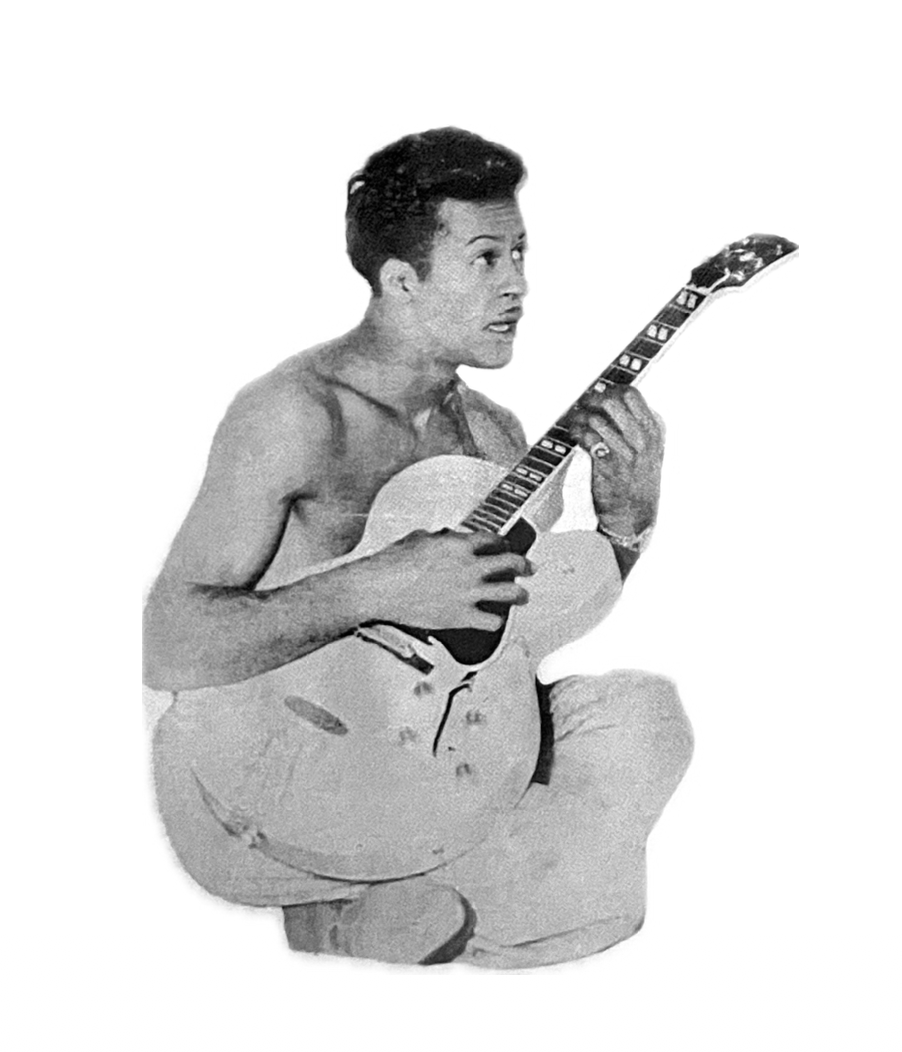
References
Images Borrowed
- Pp. 26: Image reproduced from an RCA Living Stereo inner sleeve, circa late-50’s - part of an infographic entitled “What is Stereo Sound?”
- Pp. 62: Image reproduced from the front cover of Columbia Records CL 848. The Liberian Suite by Duke Ellington.
- Pp. 66: Image reproduced from the front cover of Folkways Records FD 6502. Dances of the World’s Peoples, Vol. 2.
- Pp. 215: Image assembled from a ripped-out copy of Ginsberg’s “On Burroughs’ Work” and a Panda Express fortune.
- Pp. 231: Image reproduced from the front cover of The Mathematical Theory of Communication, UIP 1998.
- Pp. 292: Image reproduced from the front cover of RCA LPM-1254. Elvis Presley.
- Pp. 337: A fabulous Woody Guthrie painting reproduced from the informational booklet in Folkways Records FC 7501. Songs to Grow on by Woody Guthrie by Ramblin’ Jack Elliott.
- Pp. 402: Image reproduced from the hype sticker on the cover of Volt Records VOLT 412. Otis Blue / Otis Redding Sings Soul by Otis Redding.
- Pps. 423 & 430: Images reproduced from the back cover of Chess Records LP-1432. One Dozen Berrys by Chuck Berry.
Works Cited
Numbers correspond to superscript citation numbers appearing throughout the text.
- Allen Ginsberg. “On Burroughs’ Work,” ripped out of the UK Penguin Modern Classics The Essential Ginsberg. Penguin Random House UK, 2015.
- Jon Gertner. The Idea Factory. New York: Penguin Press, 2012. ↩
- Douglas Engelbart. “The Mother of All Demos.” Demonstration, Fall Joint Computer Conference, December 9, 1968. ↩
- Joseph Campbell. The Masks of God, Volume 1: Primitive Mythology. New York: Viking Press, 1959. ↩
- “The Beatles (album),” Wikipedia, accessed September 2025, https://en.wikipedia.org/wiki/The_Beatles_(album). ↩
- Marshall Mcluhan. The Gutenberg Galaxy, pp. 299. Toronto: University of Toronto Press, 2011. ↩
- Bob Dylan. “Ballad of a Thin Man.” On Highway 61 Revisited. Columbia Records, 1965. ↩
- Charlie Chaplin. The Circus. 1928. ↩
- The Beatles. “Being for the Benefit of Mr. Kite!” On Sgt. Pepper’s Lonely Hearts Club Band. Parlophone Records, 1967. ↩
- Victor Fleming, dir. The Wizard of Oz. 1939. ↩
- Erik Barnouw. Tube of Plenty, pp. 84. New York: Oxford University Press ↩
- Orson Welles, dir. Citizen Kane. 1941. ↩
- Stanley Kubrick, dir. 2001: A Space Odyssey. 1968. ↩
- Mary Shelley. Frankenstein, or, the Modern Prometheus. Penguin Classics. London: Penguin Books 1992. ↩
- @thedefenseinvestigator. “As many of you know…” Instagram, accessed October 22, 2024. ↩
- Radiolab. “War of the Worlds.” October 30, 2018. Radiolab / WNYC Studios. https://radiolab.org/podcast/war-worlds. ↩
- Bob Dylan. “Subterranean Homesick Blues.” On Bringing It All Back Home. Columbia Records, 1965. ↩
- Claude Shannon & Warren Weaver. The Mathematical Theory of Communication, “Introduction,” pp. 31. University of Illinois Press, 1998. ↩
- Allen Ginsberg, interviewed in Rolling Thunder Revue: A Bob Dylan Story, dir. Martin Scorsese, 2019. ↩
- Statement of Allen Ginsberg, Poet, New York City Hearings Before a Special Subcommittee of the Committee on the Judiciary—U.S. Senate. In the UK Penguin Modern Classics The Essential Ginsberg. Penguin Random House UK, 2015. ↩
- Jon Gertner. The Idea Factory, pp. 20. New York: Penguin Press, 2012. ↩
- Claude Shannon & Warren Weaver. The Mathematical Theory of Communication, “Some Recent Contributions,” pp. 8-9. ↩
- Claude Shannon & Warren Weaver. The Mathematical Theory of Communication, “Discrete Noiseless Systems,” pp. 50. ↩
- Claude Shannon & Warren Weaver. The Mathematical Theory of Communication, “Discrete Noiseless Systems,” pp. 43. ↩
- Claude Shannon & Warren Weaver. The Mathematical Theory of Communication, “The Discrete Channel with Noise,” pp. 66-70. ↩
- Claude Shannon & Warren Weaver. The Mathematical Theory of Communication, “The Discrete Channel with Noise,” pp. 75. ↩
- Claude Shannon & Warren Weaver. The Mathematical Theory of Communication, “The Discrete Channel with Noise,” pp. 71. ↩
- Claude Shannon & Warren Weaver. The Mathematical Theory of Communication, “Some Recent Contributions,” pp. 18. ↩
- Claude Shannon & Warren Weaver. The Mathematical Theory of Communication, “Some Recent Contributions,” pp. 27. ↩
- Max Planck. “Phantom Problems in Science,” in Scientific Biography and Other Essays, pp. 75. New York: Philosophical Library, 1949. ↩
- Walt Whitman. “As I Ponder’d in Silence,” In Leaves of Grass, pp. 1-2. New York: Modern Library, 1993. ↩
- Erik Barnouw. Tube of Plenty. New York: Oxford University Press. ↩
- See Chapters 2 and 3 of Tube of Plenty for a discussion of Radio and TV’s early history, along with their wartime consolidation and post-war regulation. ↩
- Brad Brooks. “Trump Wants to ‘Liberate’ Los Angeles, Residents Say ‘No Thanks’.” Reuters, June 11, 2025. ↩
- Elvis Presley. “My Happiness.” Sun Records, 1953. ↩
- Muddy Waters. “Long Distance,” On Folk Singer. Chess Records, 1964. ↩
- Derek Taylor. Liner notes for Yellow Submarine, by The Beatles. Apple Records, 1969. ↩
- “Revolution (Beatles song),” Wikipedia, accessed September 2025,
https://en.wikipedia.org/wiki/Revolution_(Beatles_song). ↩ - Bob Dylan, interviewed in No Direction Home, dir. Martin Scorcese, 2005. ↩
- Bob Dylan. “Talkin’ New York.” On Bob Dylan. Columbia Records, 1962. ↩
- The Beatles. “Dear Prudence.” On The Beatles. Apple Records, 1968. ↩
- Here I reference each White Album song individually, primarily to show off my thoroughness. ↩
- The Beatles. “Don’t Pass Me By.” On The Beatles. ↩
- The Beatles. “Rocky Raccoon.” On The Beatles. ↩
- The Beatles. “Cry Baby Cry.” On The Beatles. ↩
- The Beatles. “The Continuing Story of Bungalow Bill.” On The Beatles. ↩
- The Beatles. “Happiness is a Warm Gun.” On The Beatles. ↩
- The Beatles. “I Will.” On The Beatles. ↩
- The Beatles. “Long, Long, Long.” On The Beatles. ↩
- The Beatles. “Julia.” On The Beatles. ↩
- Claude Shannon & Warren Weaver. The Mathematical Theory of Communication, “The Discrete Channel with Noise,” pp. 80. ↩
- The Beatles. “Everybody’s Got Something to Hide Except Me and My Monkey.” On The Beatles.
- The Beatles. “Revolution 9.” On The Beatles. ↩
- Joan Didion. “The White Album.” In The White Album. New York: Simon & Schuster, 1979. ↩
- John Lennon. “God.” On Plastic Ono Band. Apple Records, 1970.
- Otis Redding. Otis Blue. Volt Records, 1965.
- I won’t list every song here, because I’m firm in my request that you listen to the whole LP yourself.